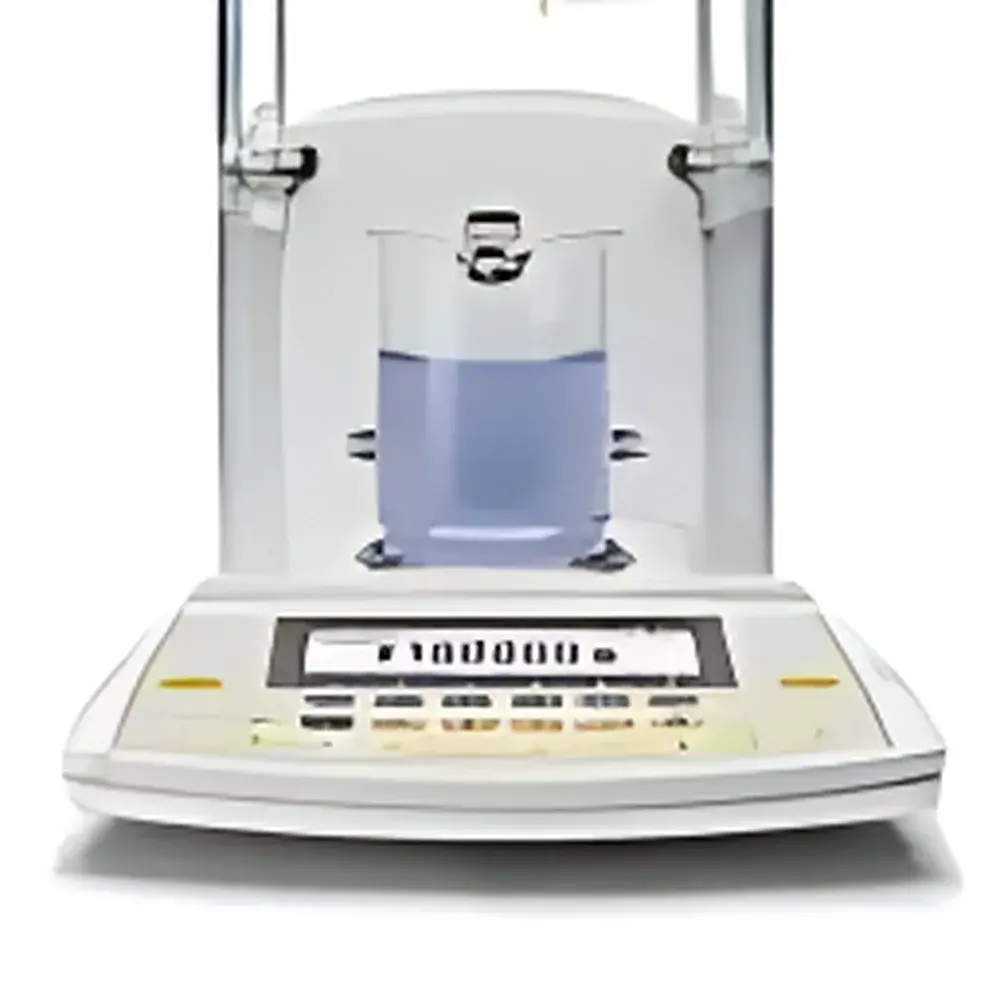
Sartorius ME254S Analytical Balance
| Brand | Sartorius |
|---|---|
| Origin | Germany |
| Model | ME254S |
| Capacity | 250 g |
| Readability | 0.1 mg |
| Calibration | Internal, isoCAL |
| Anti-static Function | Integrated ionizer with one-touch discharge |
| Draft Shield | Motorized, three-sided opening, self-learning operation |
| Stabilization Time | ≤8 s |
| Display | Graphic LCD with white LED backlight |
| Pan Diameter | Ø90 mm |
| Connectivity | RS232C (bidirectional, printer-compatible) |
| Compliance | ISO/IEC 17025, GLP/GMP-ready, USP <41> & <1251> compliant |
| Software Features | Built-in application software including SQmin (USP minimum weight calculation), isoCAL automatic adjustment, audit trail-ready data logging |
| Warranty | 3 years standard, extendable to 5 years |
Overview
The Sartorius ME254S Analytical Balance is a high-precision laboratory instrument engineered for demanding quantitative analysis in regulated and research environments. Based on electromagnetic force compensation (EMFC) technology, it delivers trace-level mass measurement accuracy with a readability of 0.1 mg and a maximum capacity of 250 g. Designed and manufactured in Germany, the ME254S conforms to international metrological standards—including OIML R76 and ISO/IEC 17025—and integrates seamlessly into quality-controlled workflows governed by USP , , and FDA 21 CFR Part 11 requirements. Its core architecture emphasizes stability, repeatability, and environmental resilience—critical for applications such as reference standard preparation, titrant standardization, active pharmaceutical ingredient (API) assay, and analytical method validation.
Key Features
- Electromagnetic force compensation sensor with temperature-compensated drift control ensures long-term stability and minimal warm-up time.
- Motorized, three-sided draft shield with self-learning positioning logic adapts automatically to ambient airflow and operator height—eliminating manual repositioning and reducing measurement variability.
- Integrated anti-static system featuring dual-polarity ion emission neutralizes electrostatic charge on samples and containers with a single key press—critical for low-mass powders, polymers, or glassware.
- isoCAL internal calibration and adjustment system performs fully automated, temperature-triggered recalibration without user intervention—maintaining traceability between scheduled maintenance intervals.
- SQmin function calculates and displays the minimum sample weight per USP , dynamically updating based on current repeatability performance—supporting compliance-driven documentation.
- Graphic LCD with white LED backlight provides high-contrast, multi-line readout of mass, status, environmental parameters (e.g., draft shield position, static status), and contextual prompts.
- RS232C interface supports bidirectional communication with LIMS, ELN, or PC-based data acquisition systems; compatible with Sartorius YDP series printers for GLP-compliant hardcopy output.
Sample Compatibility & Compliance
The ME254S accommodates a broad range of sample types—from hygroscopic solids and volatile solvents to micro-volumes in tared vials—thanks to its Ø90 mm stainless steel weighing pan and optimized draft shield geometry. Its motorized shield enables unobstructed access during sequential weighing protocols, while the anti-static module mitigates common errors associated with charged particulates. The balance meets ISO/GLP documentation requirements through configurable print output (including date/time stamp, operator ID, balance ID, and calibration status). All firmware operations—including calibration, adjustment, and parameter changes—are logged with timestamps and user identification where enabled, supporting audit readiness under GMP and 21 CFR Part 11 environments.
Software & Data Management
Embedded application software includes dedicated modules for pipette calibration (via optional ME235P-SD configuration), density determination, percentage weighing, and formulation. Data export is supported via RS232C in ASCII or Sartorius-specific formats, enabling direct integration with validated laboratory informatics platforms. The balance supports user-defined print templates and can be configured to append metadata (e.g., location tag, method ID) to each record. Firmware updates are performed via secure USB connection, with version history and change logs retained internally for regulatory review.
Applications
- Pharmaceutical QC/QA: USP-compliant assay of reference standards, excipient blending verification, and content uniformity testing.
- Academic & industrial research: Precise gravimetric preparation of calibration standards for ICP-MS, HPLC, and GC-MS instrumentation.
- Materials science: Density and specific gravity measurements of advanced ceramics, composites, and nanomaterials.
- Environmental labs: Accurate weighing of filter media pre- and post-sampling for PM2.5/PM10 quantification.
- Regulatory submissions: Generation of auditable weighing records meeting EMA, FDA, and PMDA expectations for analytical method validation reports.
FAQ
What does isoCAL do, and how often does it activate?
isoCAL is an automated internal calibration and adjustment system that monitors internal temperature gradients and triggers recalibration when deviations exceed predefined thresholds—typically every 2–4 hours under stable lab conditions, or immediately after significant ambient shifts.
Is the ME254S compliant with USP for minimum weight determination?
Yes—the built-in SQmin function continuously evaluates repeatability (n=10) and calculates the minimum weighable quantity per USP , displaying real-time compliance status directly on the screen.
Can the balance store user-specific weighing methods?
It supports up to 10 user-configurable application modes (e.g., “Pipette Check”, “Density Mode”) with saved parameters including tare memory, display units, and auto-stabilization criteria.
Does the RS232C interface support two-way communication with LIMS?
Yes—commands such as “request weight”, “initiate calibration”, and “retrieve log entries” are supported via ASCII protocol, enabling full remote orchestration in validated environments.
What warranty coverage is included, and what does extended service cover?
Standard warranty is 3 years parts-and-labor; extension to 5 years includes annual on-site verification, firmware updates, and priority technical support escalation paths.