
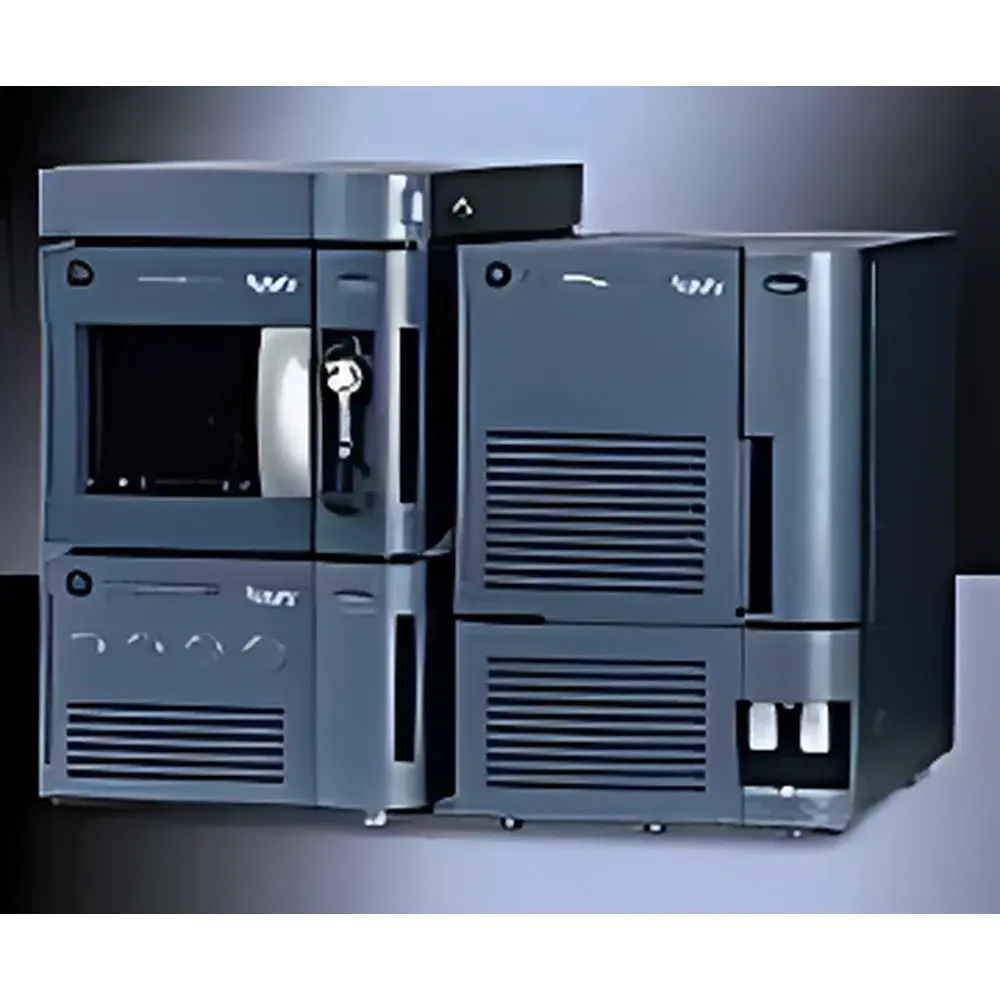
Waters ACQUITY SQD Single Quadrupole Mass Detector
| Brand | Waters |
|---|---|
| Origin | USA |
| Manufacturer Type | Authorized Distributor |
| Origin Category | Imported |
| Model | ACQUITY SQD |
| Pricing | Upon Request |
Overview
The Waters ACQUITY SQD is a high-performance single quadrupole mass detector engineered specifically for integration with the ACQUITY UPLC® platform. It leverages UltraPerformance Liquid Chromatography (UPLC®) principles—namely sub-2-µm particle separations, high-pressure operation (up to 15,000 psi), and minimized system dispersion—to deliver chromatographic peaks of exceptional narrowness and resolution. The SQD employs electrospray ionization (ESI) and atmospheric pressure chemical ionization (APCI) as primary atmospheric pressure ionization (API) techniques, with optional ESCi® dual-mode ionization and APPI capability. Its core function is quantitative and qualitative analysis via selected ion recording (SIR), full-scan MS, and time-scheduled SIR acquisition. Designed for laboratories performing high-throughput small-molecule characterization—including pharmaceutical impurity profiling, synthetic compound verification, degradation product identification, and method development—the SQD ensures robust, reproducible data acquisition aligned with UPLC’s sub-second peak widths.
Key Features
- High-speed scanning capability: up to 10,000 Da/sec across a mass range of 20–2,000 Da, synchronized with UPLC peak widths as narrow as 2–3 seconds
- ZSpray™ dual orthogonal API source architecture: minimizes neutral and solvent cluster interference while enabling rapid source removal and cleaning without venting the vacuum system
- ESCi® technology: simultaneous ESI and APCI ionization in a single injection, with automated polarity switching in under 50 ms
- IntelliStart™ intelligent diagnostics: real-time hardware self-assessment, automatic mass calibration, resolution optimization, and SIR method generation without manual tuning
- Sensitivity: ≤1 pg on-column for reserpine (ESI positive mode, SIR), validated per USP and ASTM D7899-15 guidelines for LC/MS system performance verification
- Modular detection compatibility: supports optional TUV (Tunable UV), PDA (Photodiode Array), and ELSD (Evaporative Light Scattering Detection) modules for hybrid LC-UV-MS workflows
Sample Compatibility & Compliance
The ACQUITY SQD accommodates a broad range of sample matrices, including aqueous buffers, organic solvents (acetonitrile, methanol), and complex biological extracts (plasma, urine, tissue homogenates). Its API interface tolerates flow rates from 0.01–2.0 mL/min and supports gradient elution programs typical of reversed-phase, HILIC, and ion-pairing UPLC methods. From a regulatory standpoint, the instrument complies with FDA 21 CFR Part 11 requirements when operated with Empower™ 3 CDS or MassLynx™ 4.2 software configured for audit trail, electronic signatures, and role-based access control. System suitability testing, calibration verification, and preventive maintenance logs are fully traceable and exportable for GLP/GMP audits. All ion source components meet ISO 9001-certified manufacturing standards and are compatible with ICH Q2(R2) validation protocols for analytical instrumentation.
Software & Data Management
Control and data acquisition are managed through either Waters Empower™ 3 Chromatography Data System (CDS) or MassLynx™ MS software—both compliant with LIMS integration via ASTM E1578-18 and SDMX 2.1 standards. Empower™ enables seamless LC-MS method transfer from development to QC environments, with built-in tools for peak purity assessment, mass spectral deconvolution, and reporting templates aligned with ISO/IEC 17025:2017 Annex A. MassLynx™ provides advanced spectral interpretation, library searching (NIST, Wiley), and batch processing for targeted quantitation. Optional QuanOptimize™ automates quantitative method setup—including dwell time allocation, cone voltage optimization, and MRM transition selection—reducing analyst-dependent variability. OpenLynx™ Application Manager offers guided workflows for non-MS specialists, while Connections INSIGHT® delivers remote diagnostic telemetry, predictive maintenance alerts, and secure vendor-assisted troubleshooting.
Applications
The ACQUITY SQD is routinely deployed in pharmaceutical quality control for assay and related substances testing per USP , ICH Q3B(R2), and EP 2.2.47. It supports environmental analysis of pesticides and pharmaceutical residues in water per EPA Method 1694 and ISO 21675:2019. In food safety, it quantifies mycotoxins and veterinary drug residues following AOAC 2012.01 and EN 15662:2018. Academic and contract research labs utilize its fast polarity switching and ESCi® flexibility for natural product dereplication, metabolite identification in ADME studies, and stability-indicating method development. Its compact footprint (50 × 60 × 45 cm) and low helium consumption (<10 mL/min) make it suitable for shared-core facilities requiring multi-user scheduling and minimal infrastructure modification.
FAQ
What ionization sources are standard on the ACQUITY SQD?
ESI and APCI are standard; ESCi® (dual ESI/APCI), APPI, and ZSpray™ dual-orthogonal source geometry are factory-installed options.
Is the SQD compatible with third-party UPLC systems?
No—it is engineered exclusively for native integration with Waters ACQUITY UPLC® systems via direct digital communication and synchronized timing protocols.
Does the SQD support GLP-compliant data archiving?
Yes, when paired with Empower™ 3 CDS configured with 21 CFR Part 11 modules and networked to a validated file server meeting ISO/IEC 27001:2022 storage requirements.
Can the SQD perform tandem MS experiments?
No—it is a single quadrupole mass spectrometer and does not support MS/MS fragmentation; for MRM or product ion scanning, the ACQUITY QDa or Xevo TQ-S micro is recommended.
What maintenance intervals are recommended for routine operation?
Source cleaning every 72 hours for high-salt matrices; vacuum pump oil change every 6 months; annual mass calibration verification using sodium formate or caffeine standards per ASTM E2620-20.





