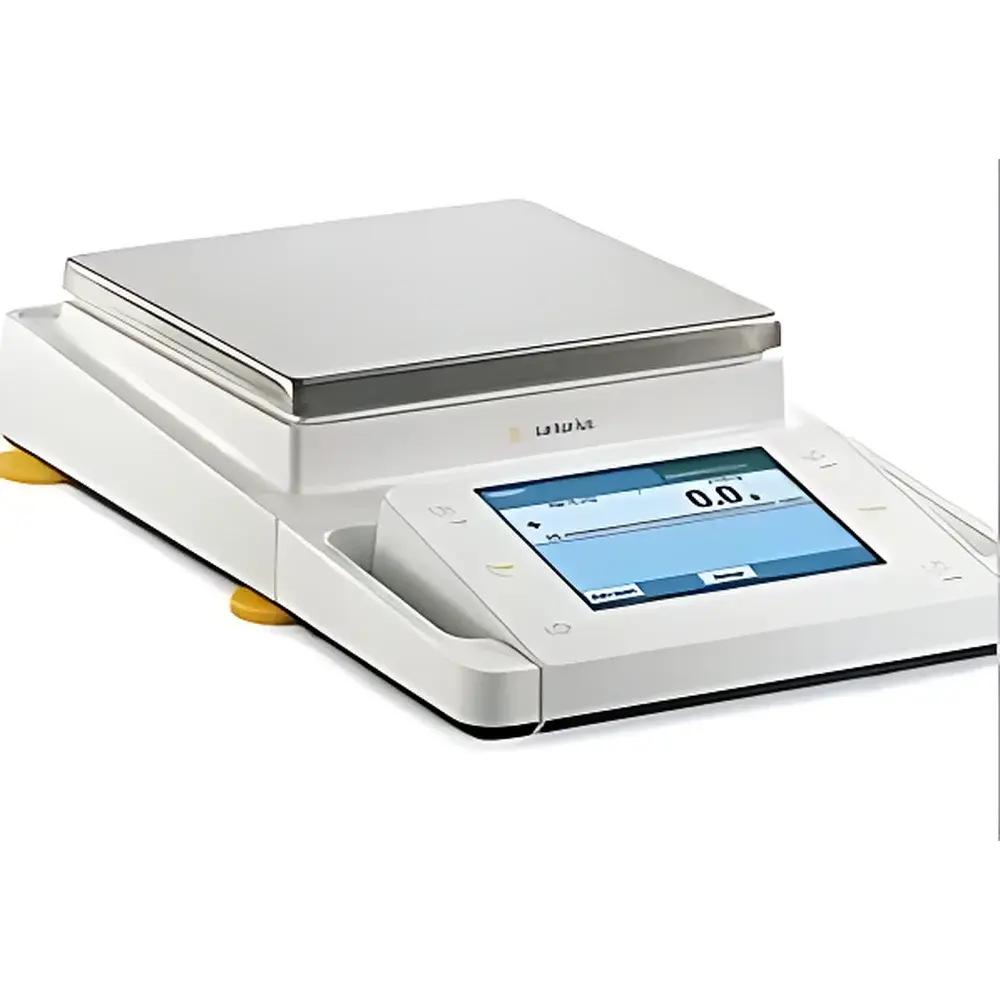
Sartorius Cubis® Precision Balance
| Brand | Sartorius |
|---|---|
| Origin | Germany |
| Model | Cubis® |
| Readability | 1 mg (select models) |
| Construction | Modular architecture with interchangeable display/control units, weighing module, draft shield, interface modules, and accessories |
| Compliance | Designed for GxP environments (FDA 21 CFR Part 11, EU Annex 11, ISO/IEC 17025, USP <41> & <1251>) |
| Calibration | isoCAL™ fully automatic internal calibration and adjustment |
| Leveling | Q-Level™ manual leveling with interactive guidance (MSA/MSU) |
| Connectivity | USB, Ethernet, RS-232C (standard), SD card data storage (excl. MSE), Bluetooth module (optional) |
| Display Options | MSA (high-res color TFT touchscreen), MSU (monochrome graphic display + tactile keypad), MSE (large LCD with simplified menu navigation) |
| Weighing Pan | Extra-large pan |
| Cleaning | Smooth, seamless surfaces |
| Software Integration | Compatible with Sartorius LabX® software for full audit trail, electronic signatures, SOP-driven workflows, and instrument qualification (IQ/OQ/PQ) |
Overview
The Sartorius Cubis® Precision Balance is a modular, high-integrity weighing platform engineered for laboratories requiring metrological rigor, regulatory traceability, and operational flexibility. Built upon Sartorius’ decades of mass measurement expertise in German manufacturing facilities, the Cubis® system implements electromagnetic force compensation (EMFC) technology—ensuring high reproducibility, minimal drift, and long-term stability across its full range of readability options (down to 1 mg). Its architecture separates core functional domains—display/control unit, weighing sensor module, draft shield assembly, and communication interface—enabling purpose-built configuration without compromising mechanical integrity or thermal equilibrium. This design supports both routine gravimetric tasks and mission-critical applications governed by Good Manufacturing Practice (GMP), Good Laboratory Practice (GLP), and pharmaceutical quality systems. The balance operates within defined environmental tolerances (temperature: 10–30 °C, humidity: 20–80 % RH non-condensing), and all models undergo factory verification against OIML R 76-1 and ASTM E898 standards.
Key Features
- Modular Configuration: Independent selection of display/control unit (MSA, MSU, or MSE), weighing module, draft shield, and interface modules ensures optimal alignment with user workflow, data governance requirements, and physical lab constraints.
- Q-Level™ Interactive Leveling: Real-time visual and haptic feedback guides manual leveling; motorized auto-leveling is available as an option on 1 mg readability models—reducing setup time and operator variability.
- Q-Pan™ Eccentric Load Compensation: Proprietary algorithm dynamically corrects for off-center placement, maintaining accuracy across the entire weighing pan surface—critical for volumetric flask tare operations and multi-step dispensing protocols.
- isoCAL™ Fully Automatic Internal Calibration: Temperature- and time-triggered recalibration ensures continuous compliance with ISO 9001 and pharmacopeial requirements (e.g., USP repeatability thresholds).
- GxP-Ready Firmware: Role-based user management, password protection, electronic signature support, and tamper-proof audit trail generation meet FDA 21 CFR Part 11 and EU Annex 11 data integrity mandates.
- IP54-Rated Enclosure: Dust- and splash-resistant housing facilitates cleaning in classified environments; smooth, crevice-free surfaces comply with ISO 14644-1 cleanroom compatibility guidelines.
Sample Compatibility & Compliance
The Cubis® accommodates a broad spectrum of sample types—from powders and granules to volatile solvents and hygroscopic compounds—thanks to its large weighing pan geometry (up to 220 mm diameter) and optional manual draft shield. All models are validated for use with standard laboratory glassware (volumetric flasks, beakers, weighing boats) and compatible with antistatic accessories for low-conductivity materials. Regulatory alignment includes full traceability to national metrology institutes (PTB, NIST), conformance with ISO/IEC 17025 for accredited testing labs, and built-in features supporting ALCOA+ principles (Attributable, Legible, Contemporaneous, Original, Accurate, Complete, Consistent, Enduring, Available). Documentation packages include Factory Acceptance Test (FAT) reports, Certificate of Conformance, and optional IQ/OQ documentation templates aligned with Annex 15.
Software & Data Management
Cubis® balances integrate natively with Sartorius LabX® software—a centralized platform for method development, electronic batch records, and instrument lifecycle management. LabX enforces SOP-driven workflows, captures full metadata (operator ID, timestamp, environment logs, calibration status), and generates compliant PDF audit trails with digital signatures. Local data export is supported via USB or SD card (except MSE models); Ethernet connectivity enables direct integration into LIMS and MES systems using standard protocols (TCP/IP, HTTP, OPC UA). All firmware updates are digitally signed and version-controlled, with rollback capability maintained per change control procedures.
Applications
- Pharmaceutical formulation: Active pharmaceutical ingredient (API) weighing, excipient blending, and tablet content uniformity testing per USP .
- Quality control laboratories: Reference standard preparation, dissolution media weighing, and stability study sample handling under ICH Q5C conditions.
- Academic and contract research: High-precision stoichiometric reagent dosing for synthetic chemistry and material science experiments.
- Clinical diagnostics: Calibration standard preparation for immunoassay and molecular diagnostic platforms.
- Regulatory submissions: Generation of auditable weight data meeting EMA, PMDA, and Health Canada submission requirements.
FAQ
Is the Cubis® balance compliant with FDA 21 CFR Part 11?
Yes—when used with LabX® software and configured with role-based access controls, electronic signatures, and audit trail activation, it satisfies all technical and procedural requirements of 21 CFR Part 11.
What is the difference between MSA, MSU, and MSE display units?
MSA features a color TFT touchscreen optimized for complex data entry and graphical analysis; MSU uses a monochrome display with tactile keypad for traditional keyboard users; MSE offers a simplified LCD interface for basic weighing tasks with minimal data handling needs.
Can the Cubis® perform automatic internal calibration without user intervention?
Yes—isoCAL™ initiates calibration automatically based on temperature fluctuations or scheduled intervals, ensuring continuous metrological validity without manual triggers.
Is motorized auto-leveling available on all models?
No—motorized auto-leveling is exclusively offered on models with 1 mg readability; other models rely on Q-Level™ guided manual leveling.
Does the Cubis® support wireless data transfer?
Bluetooth connectivity is available as an optional interface module, enabling secure, short-range transmission to mobile devices or local gateways—subject to site-specific IT security policies.