
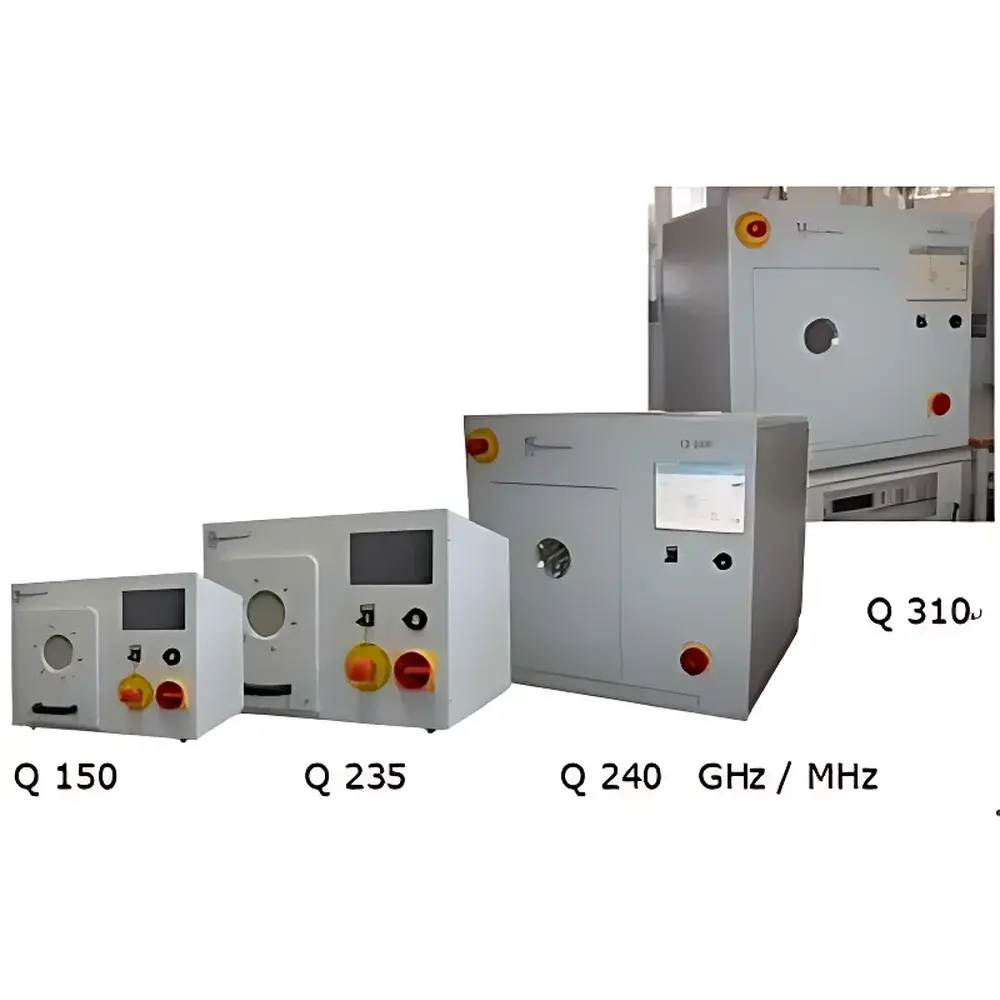
Alpha Plasma Q150 Microwave Plasma Asher
| Brand | Alpha Plasma |
|---|---|
| Origin | Germany |
| Model | Q150 |
| Instrument Type | Imported Microwave Plasma Surface Treater |
| Category | Plasma-Based Sample Preparation Equipment |
| Distribution Status | Authorized Distributor (Non-Manufacturer) |
| Import Classification | Imported Equipment |
| Pricing | Available Upon Request |
Overview
The Alpha Plasma Q150 Microwave Plasma Asher is a compact, high-efficiency benchtop system engineered for low-damage, residue-free photoresist and organic contaminant removal via microwave-excited oxygen-based plasma. Unlike RF-driven or downstream plasma sources, the Q150 utilizes a 2.45 GHz magnetron-coupled resonant cavity to generate high-density, low-electron-temperature plasma (< 2 eV), minimizing ion bombardment energy while maximizing radical-driven oxidation kinetics. This physical-chemical ablation mechanism ensures nanoscale surface integrity—critical for post-ion-implantation wafers, MEMS devices with fragile released structures, and SU-8 microstructures requiring sub-10 nm dimensional stability. The system operates under controlled vacuum (1–10 Pa) with precise gas flow regulation (O₂, O₂/Ar mixtures), enabling reproducible ashing across 4″–6″ substrates without thermal stress or undercutting.
Key Features
- 2.45 GHz microwave plasma source with tunable power output (0–600 W), optimized for radical-dominated chemistry and minimal sputtering
- Stainless steel vacuum chamber (Ø200 mm × H180 mm) with quartz window and integrated RF-shielded viewport for real-time process monitoring
- Integrated turbomolecular pumping system (base pressure < 5×10⁻³ Pa) and mass flow controllers (MFCs) for O₂, Ar, and N₂ with ±1% full-scale accuracy
- Programmable process controller with 99-step recipe storage, ramp/soak profiles, and real-time pressure/power/gas flow logging
- Interlocked safety architecture compliant with IEC 61000-6-3 (EMC) and IEC 61000-6-4 (emission), including door-open plasma cutoff and emergency venting
- Modular design supporting optional upgrades: in-situ optical emission spectroscopy (OES) port, substrate temperature control (−20°C to +120°C), and remote SECS/GEM interface
Sample Compatibility & Compliance
The Q150 accommodates rigid and flexible substrates up to 150 mm in diameter—including silicon wafers, fused silica masks, GaAs, SiC, glass slides, and polymer films (e.g., PDMS, PI). It supports both batch and single-wafer configurations with customizable sample holders (ceramic, graphite, or electrostatic chuck options). Process validation aligns with SEMI S2-0201 (safety) and SEMI E10-0701 (equipment reliability). For regulated environments, the system’s audit trail functionality—recording operator ID, timestamp, recipe version, gas parameters, and chamber history—supports GLP and GMP documentation requirements per FDA 21 CFR Part 11 when paired with validated software. All plasma chemistries comply with ISO 14644-1 Class 5 cleanroom compatibility standards.
Software & Data Management
Control is managed via the AlphaPlasma ControlSuite v3.2—a Windows-based application with dual-mode operation: manual parameter adjustment for R&D tuning and recipe-driven automation for production repeatability. Data acquisition captures >20 process variables at 100 ms resolution, exportable in CSV, HDF5, or direct SQL database push. Built-in statistical process control (SPC) tools calculate Cp/Cpk for critical ash rate and uniformity metrics across wafer maps. Audit logs are digitally signed and time-stamped using NIST-traceable system clocks; electronic signatures meet ALCOA+ principles (Attributable, Legible, Contemporaneous, Original, Accurate, Complete, Consistent, Enduring, Available). Optional integration with LabVantage LIMS or Thermo Fisher SampleManager enables end-to-end traceability from sample intake to final ash verification.
Applications
- Stripping high-dose ion-implanted resists (e.g., AZ®系列, Shipley UVIII) without silicon damage or dopant redistribution
- Cleaning post-RIE or ICP etch residues (polymer sidewall deposits, metal halides) prior to metrology or bonding
- Sacrificial layer removal in surface-micromachined MEMS (e.g., SiO₂ release etch in accelerometers, gyroscopes)
- Removal of SU-8 residual crosslinks and carbonaceous scum after development—critical for high-aspect-ratio microfluidic molds
- Surface activation of polymers (PET, PC, COC) for improved adhesion in microassembly or biofunctionalization workflows
- Decontamination of TEM grids and AFM tips prior to high-resolution imaging
FAQ
What plasma gases are supported, and can gas ratios be dynamically adjusted during a single process?
The Q150 supports O₂, Ar, N₂, and custom mixtures via independent MFCs; ratio modulation is fully programmable within any step of a multi-stage recipe.
Is the system compatible with automated wafer handling or cluster tool integration?
Yes—optional load-lock modules and SECS/GEM-compliant communication enable integration into 300 mm FOUP-based cluster platforms per SEMI E47.1.
How is endpoint detection implemented for variable-thickness resist layers?
Endpoint is determined via real-time OES monitoring of CO and CO₂ emission bands (210–220 nm); algorithmic peak tracking correlates signal decay with resist consumption, eliminating reliance on fixed time-based ashing.
Does the system require external water cooling or dedicated exhaust ducting?
No external chiller is needed—the magnetron and chamber use air-cooled heat sinks; standard acid-resistant exhaust (≥100 CFM) suffices for O₂-based processes.
Can process data be exported to third-party statistical analysis packages such as JMP or Python pandas?
Yes—CSV and HDF5 exports include metadata headers and SI-unit annotations, enabling direct ingestion into Jupyter notebooks or JMP workflows without parsing overhead.



