
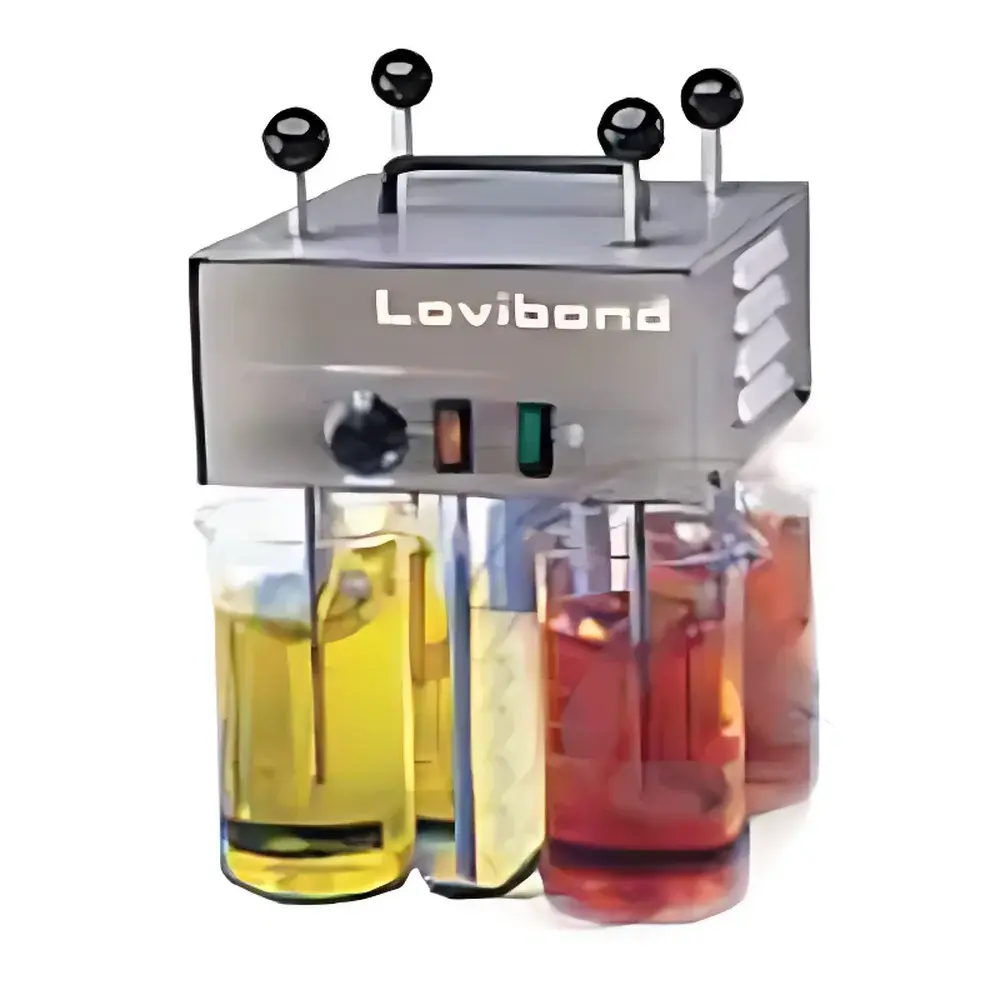
Lovibond ET99700 Portable Jar Test Apparatus for Flocculation and Settling Performance Assessment
| Brand | Lovibond (Tintometer) |
|---|---|
| Origin | United Kingdom |
| Model | ET99700 |
| Stirring Positions | 4 |
| Speed Range | 10–150 rpm, continuously variable |
| Speed Accuracy | ±10 rpm |
| Operating Temperature | 10–45 °C |
| Power Supply | 220 V / 60 Hz |
| Dimensions | 230 × 245 × 325 mm |
| Weight | ~6.9 kg |
| Compliance | CE Marked |
| Standard Package | ET99700 instrument, carrying case, user manual, Chinese warranty card |
| Note | 1500 mL high-temperature and low-temperature beakers (ET99710 accessories) sold separately |
Overview
The Lovibond ET99700 Portable Jar Test Apparatus is an engineered solution for standardized evaluation of coagulation, flocculation, and sedimentation behavior in water and wastewater treatment processes. Based on the jar test methodology—a widely accepted bench-scale simulation of full-scale clarification—the ET99700 enables quantitative assessment of floc formation kinetics, settling velocity, supernatant clarity, and optimal coagulant/flocculant dosing. Its four independent stirring stations operate under precisely controlled rotational shear conditions, replicating hydraulic regimes encountered in rapid mix basins, flocculation tanks, and settling zones. The apparatus adheres to core principles outlined in ASTM D2035 (Standard Practice for Coagulation-Flocculation Jar Tests), ISO 5667-3 (Water quality – Sampling – Part 3: Guidance on preservation and handling of water samples), and USEPA Method 180.1 (Determination of Turbidity). Designed for both laboratory and field deployment, it supports method development, process optimization, and regulatory compliance verification in municipal, industrial, and research settings.
Key Features
- Four independently controlled stirring positions with continuous speed adjustment from 10 to 150 rpm—enabling parallel testing of multiple coagulant doses or polymer types under identical shear history.
- Digital LED display providing real-time monitoring of current rotational speed and elapsed timer duration for each station—critical for reproducible shear application and standardized test timing per ASTM D2035 protocols.
- Adjustable impeller height and geometry to accommodate varying beaker dimensions (standard 1500 mL beakers recommended; high- and low-temperature variants available as optional accessories under ET99710).
- Integrated light-source alignment system: stirrer shafts are concentrically positioned around a central vertical lamp column, allowing unobstructed visual observation of floc growth, size distribution, and settling front progression without parallax error.
- Rugged, portable architecture housed in a CE-compliant enclosure with integrated carrying case—optimized for transport between treatment plants, mobile labs, and field sampling sites while maintaining mechanical stability during operation.
- Maintenance-free design featuring brushless DC motors, sealed gear mechanisms, and corrosion-resistant stainless-steel impellers—ensuring long-term repeatability without calibration drift or lubrication requirements.
Sample Compatibility & Compliance
The ET99700 accommodates standard 1500 mL cylindrical glass or borosilicate beakers (not included), supporting turbidity, suspended solids (TSS), and settleable solids (SS) measurements per APHA Standard Methods 2130 B, 2540 D, and 2540 E. It is compatible with common coagulants (e.g., aluminum sulfate, ferric chloride), flocculants (e.g., polyacrylamides), and pH-adjusting reagents used across potable water, tertiary effluent, and industrial process water applications. All electrical components conform to IEC 61000-6-3 (EMC emission standards) and IEC 61000-6-2 (immunity requirements). The device meets CE marking directives for Low Voltage (2014/35/EU) and Electromagnetic Compatibility (2014/30/EU), and its operational parameters align with GLP documentation practices for method validation and audit readiness.
Software & Data Management
While the ET99700 operates as a standalone hardware platform, its test protocol structure supports integration into digital lab workflows. Users may record time-stamped observations—including floc onset time, maximum floc size, settling rate (cm/min), and final supernatant turbidity—into LIMS-compatible spreadsheets or validated electronic notebooks. For laboratories operating under FDA 21 CFR Part 11 requirements, manual entry logs can be supplemented with digital signatures and version-controlled SOP attachments. Optional data logging modules (sold separately) enable serial output of speed and timer values to external acquisition systems for automated reporting and trend analysis across batch trials.
Applications
- Optimization of coagulant and flocculant dosage in drinking water treatment plants to minimize residual metal content and reduce sludge volume.
- Performance evaluation of novel polymeric flocculants in industrial wastewater streams containing colloidal organics, dyes, or heavy metal hydroxides.
- Educational demonstration of colloid destabilization mechanisms and Stokes’ law-based settling theory in environmental engineering curricula.
- Regulatory compliance testing for discharge permits requiring documented evidence of suspended solids removal efficiency prior to surface water release.
- Root-cause analysis of clarifier upsets by correlating jar test outcomes with full-scale plant performance metrics such as overflow rate and sludge blanket depth.
FAQ
What beaker sizes are supported by the ET99700?
The instrument is calibrated for use with standard 1500 mL cylindrical beakers. High-temperature (ET99710-HT) and low-temperature (ET99710-LT) variants are available as optional accessories but are not included in the base configuration.
Is the ET99700 suitable for GLP-compliant laboratories?
Yes—its repeatable mechanical design, CE certification, and traceable operational parameters support GLP-aligned method validation when paired with documented SOPs, trained personnel, and controlled environmental conditions (10–45 °C).
Can speed accuracy be verified externally?
Speed accuracy (±10 rpm) is factory-verified using NIST-traceable tachometric reference standards; periodic verification may be performed using a handheld optical tachometer calibrated to ISO 16063-31.
Does the unit support variable-speed ramping profiles?
No—the ET99700 provides constant-speed operation per station; multi-stage shear protocols (e.g., rapid mix followed by gentle flocculation) require manual speed adjustment at predefined time intervals.
What power input specifications apply outside the UK?
The standard unit is configured for 220 V / 60 Hz operation; units for 100–240 V / 50–60 Hz universal input are available upon request and subject to regional certification requirements.







