
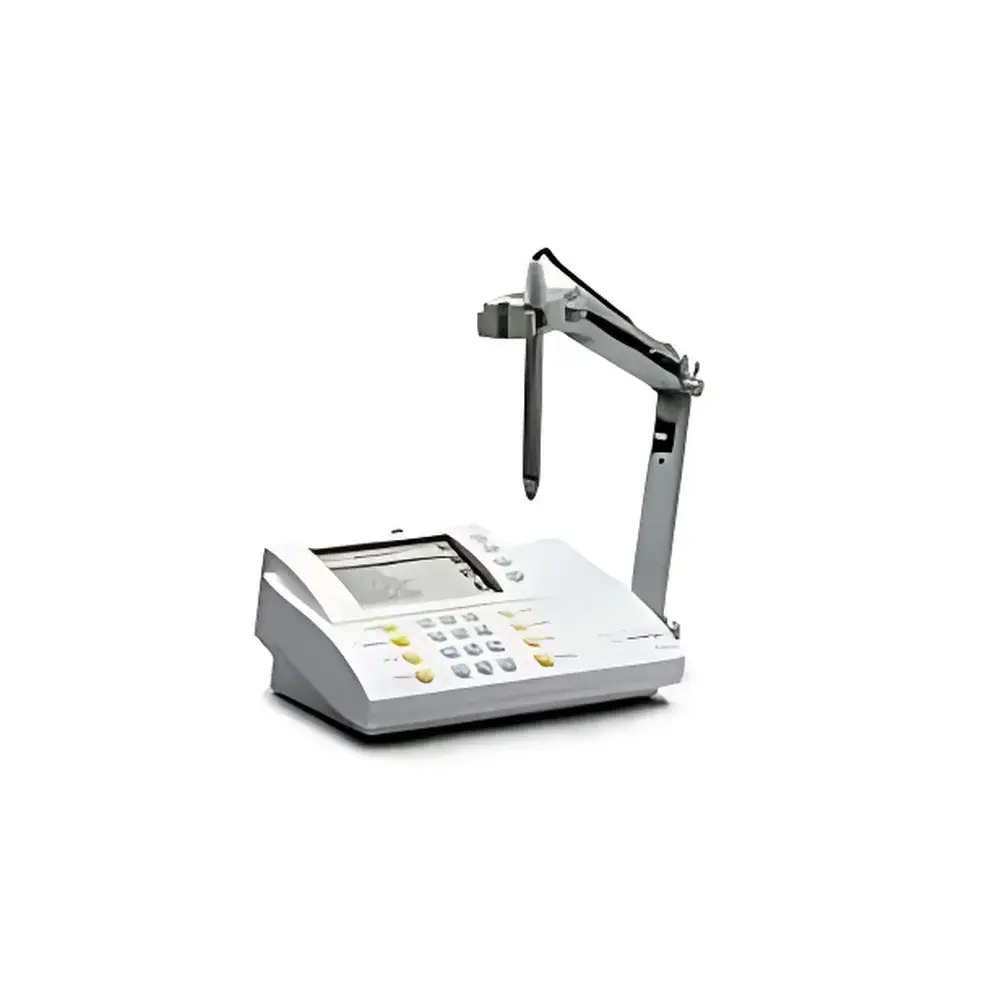
Sartorius PP-25 Professional pH/ION/Conductivity Meter
| Brand | Sartorius |
|---|---|
| Origin | Germany |
| Model | PP-25 |
| Measurement Modes | pH, mV, ion concentration (ISE), conductivity, TDS, salinity, resistivity |
| Temperature Compensation | Automatic (ATC) |
| Buffer Recognition | Auto-detection of standard pH buffers (pH 4.01, 7.00, 9.21, etc.) |
| Electrode Check | Integrated self-diagnostic function for electrode status |
| Calibration Alerts | Visual and audible prompts for overdue calibration |
| Data Storage | 620 measurement records with timestamp, sample ID, and electrode info |
| Interface | Bidirectional RS232 serial port |
| Compliance | Designed for GLP-compliant environments |
Overview
The Sartorius PP-25 Professional pH/ION/Conductivity Meter is a benchtop electrochemical analyzer engineered for precision, repeatability, and regulatory readiness in quality control laboratories, academic research facilities, and pharmaceutical production environments. Built on Sartorius’ legacy of German-engineered metrology, the PP-25 operates on potentiometric principles for pH and ion-selective electrode (ISE) measurements, and employs four-electrode AC conductivity measurement technology to minimize polarization errors and ensure stable readings across wide conductivity ranges. Its dual-mode architecture enables seamless switching between pH/mV/ISE and conductivity/TDS/salinity/resistivity modes without hardware reconfiguration—making it suitable for multi-parameter analysis of aqueous samples in compliance-driven workflows.
Key Features
- Triple-function capability: Simultaneous support for pH, ion concentration (via ISE), and comprehensive conductivity analysis—including temperature-compensated conductivity, total dissolved solids (TDS), salinity, and specific resistivity.
- Intelligent calibration management: Automatic recognition of IUPAC- and NIST-traceable pH buffer solutions (e.g., pH 4.01, 7.00, 9.21 at 25 °C); stores calibration history with date, time, slope (%), offset (mV), and asymmetry potential.
- Real-time electrode diagnostics: On-demand or automatic electrode health assessment—including junction resistance, reference stability, and glass membrane response time—flagging drift or contamination before measurement error occurs.
- GLP-aligned data integrity: Each stored record (up to 620 entries) includes sample ID, operator ID (configurable), timestamp (YYYY-MM-DD HH:MM:SS), measured value, unit, temperature, electrode serial number, and calibration status.
- Rugged industrial design: IP54-rated enclosure with chemical-resistant front panel; stable base with integrated cable management; CE, FCC, and RoHS certified.
- RS232 bidirectional communication: Enables direct connection to PCs or LIMS for automated data transfer; compatible with Sartorius LabX® Lite (optional) for enhanced traceability and electronic signature support.
Sample Compatibility & Compliance
The PP-25 accommodates standard 12-mm diameter combination pH electrodes, refillable double-junction reference electrodes, and a broad range of ISEs (e.g., F⁻, Cl⁻, NO₃⁻, NH₄⁺, Ca²⁺) as well as conductivity cells with cell constants from 0.01 to 10 cm⁻¹. It meets functional requirements aligned with ASTM D1125 (Standard Test Methods for Electrical Conductivity and Resistivity of Water), ISO 7888 (Water quality — Determination of electrical conductivity), and USP (pH Measurements). While not a 21 CFR Part 11–validated system out-of-the-box, its data structure, audit trail metadata, and export capabilities support integration into validated environments when deployed with appropriate procedural controls and supplementary software validation.
Software & Data Management
Data export is performed via ASCII-formatted text files (.txt) through the RS232 interface, preserving all metadata fields for traceability. The meter supports manual or scheduled data dump protocols, allowing synchronization with laboratory information management systems (LIMS) or spreadsheet-based QA review. Optional LabX® Lite software provides graphical trend analysis, customizable report templates (PDF/CSV), user access levels, and electronic signature capture—facilitating adherence to GLP and internal SOPs. All calibration and measurement logs are non-erasable until explicitly cleared by an authorized user with administrative credentials.
Applications
- Pharmaceutical water system monitoring (PW, WFI, Purified Water per EP/USP)
- Buffer preparation and verification in bioprocessing and formulation labs
- Environmental water testing (surface, groundwater, wastewater effluent)
- Food & beverage quality assurance (acidity titration support, brine concentration, fermentation pH control)
- Academic teaching labs requiring multi-parameter electrochemical instruction
- Chemical synthesis QC where ionic strength and proton activity must be concurrently tracked
FAQ
Does the PP-25 support automatic temperature compensation for all measurement modes?
Yes—ATC is applied in real time to pH, ISE, conductivity, TDS, salinity, and resistivity measurements using either a built-in Pt1000 sensor or an external ATC probe.
Can I use third-party pH or conductivity electrodes with the PP-25?
The instrument accepts any BNC- or DIN-compatible electrode with standard analog output; however, full diagnostic functionality (e.g., electrode health reporting) is guaranteed only with Sartorius-certified electrodes.
Is password protection available for calibration and configuration changes?
Yes—three-tier user access (Operator, Supervisor, Administrator) with configurable password policies prevents unauthorized modification of calibration parameters or system settings.
How is data integrity ensured during power loss or unexpected shutdown?
All measurements and calibration events are written to non-volatile memory immediately upon confirmation; no data is held solely in RAM.
What documentation is provided for IQ/OQ validation support?
Sartorius supplies a Factory Acceptance Test (FAT) certificate, electrical safety report, and a comprehensive User Manual with technical specifications, uncertainty budget guidance, and recommended verification procedures for lab-based OQ execution.
Related Products





