
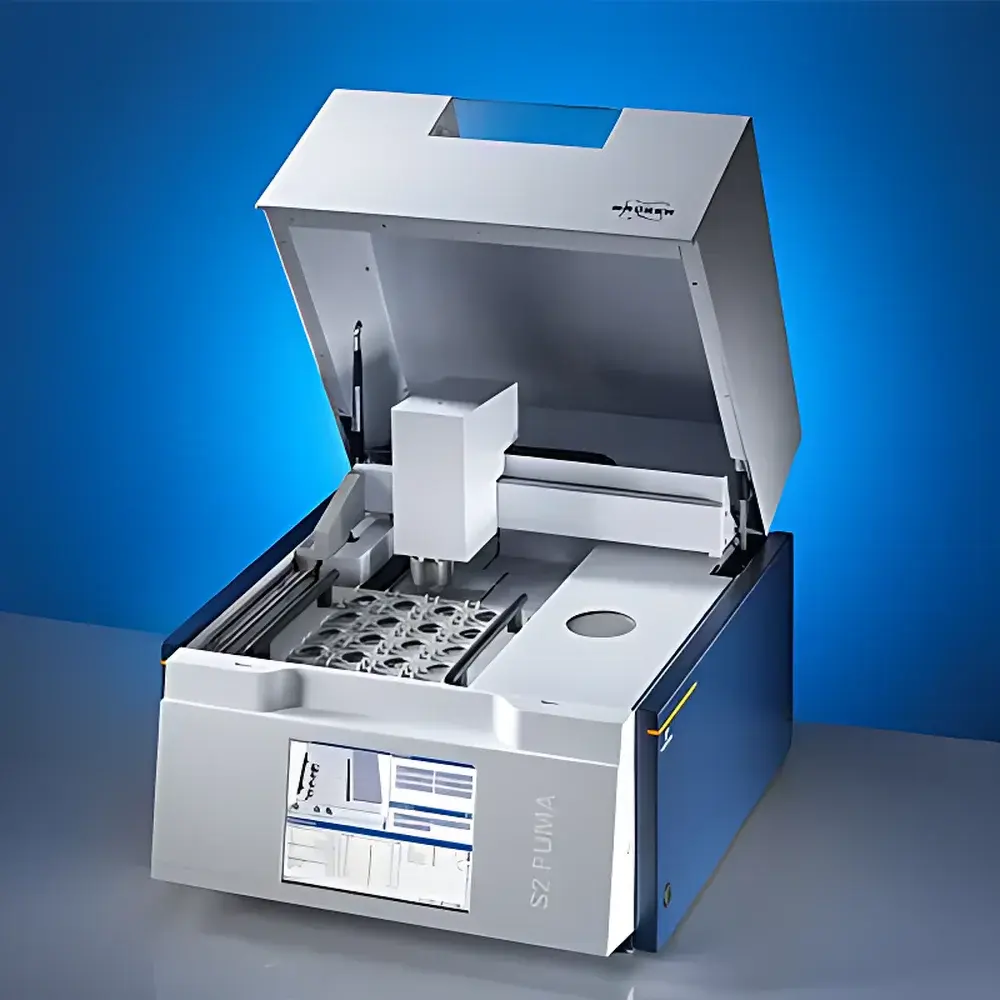
Bruker S2 PUMA Series 2 Energy Dispersive X-Ray Fluorescence Spectrometer
| Brand | Bruker |
|---|---|
| Origin | Germany |
| Model | S2 PUMA Series 2 |
| Configuration Options | Benchtop / Floor-standing |
| Elemental Range | C (Z=6) to Am (Z=95) |
| X-ray Tube Power | 50 W |
| Detector | HighSense™ Silicon Drift Detector (SDD) |
| Sample Chamber Dimensions | 450 × 420 × 100 mm |
| Autochanger Capacity | Up to 20 positions (XY Autochanger) or 12–18 samples (Carousel) |
| Mapping Resolution | Down to 1 mm |
| Spot Size | 1–34 mm (with collimator masks) |
| Software | SPECTRA.ELEMENTS with SMART.QUANT FP |
| Compliance | Designed for GLP/GMP environments |
Overview
The Bruker S2 PUMA Series 2 is a high-performance, benchtop-to-floor-standing energy dispersive X-ray fluorescence (EDXRF) spectrometer engineered for precision elemental analysis across research, quality control, and industrial process monitoring environments. Based on the fundamental principle of X-ray fluorescence—where primary X-rays excite atoms in a sample, causing emission of characteristic secondary X-rays—the instrument delivers quantitative and semi-quantitative compositional data from carbon (C, Z=6) to americium (Am, Z=95). Its analytical core integrates a high-stability 50 W microfocus X-ray tube with Bruker’s proprietary HighSense™ silicon drift detector (SDD), enabling high count-rate throughput and superior energy resolution (<125 eV at Mn Kα). The tightly coupled optical path minimizes signal loss and maximizes detection efficiency, particularly critical for light elements such as Na, Mg, Al, and Si. Unlike wavelength-dispersive systems, EDXRF offers rapid multi-element acquisition without mechanical scanning, making it ideal for routine screening, compliance verification (e.g., RoHS, ELV, ASTM F2617), and high-throughput laboratory workflows.
Key Features
- High-power 50 W X-ray source with long-life anode design and integrated thermal management for stable, reproducible excitation.
- HighSense™ SDD detector with >1,000,000 cps maximum input count rate and optimized low-noise electronics for enhanced light-element sensitivity and reduced measurement time.
- Modular hardware platform supporting five distinct configurations: Single (manual), XY Autochanger (20-position), Carousel (12–18 samples), Mapping-Stage (spatially resolved analysis), and Automation-ready (24/7 integration).
- Large sample chamber (450 × 420 × 100 mm) accommodating solids, powders, liquids, fused beads, and irregularly shaped specimens—no pre-pressing or mounting required for many applications.
- TouchControl™ interface with glove-compatible capacitive touchscreen, multilingual support (9 languages), and remote operation via external PC running SPECTRA.ELEMENTS software.
- SampleCare™ protection system and built-in Smart-UPS ensure safe shutdown during power interruption and prevent damage to critical optics and detector components.
Sample Compatibility & Compliance
The S2 PUMA Series 2 accepts a broad spectrum of sample forms—including bulk metals, coated substrates, geological powders, polymer pellets, thin films, electronic components, and environmental filters—without requiring vacuum or helium purge for most analyses. Optional helium flush or vacuum capability enables reliable quantification of elements below sodium (e.g., Be, B, C, N, O, F). All configurations comply with IEC 61000-6-3 (EMC) and IEC 61010-1 (safety) standards. The system architecture supports regulatory compliance frameworks including ISO/IEC 17025, ASTM E1621 and E2857, and USP . When deployed in regulated environments, SPECTRA.ELEMENTS provides full audit trail logging, electronic signatures, role-based user permissions, and 21 CFR Part 11–compliant data integrity controls—enabling seamless integration into GLP and GMP workflows.
Software & Data Management
SPECTRA.ELEMENTS is a modular, object-oriented software suite built on modern C++ and Qt frameworks, offering intuitive navigation while retaining deep analytical flexibility. Its SMART.QUANT FP engine implements fundamental parameter (FP) algorithms with matrix correction, standardless quantification, and optional empirical calibration modes. The software supports method transfer between instruments, batch report generation (PDF/CSV/XLSX), spectral library matching, and real-time spectral deconvolution. For automated labs, AXSCOM—a dedicated communication protocol—enables bidirectional data exchange with LIMS, MES, and PLC systems. Integrated HD camera functionality captures reference images before and after measurement, linking visual metadata directly to analytical results for traceability and root-cause analysis.
Applications
The S2 PUMA Series 2 serves diverse sectors requiring fast, non-destructive elemental profiling. In metallurgy, it verifies alloy grade conformity and detects tramp elements in incoming raw materials. In electronics manufacturing, it performs RoHS-compliant screening of Pb, Cd, Hg, Cr(VI), and Br-containing flame retardants in PCBs and connectors. In mining and geochemistry, it delivers rapid assay data for exploration samples and process streams. In coatings and plating industries, the Mapping-Stage option enables micron-level thickness mapping of Ni/Cu/Zn layers on steel or Sn on PCB pads. In polymers and packaging, it validates additive concentrations (e.g., Ca, Ti, Zn stearates) and detects catalyst residues. Its ability to analyze loose powders, pressed pellets, and fused beads makes it equally suitable for cement, ceramics, and pharmaceutical excipient QA.
FAQ
What is the lightest element detectable under standard air conditions?
Carbon (C, Z=6) is routinely quantified; with optional helium purge or vacuum, detection extends down to beryllium (Be, Z=4).
Can the instrument perform coating thickness analysis?
Yes—using fundamental parameter modeling and calibrated standards, thicknesses from ~10 nm to >100 µm can be determined for single- and multi-layer systems.
Is method validation supported for regulated environments?
Yes—SPECTRA.ELEMENTS includes tools for limit of detection (LOD), limit of quantification (LOQ), repeatability, and intermediate precision assessment per ICH Q2(R2) guidelines.
How does the Mapping-Stage achieve spatial resolution of 1 mm?
Via a motorized, linear-stage positioning system with encoder feedback and sub-micron step resolution, synchronized with collimated beam geometry and real-time camera registration.
Does the system support remote diagnostics and firmware updates?
Yes—via secure HTTPS-based web interface and Bruker’s remote support portal, enabling predictive maintenance and version-controlled software deployment.





