
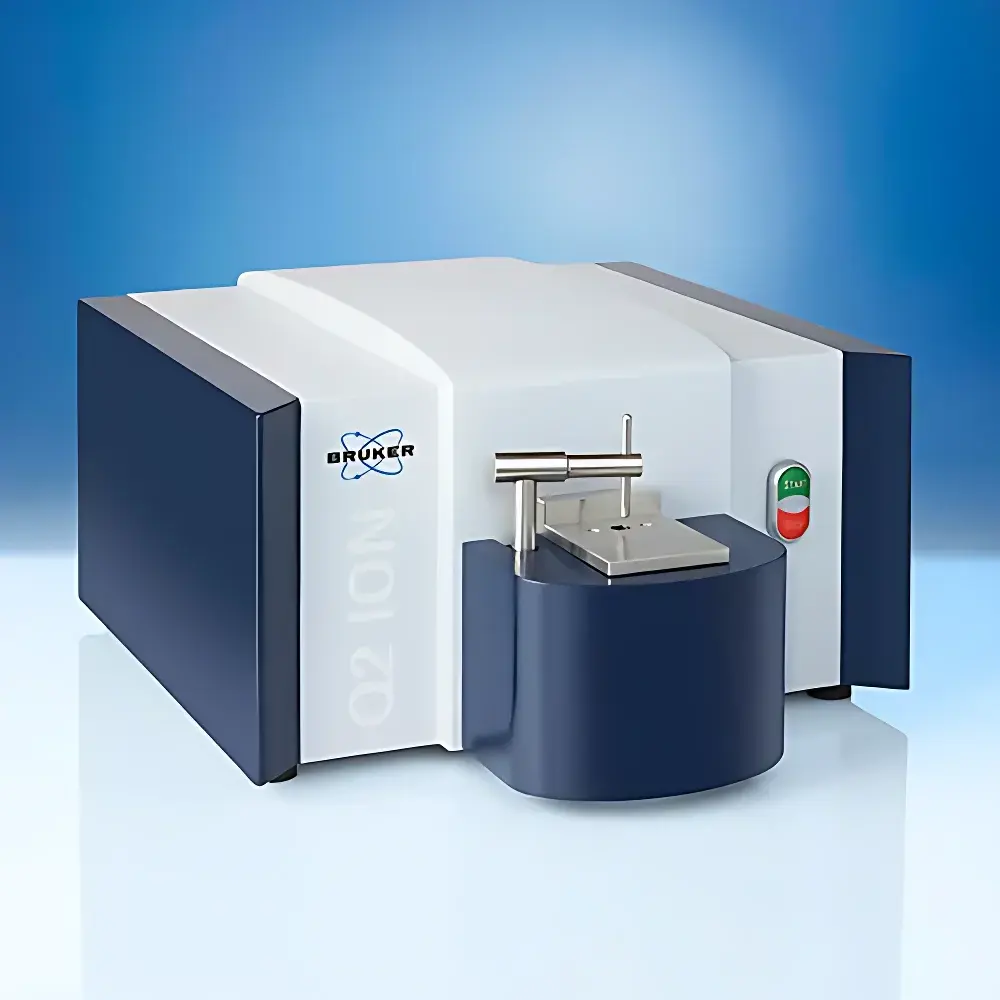
Bruker Q2 ION Compact Desktop Direct-Reading Optical Emission Spectrometer
| Brand | Bruker |
|---|---|
| Origin | Germany |
| Instrument Type | Benchtop |
| Excitation Source | Spark Discharge |
| Detector Configuration | Dual Detector (PMT + CCD) |
| Focal Length | 400 mm |
| Grating Groove Density | 3600 lines/mm |
| Wavelength Range | 170–685 nm |
| Number of Analytical Channels | 32 |
Overview
The Bruker Q2 ION is a compact, lightweight benchtop optical emission spectrometer (OES) engineered for high-precision elemental analysis of metallic samples in industrial and laboratory environments. Utilizing spark discharge excitation and a high-resolution flat-field CCD optical system coupled with photomultiplier tube (PMT) channels, the Q2 ION delivers robust spectral acquisition across a broad wavelength range (170–685 nm). Its 400 mm focal length Czerny-Turner spectrometer architecture—featuring a 3600 lines/mm holographic grating—ensures excellent spectral dispersion and peak separation, critical for accurate multi-element quantification in complex alloys. Designed specifically for routine metal analysis, the instrument operates on the fundamental principle of atomic emission spectroscopy: when a metal sample is subjected to controlled spark ablation, excited atoms emit characteristic photons whose intensities are directly proportional to elemental concentrations. This physics-based measurement enables trace-level detection (ppm-level) and quantitative analysis compliant with ASTM E415, ISO 11577, and EN 10052 standards.
Key Features
- Ultra-compact and portable benchtop design weighing under 35 kg—enabling deployment in foundries, warehouses, QC labs, and scrap sorting facilities without dedicated infrastructure.
- Dual-detection architecture: Simultaneous use of PMT for high-sensitivity trace element monitoring (e.g., C, P, S, N in steel) and CCD for full-spectrum coverage and flexible method development.
- Flat-field CCD optical system eliminates mechanical slit adjustment and provides uniform spectral resolution across the entire 170–685 nm range—reducing calibration drift and improving long-term stability.
- Integrated spark stand with argon-flushed sample chamber and automatic electrode cleaning—ensuring reproducible excitation conditions and minimizing matrix effects.
- Industrial-grade Linux-based controller with real-time SQL database backend for secure, auditable data storage and retrieval—fully compatible with GLP/GMP workflows.
- Touchscreen interface with physical function keys for glove-compatible operation in production environments.
Sample Compatibility & Compliance
The Q2 ION supports solid metallic samples up to Ø40 mm × 30 mm height—including cast iron, carbon and stainless steels, aluminum alloys (e.g., 1xxx–8xxx series), copper-based alloys (brass, bronze), nickel superalloys, and titanium grades. Sample surface requirements align with ISO 11577: flatness ≤ 0.1 mm, roughness Ra < 3.2 µm, and minimal oxide contamination. The instrument meets CE marking requirements (2014/30/EU EMC Directive, 2014/35/EU LVD Directive) and incorporates hardware-level safeguards for spark safety (IEC 61000-4-2/3/4 compliance). All analytical methods are validated per ISO/IEC 17025:2017 Annex A.5 for competence in testing laboratories; software audit trails satisfy FDA 21 CFR Part 11 requirements for electronic records and signatures.
Software & Data Management
The Q2 ION runs ElementalSuite™—a unified software platform originally developed for Bruker’s mobile OES systems and extended to benchtop instrumentation. Built on a deterministic Linux kernel and SQLite/PostgreSQL-capable database engine, ElementalSuite provides role-based user access control, method versioning, and automated calibration curve validation. It supports ASTM E1086-compliant type identification (grade matching) against internal or user-defined libraries (e.g., UNS, EN, GB/T, JIS), including real-time pass/fail evaluation against specification limits. Raw spectra are stored with full metadata (operator ID, timestamp, argon pressure, spark energy, integration time), enabling retrospective reprocessing and inter-laboratory comparison. Export formats include CSV, XML, PDF reports (with digital signature), and direct integration with LIMS via HL7 or ODBC.
Applications
- Metal production & casting: Rapid melt analysis for Fe-, Al-, Cu-, and Ni-based alloys with <60-second cycle time from loading to report.
- Quality assurance in machining and forging: In-line verification of incoming raw materials and finished components per ASTM A751 or EN 10204 3.1 certification requirements.
- Scrap metal recycling: On-site alloy sorting and contamination screening using grade identification and residual element profiling (e.g., Pb, Sn, Bi in aluminum).
- Pressure equipment manufacturing: Compliance testing for ASME BPVC Section II Part A material verification and weld deposit analysis.
- Automotive and aerospace supply chains: PPAP-ready reporting for elemental compliance with OEM specifications (e.g., Ford WSS-M1A365-B2, Boeing D6-17487).
- Third-party testing labs: Accredited analysis for ISO/IEC 17025 scope expansion in metallurgical testing, including low-alloy steel microanalysis and intermetallic phase characterization support.
FAQ
What sample preparation is required prior to analysis?
Minimal preparation is needed: samples must be flat, clean, and free of oil, grease, or heavy oxidation. A standard grinding wheel or milling cutter suffices; no acid etching or polishing is necessary for routine analysis.
Can the Q2 ION perform nitrogen analysis in stainless steel?
Yes—using optimized spark parameters and PMT channel configuration at 149.26 nm, the instrument achieves reliable quantification of nitrogen down to 30 ppm with RSD < 3% (n=10) in certified reference materials.
Is remote diagnostics and software update supported?
Yes—ElementalSuite includes secure SSH-enabled remote maintenance mode with encrypted firmware update capability and real-time performance telemetry, subject to customer-configured firewall policies.
How many calibration curves can be stored on the system?
The embedded SQL database supports unlimited method storage; typical installations maintain 20–50 active calibrations across Fe, Al, Cu, and Ni matrices, each with up to 32 elements and 5-point polynomial fits.
Does the instrument comply with environmental operating conditions for foundry floors?
Rated IP20 with operating temperature range 10–35°C and humidity 20–80% RH non-condensing; optional vibration-damping feet and argon gas pressure regulation extend usability in high-noise, high-dust environments.
Related Products





