
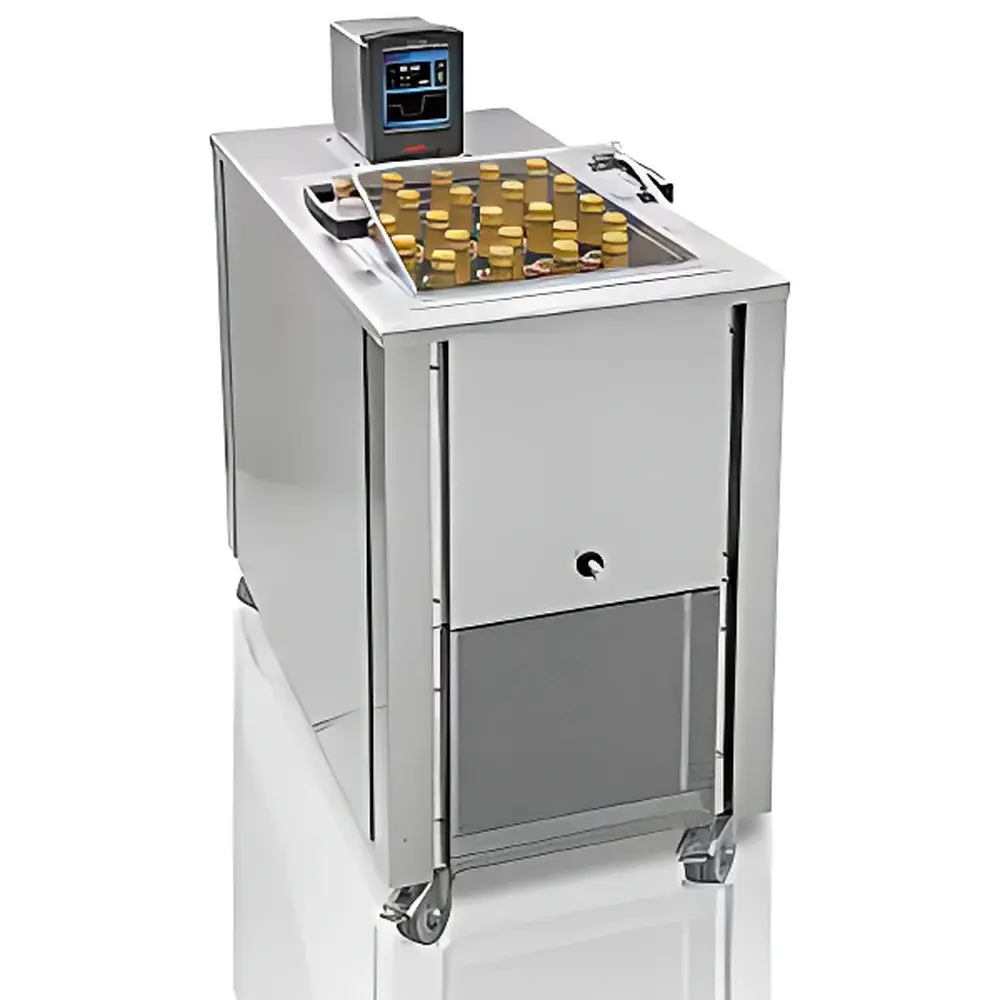
Huber BFT5 Beer Aging Test Bath
| Brand | Huber |
|---|---|
| Origin | Germany |
| Model | BFT5 |
| Bath Volume | 40 L |
| Temperature Range | −40 to +80 °C |
| Temperature Stability | ±0.03 °C |
| Circulation Type | Internal & External |
| Cooling Method | Air-Cooled (R507 refrigerant, 0.9 kg) |
| Heating Power | 2 kW |
| Cooling Power | 1.2 kW (at 0 °C), 0.9 kW (at −20 °C), 0.35 kW (at −40 °C) |
| Pump Pressure | Up to 0 bar / 0 L/min |
| Controller | Pilot ONE E-grade Basic (5.7″ color touchscreen, 11 languages, graph-based real-time temperature display) |
| Safety Class | DIN 12876 Class III / FL (for flammable liquids) |
| Protection Rating | IP20 |
| Dimensions (W×D×H) | 460 × 710 × 911 mm |
| Weight | 76 kg |
| Power Supply | 230 V, 1~ 50/60 Hz, 13 A max, 16 A fuse |
| Ambient Operating Temperature | 5–40 °C |
| Sound Pressure Level | 31 dB(A) |
| Bath Opening | 350 × 410 mm (base depth: 270 mm) |
| Minimum Fill Volume | 8.5 L |
| Interfaces | RS232, Ethernet, USB Device & Host |
| Sensors | Integrated Pt100 |
| Safety Features | Overtemperature protection, low-level detection, calendar-based start timer |
Overview
The Huber BFT5 Beer Aging Test Bath is a precision-engineered constant-temperature circulation bath specifically designed for accelerated aging studies in brewing science and quality assurance laboratories. Based on the thermodynamic principle of controlled thermal stress application, the BFT5 enables reproducible simulation of long-term beer storage conditions by maintaining highly stable temperature profiles across extended durations — critical for evaluating flavor stability, colloidal haze formation, oxidation kinetics, and shelf-life prediction. Its dual-mode (heating/cooling) operation and wide operational range (−40 to +80 °C) support both oxidative aging protocols (e.g., 60 °C for 7 days per ASBC Method Beers-31) and cold-storage stability testing. Engineered to DIN 12876 Class III / FL safety standards, the unit permits safe use with flammable organic solvents or ethanol-water mixtures commonly employed in extractive aging assays.
Key Features
- High-stability temperature control (±0.03 °C) over full range (−40 to +80 °C), validated per ISO/IEC 17025-compliant calibration procedures
- Air-cooled refrigeration system using R507 (0.9 kg charge), eliminating need for external water supply and reducing infrastructure dependencies
- Pilot ONE E-grade Basic controller with 5.7″ capacitive touchscreen, graphical real-time temperature trend visualization, and intuitive smartphone-style navigation
- Multi-language interface (11 languages), calendar-based scheduling, and programmable ramp-soak cycles up to 24 hours — essential for standardized aging protocols such as EBC 7.11 or ASBC Beers-31
- Full stainless-steel construction (AISI 304), IP20-rated electronics enclosure, and integrated safety systems including overtemperature cutoff and low-bath-level detection
- Dual-circulation capability (internal recirculation + external pump-out) for integration with external reactors, viscometers, or sensor arrays
- Comprehensive digital connectivity: RS232, Ethernet (TCP/IP), USB Device (data export), and USB Host (firmware updates, profile import)
Sample Compatibility & Compliance
The BFT5 accommodates standard beer aging vessels — including 250 mL to 2 L amber glass bottles, stainless-steel pressure-rated canisters, and jacketed reaction tubes — within its 40 L bath volume and 350 × 410 mm opening. Minimum fill volume (8.5 L) ensures adequate thermal mass for stability during dynamic temperature programs. Its Class III / FL certification confirms compliance with DIN 12876 for use with flammable media, enabling direct immersion of ethanol-diluted model systems or solvent-based extraction baths. The unit meets CE marking requirements under the EU Machinery Directive 2006/42/EC and Low Voltage Directive 2014/35/EU. While not inherently 21 CFR Part 11 compliant, audit-ready data logging (via Ethernet or USB) supports GLP/GMP-aligned workflows when paired with validated third-party software.
Software & Data Management
The Pilot ONE controller natively records timestamped temperature values at user-defined intervals (1 s to 60 min resolution) and stores up to 10,000 data points internally. Export is supported via USB stick (CSV format) or Ethernet (FTP/SFTP or Modbus TCP). No proprietary software is required for basic operation; however, Huber’s optional ChillerControl suite (Windows-based) enables remote monitoring, multi-unit synchronization, alarm notification (email/SNMP), and PDF report generation with embedded trend graphs. All logged data include metadata: setpoint, actual bath temperature, ambient temperature, runtime, and event markers (e.g., “Soak Start”, “Ramp Complete”). For regulated environments, configuration change logs and user access controls are available in higher-tier Pilot ONE firmware versions (not included in E-grade Basic but upgradeable).
Applications
- Accelerated oxidative aging of lager and ale samples per ASBC Beers-31 (60 °C, 7 days) and EBC 7.11 (40 °C, 14 days)
- Colloidal stability assessment through chill-proofing tests (e.g., −1 to 0 °C hold for 24–72 h)
- Thermal stress validation of packaging materials (crown caps, PET bottles, keg liners)
- Reference bath for calibrating Pt100 probes, digital thermometers, and inline process sensors
- Support bath for rheological measurements requiring precise thermal conditioning of sample cells
- Controlled degradation studies of hop oils, polyphenols, and Maillard reaction products
FAQ
What aging protocols is the BFT5 validated for?
The BFT5 supports all major international beer aging standards including ASBC Beers-31, EBC 7.11, and IOB Method 5.1, with documented thermal uniformity and stability performance across the required temperature ranges.
Can it operate continuously at −40 °C?
Yes — the air-cooled R507 system is rated for continuous operation at −40 °C with appropriate bath fluid (e.g., silicone oil or specialized low-temp heat transfer fluid); ambient temperature must remain ≤25 °C for optimal compressor efficiency.
Is external pump integration possible?
Yes — the unit provides dedicated inlet/outlet ports (G½″) and adjustable flow pressure (0–0.5 bar), supporting external circulation to jacketed reactors or inline analytical cells.
Does the Pilot ONE controller support audit trails?
The E-grade Basic version logs operational events and temperature history, but full electronic signature, user-role management, and immutable audit trail features require Pilot ONE Professional firmware and optional license.
What maintenance is required?
Annual verification of Pt100 sensor accuracy and refrigerant charge level is recommended; no routine oil changes or filter replacements are needed due to sealed compressor and passive cooling architecture.



