
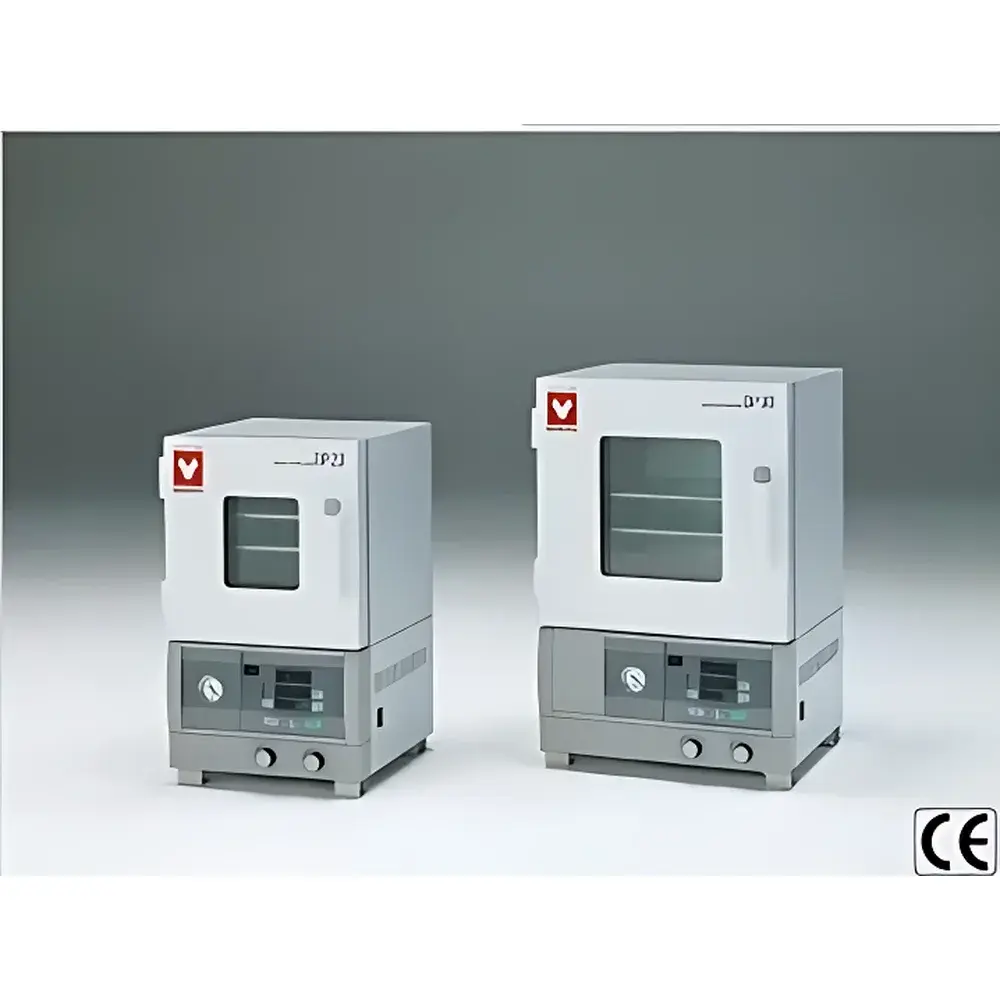
YAMATO DP23C / DP33C Benchtop Vacuum Drying Oven
| Brand | YAMATO |
|---|---|
| Origin | Japan |
| Model | DP23C / DP33C |
| Heating Method | Chamber Wall Direct Heating |
| Temperature Range | 40–240 °C |
| Pressure Range | 101–0.1 kPa (760–1 Torr) |
| Temp. Control Accuracy | ±1.5 °C at 240 °C |
| Internal Volume | 10 L (DP23C) / 27 L (DP33C) |
| Controller | 3-Stage PID with Digital LED Display (Green for Actual, Red for Setpoint) |
| Program Capacity | 3-Stage × 30 Steps (Configurable as 30×1, 15×2, or 10×3) |
| Safety Features | Dual Independent Over-Temperature Protection (PID Controller + Dedicated Overshoot Preventer), Self-Diagnostic Circuit (Thermocouple Open/Short, Heater Break, SSR Failure), Earth Leakage Circuit Breaker, Resin Safety Shield on Observation Window |
| Power Supply | AC 220 V, 50/60 Hz |
| Weight | 43 kg (DP23C) / 69 kg (DP33C) |
Overview
The YAMATO DP23C and DP33C benchtop vacuum drying ovens are precision-engineered laboratory instruments designed for controlled, low-pressure thermal processing of moisture-sensitive, heat-labile, or oxidation-prone samples. Operating on the principle of vacuum-assisted evaporation—where reduced ambient pressure lowers the boiling point of solvents and water—the system enables efficient drying at significantly lower temperatures than atmospheric ovens, minimizing thermal degradation, polymerization, or decomposition. These units employ direct wall heating via embedded resistive elements in the chamber walls, ensuring uniform thermal distribution and rapid heat recovery after door opening. The dual-sensor architecture—comprising a primary K-type thermocouple for process control and a physically independent backup sensor for over-temperature cutoff—fulfills fundamental safety requirements under ISO/IEC 17025-compliant laboratory environments and aligns with risk-based approaches outlined in ICH Q5C and USP <1210> for stability-indicating drying protocols.
Key Features
- Intuitive digital operation interface with dedicated function keys, up/down navigation, and real-time dual LED display (green: actual temperature; red: setpoint).
- Flexible programmable control: 3-segment, 30-step profile capability—configurable as 30 steps × 1 segment, 15 steps × 2 segments, or 10 steps × 3 segments—enabling complex ramp-hold-cool sequences for multi-phase drying protocols.
- Comprehensive safety architecture: self-diagnostic circuitry monitors thermocouple integrity, heater continuity, SSR functionality, and detects abnormal thermal runaway; redundant over-temperature protection includes both controller-integrated and hardware-independent overshoot preventers.
- Robust mechanical design: stainless steel interior chamber, cold-rolled steel exterior with chemical-resistant coating, and double-layer observation window (tempered glass + impact-absorbing resin shield) compliant with EN 61000-6-3 EMC and EN 61010-1 safety standards.
- Integrated timer with extended range (1 min–99 h 59 min and 100–999 h 50 min), featuring “timer wait” mode for delayed start—critical for unattended overnight or weekend drying cycles under GLP audit conditions.
- SSR-driven heating circuit ensures zero-contact switching, eliminating arcing and extending component life while supporting precise power modulation across the full 40–240 °C operating range.
Sample Compatibility & Compliance
The DP23C (10 L) and DP33C (27 L) accommodate a broad spectrum of sample formats—including Petri dishes, weighing bottles, crucibles, vials, and custom trays—without requiring internal fan circulation, thus preserving delicate crystalline structures or volatile analytes. Their vacuum-tight construction (rated to 0.1 kPa / 1 Torr) supports applications governed by ASTM D2243 (polymer moisture content), ISO 787-2 (pigment drying loss), and JP XVII General Tests 2.05 (loss on drying). Optional RS485 communication and 4–20 mA analog output enable integration into centralized lab automation systems compliant with FDA 21 CFR Part 11 requirements for electronic record integrity and audit trail generation.
Software & Data Management
While the DP23C/DP33C operate via embedded firmware without PC-dependent software, their hardware-level data handling supports full traceability: all parameter changes (setpoints, program edits, timer adjustments) are logged internally with timestamped entries accessible via service menu. The optional external recorder (e.g., YAMATO REX-200 series) provides continuous analog chart recording meeting GLP documentation standards. For laboratories implementing LIMS or ELN workflows, the RS485 interface permits bidirectional command/response communication using Modbus RTU protocol—allowing remote initiation, status polling, and alarm acknowledgment without manual intervention.
Applications
- Drying hygroscopic pharmaceutical intermediates and active pharmaceutical ingredients (APIs) prior to lyophilization or tablet compression.
- Removing residual solvents from polymer films, coatings, and composite laminates without inducing thermal stress cracking.
- Stabilizing calibration standards (e.g., certified reference materials for moisture analysis) under reproducible low-humidity conditions.
- Pre-conditioning sensors, optical components, and MEMS devices where surface adsorption must be eliminated without exposure to ambient particulates.
- Accelerated aging studies per ISO 11607-1, where controlled vacuum dehydration simulates long-term packaging barrier performance.
FAQ
What vacuum pump is recommended for optimal performance with the DP23C/DP33C?
A two-stage oil-sealed rotary vane pump with ultimate vacuum ≤0.05 kPa (e.g., YAMATO VP-100 or equivalent) is advised to achieve and maintain the specified 0.1 kPa operating pressure reliably.
Can the unit be operated continuously for extended periods (e.g., >72 hours)?
Yes—designed for unattended operation with built-in thermal cutouts, leakage detection, and automatic shutdown on fault condition; however, periodic verification of vacuum integrity and seal condition is required per ISO/IEC 17025 clause 5.5.2.
Is the temperature calibration traceable to NIST or JCSS standards?
The factory calibration uses K-type thermocouples traceable to JCSS-accredited reference standards; users may perform in-house verification using a calibrated portable thermometer per ISO/IEC 17025 section 6.6.2.
Does the unit support validation protocols such as IQ/OQ/PQ?
Yes—complete technical documentation, wiring diagrams, and factory test reports are provided; the dual-sensor safety architecture, programmable logic, and event logging facilitate execution of qualification protocols aligned with Annex 15 of the EU GMP Guidelines.
Are replacement parts (e.g., door gaskets, heating elements) available globally?
Original YAMATO spare parts—including silicone door seals, stainless steel shelves, and SSR modules—are distributed through authorized service centers in North America, EMEA, and APAC regions with lead times under 10 business days.



