
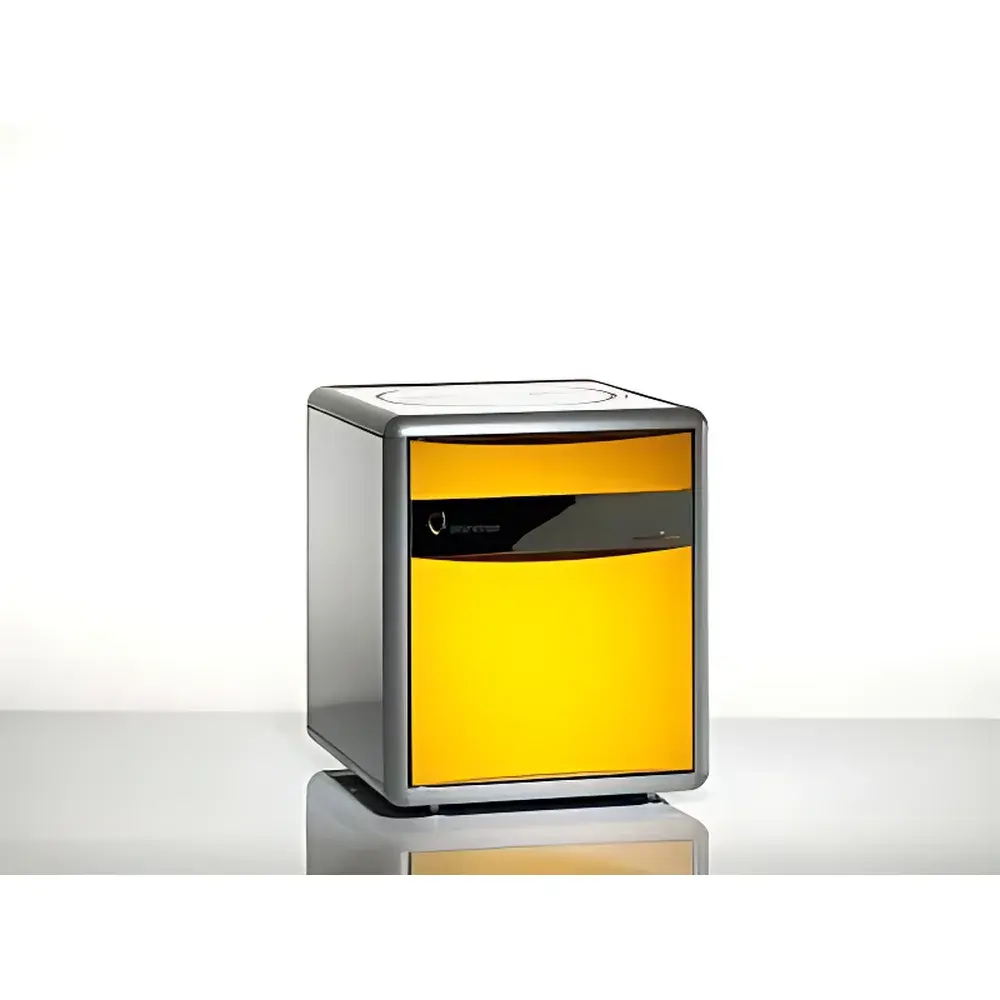
Elementar rapid CS cube Infrared Carbon-Sulfur Analyzer
| Brand | Elementar |
|---|---|
| Origin | Germany |
| Model | rapid CS cube |
| Measurement Principle | Infrared Absorption |
| Heating System | Resistance Furnace |
| Carbon Range | 0–100% |
| Sulfur Range | 0–100% |
| Sensitivity | 1 ppm |
| Accuracy | ±1 ppm |
| Analysis Time | 5 min |
| Sample Throughput | Standard 60-position Autosampler |
| Optional Autosamplers | 80- or 120-position |
| Chlorine Detection Module | Optional solid-state electrochemical cell |
| TOC/TIC Capability | Yes (via external acidification + optional TIC module) |
| Sample Mass Range | 1 mg – 400 mg |
| Warranty | 10 years on combustion furnace and thermal conductivity detector |
Overview
The Elementar rapid CS cube is a high-performance, fully automated infrared carbon-sulfur analyzer engineered for precise quantification of total carbon (C) and total sulfur (S) in solid, liquid, and acidified samples using non-dispersive infrared (NDIR) detection. Based on the fundamental principle of infrared absorption spectroscopy, the instrument combusts samples quantitatively in a high-temperature resistance furnace (up to 1,500 °C), converting carbon and sulfur into CO₂ and SO₂ gases, respectively. These gaseous species are then swept through dedicated NDIR cells where their characteristic absorption bands at 4.26 µm (CO₂) and 7.35 µm (SO₂) are measured with photometric precision. The system’s robust architecture ensures stoichiometric combustion across heterogeneous matrices—including coal, coke, biomass, rubber, soils, and pharmaceutical intermediates—without matrix-matched calibration requirements. Its design conforms to ISO 11725 (solid fuels), ASTM D4294 (petroleum products), and USP (elemental impurities), supporting GLP-compliant workflows in QC laboratories and R&D facilities.
Key Features
- Integrated 60-position autosampler as standard—enabling unattended overnight operation and consistent sample introduction
- Patented zero-blank ball valve mechanism for inert, contamination-free transfer of solid samples into the combustion zone
- 10-year warranty on both the high-stability resistance furnace and thermal conductivity detector (TCD), reflecting long-term reliability engineering
- Sub-ppm sensitivity: LOD for sulfur in coal is ≤2 ppm; overall system sensitivity is 1 ppm for both C and S
- Analysis time of ≤5 minutes per sample—including combustion, gas conditioning, and signal integration—with reproducibility better than 0.5% RSD at 100 ppm level
- Modular expandability: Optional chlorine detection module based on solid-state electrochemical sensing (no titrant, no electrodes to replace); analysis time for Cl in coke: ~15 min
- TOC/TIC capability via external acidification station and optional TIC module—enabling TC–TIC differential calculation per ISO 8245 and EPA Method 415.1
Sample Compatibility & Compliance
The rapid CS cube accommodates a broad spectrum of sample types and masses: from 1 mg of high-purity fine chemicals to 400 mg of coal or biomass pellets. Liquid samples—including aqueous extracts, oils, and digested environmental matrices—are introduced via ceramic boat or quartz crucible with appropriate catalyst support. Solid samples require no grinding beyond standard lab preparation; encapsulation in tin foil prevents furnace contamination and eliminates carryover. The system meets regulatory expectations for audit readiness: full electronic records, user access control, and 21 CFR Part 11–compliant software options (with optional audit trail, electronic signatures, and data integrity safeguards). All hardware and firmware comply with IEC 61000-6-3 (EMC) and IEC 61010-1 (safety), and method validation documentation supports ISO/IEC 17025 accreditation.
Software & Data Management
Control and evaluation are managed via the unified vario ELEMENTAR software platform, which provides real-time monitoring of combustion parameters (O₂ flow, furnace temperature, pressure differentials), spectral baseline stability, and detector response. Raw absorbance data are stored in vendor-neutral .csv and .xml formats. Calibration curves support multi-point linear and quadratic regression with automatic outlier rejection. The software includes built-in uncertainty estimation per GUM principles and generates compliant reports aligned with ISO 17025 clause 7.8. Data archiving follows ALCOA+ principles (Attributable, Legible, Contemporaneous, Original, Accurate, Complete, Consistent, Enduring, Available), with optional integration into LIMS via ASTM E1482 or HL7 interfaces.
Applications
- Coal and coke quality control: Rapid determination of total sulfur for compliance with EN 15148 and ASTM D3177
- Biomass fuel certification: Quantification of C/S ratios for energy content modeling and emissions forecasting
- Environmental soil testing: Screening for anthropogenic sulfur contamination and organic carbon sequestration assessment
- Pharmaceutical excipient release testing: Verification of residual carbon/sulfur in APIs per ICH Q3D guidelines
- Recycled rubber characterization: Detection of vulcanization agents (e.g., sulfur) and accelerators (e.g., thiurams)
- Geochemical research: High-precision C/S isotopic ratio preparation (when coupled with EA-IRMS systems)
FAQ
Does the rapid CS cube require matrix-matched calibration standards?
No. Its combustion efficiency and gas-phase detection enable accurate quantification across diverse sample types without requiring calibrants that match the sample matrix.
Can it analyze liquid samples directly?
Yes—liquids are introduced in sealed ceramic boats or quartz crucibles with tungsten oxide catalyst; no derivatization or pre-concentration is needed.
What is the maintenance interval for the chlorine detection module?
The solid-state electrochemical chlorine sensor requires no routine maintenance, electrolyte replacement, or electrode polishing—typical service life exceeds 5 years under normal use.
Is TOC analysis compliant with regulatory methods?
Yes—when configured with the optional TIC module and external acidification unit, it satisfies ISO 8245, EPA 415.1, and ASTM D7573 for total organic carbon determination in solids.
How is data integrity ensured during long-term unattended runs?
All analytical events—including autosampler position logs, combustion parameter traces, and raw detector outputs—are timestamped, digitally signed, and stored with checksum verification to prevent tampering or loss.
Related Products




