
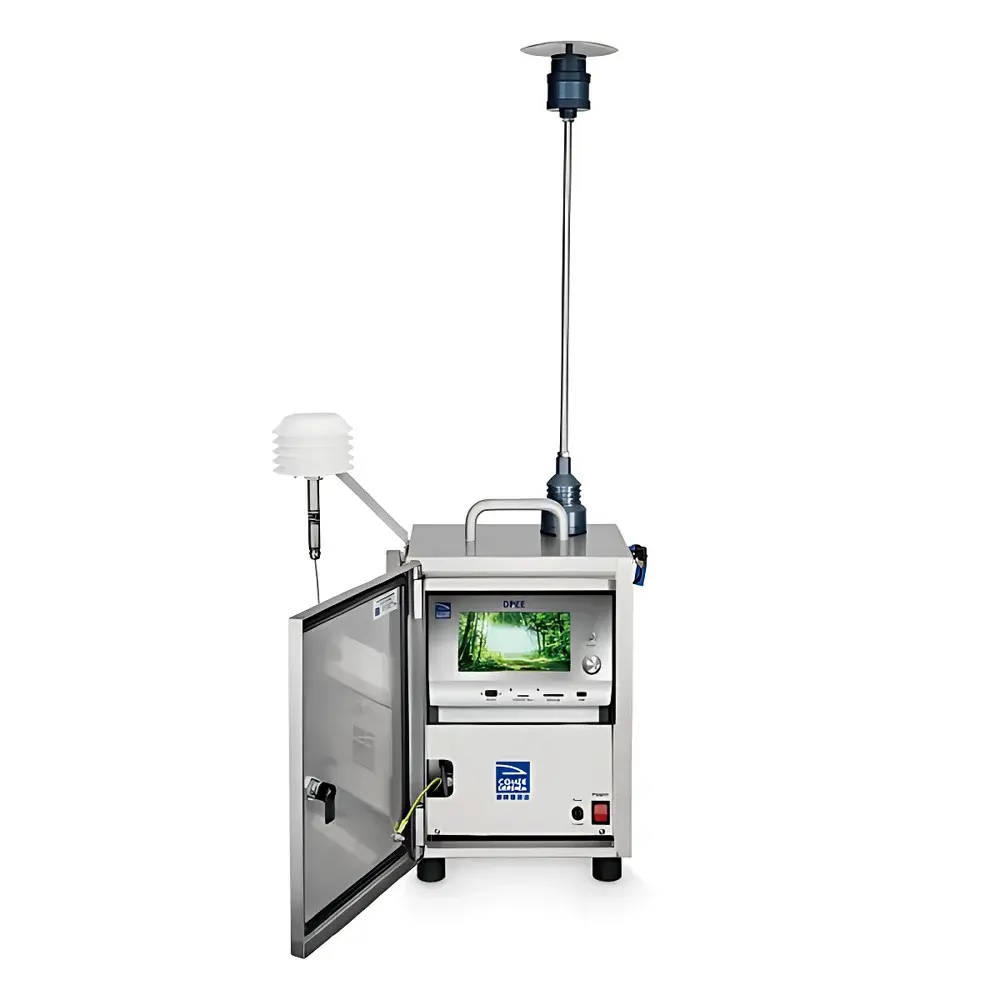
Derenda APM-2E Portable Real-Time Atmospheric Particulate Matter Monitor
| Brand | Derenda |
|---|---|
| Origin | Germany |
| Model | APM-2E |
| Measurement Principle | Laser Light Scattering |
| Measured Parameters | PM₁₀ / PM₂.₅ |
| Measurement Range | 0–2500 µg/m³ |
| Minimum Detection Limit | 1 µg/m³ |
| Measurement Interval | 5 s |
| Flow Stability | ±5% |
| Resolution | 0.1 µg/m³ |
| Operating Temperature | −30 °C to +50 °C |
| Operating Humidity | 0–100 %RH (with automatic heating dehumidification) |
| Acoustic Noise | <35 dB(A) (per DIN 2058, at 8 m) |
| Power Supply | AC 220 V ±10 %, 50/60 Hz |
| Enclosure Rating | IP65 |
| Dimensions | 300 × 250 × 480 mm |
| Weight | 15 kg |
Overview
The Derenda APM-2E Portable Real-Time Atmospheric Particulate Matter Monitor is an engineered solution for continuous, field-deployable measurement of ambient airborne particulate mass concentrations. It operates on the principle of multi-angle laser light scattering—enhanced with integrated temperature compensation—to quantify aerosol optical properties and derive mass concentration equivalents for PM2.5 and PM10 in real time. Unlike fixed-station monitors requiring separate inlet configurations or manual recalibration, the APM-2E employs a dual-stage impactor-based particle size separation system compliant with EN 12341 and ISO 7708 standards, enabling sequential, alternating measurement of both fractions within a single compact optical chamber. Its design supports unattended operation across diverse environmental conditions—from urban street canyons to industrial perimeters—and is optimized for mobile deployment scenarios including vehicle-mounted air quality mapping (‘mobile monitoring’ or ‘sniffer’ applications).
Key Features
- Integrated EU-compliant sharp-cut cyclonic particle size selectors for PM2.5 and PM10, eliminating the need for physical inlet swapping or external fractionation hardware
- Automated hourly optical chamber cleaning cycle with simultaneous zero-point and span calibration using internal reference sources
- Real-time measurement interval of 5 seconds, delivering high-temporal-resolution data suitable for transient emission source identification
- Active thermal management system with automatic heating-based dehumidification, ensuring stable performance under condensing humidity conditions (0–100 %RH)
- Ruggedized IP65-rated enclosure rated for outdoor exposure, vibration-resistant mounting interface, and low acoustic signature (<35 dB(A) at 8 m)
- Multi-protocol communication suite supporting USB 2.0, RS-232 serial interface, and embedded 3G/4G LTE cellular modem for secure remote telemetry
Sample Compatibility & Compliance
The APM-2E is validated for ambient air sampling in accordance with regulatory frameworks governing ambient air quality monitoring in the European Union (EU Directive 2008/50/EC), the U.S. EPA Reference and Equivalent Method requirements (40 CFR Part 53), and ISO 12103-1 for aerosol generation standards. Its impactor geometry and flow control architecture meet the aerodynamic cut-point tolerances specified in EN 12341:2014 for PM10 and PM2.5 samplers. All firmware and data logging routines are structured to support audit-ready traceability, including timestamped calibration logs, flow verification records, and diagnostic event flags—enabling alignment with GLP and ISO/IEC 17025 laboratory quality systems.
Software & Data Management
The instrument interfaces with Derenda’s cloud-hosted AirSight™ platform via TLS-encrypted MQTT or HTTP(S) protocols. This enables centralized configuration management, over-the-air firmware updates, and role-based access control for multi-user deployments. Raw scatter signal outputs, temperature-compensated concentration values, and system health metrics (e.g., laser diode current, photodetector gain, flow sensor deviation) are logged at native 5-second resolution and retained for ≥90 days on-device (microSD slot) and indefinitely in the cloud. Export formats include CSV, NetCDF, and JSON-LD, with optional integration into third-party SCADA or GIS platforms via RESTful API. Audit trails comply with FDA 21 CFR Part 11 requirements for electronic records and signatures where enabled by organizational policy.
Applications
- Mobile emissions mapping along transportation corridors, construction sites, and waste transfer stations
- Short-term compliance verification during industrial commissioning or remediation activities
- Community-level air quality screening in sensitive receptor zones (e.g., schools, hospitals, residential neighborhoods)
- Calibration and validation support for stationary reference-grade monitoring networks
- Research-grade temporal profiling of secondary aerosol formation events under varying meteorological conditions
- Emergency response deployment during wildfire smoke episodes or fugitive dust incidents
FAQ
Does the APM-2E require annual factory recalibration?
No—its self-calibrating optical module and automated zero/span verification reduce the need for routine factory service. However, biannual verification against NIST-traceable aerosol generators (e.g., PSL or ammonium sulfate) is recommended for regulatory reporting.
Can the device operate continuously on battery power?
The APM-2E is designed for AC mains operation; however, it supports external DC input (12–24 V) for integration with vehicle power systems or solar-charged battery banks—subject to proper voltage regulation and surge protection.
Is raw scatter signal data accessible for custom algorithm development?
Yes—full-resolution analog photodetector output and synchronized environmental sensor streams (temperature, RH, pressure) are available via RS-232 and USB CDC ACM mode for OEM or academic use cases.
How is data integrity ensured during intermittent cellular connectivity?
On-device non-volatile memory buffers up to 72 hours of 5-second data; transmission resumes automatically upon reconnection without loss or duplication.
What maintenance intervals are specified for consumables?
The only scheduled consumable is the replaceable hydrophobic inlet filter (recommended every 3 months in high-dust environments); all other subsystems—including laser diode and impactor surfaces—are maintenance-free for ≥24 months under typical operation.







