
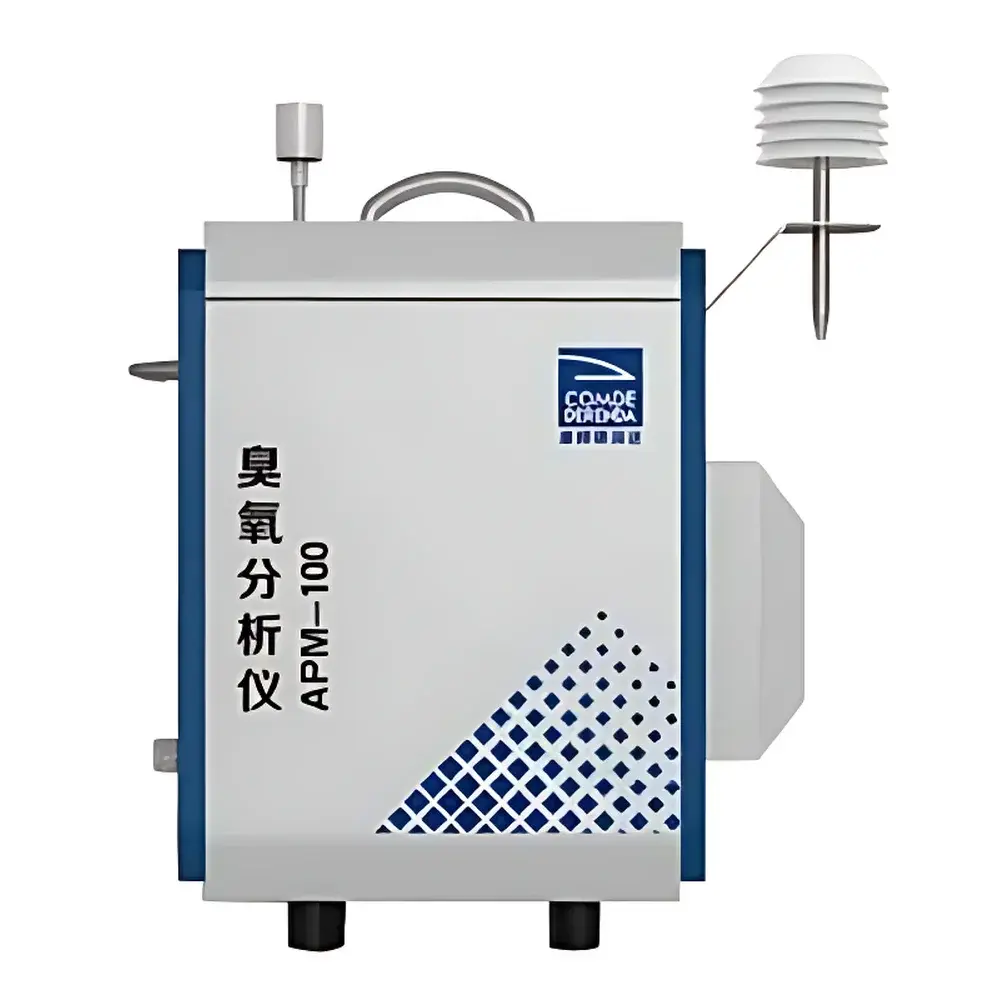
Derenda APM-100 Ozone Analyzer
| Brand | Derenda |
|---|---|
| Origin | Germany |
| Model | APM-100 |
| Measurement Principle | UV Absorption (Beer–Lambert Law) |
| Measurement Range | 0–500 µg/m³ |
| Resolution | 0.1 µg/m³ |
| Accuracy | ±2 µg/m³ |
| Detection Limit | 2.0 µg/m³ |
| Baseline Drift | <3 µg/m³/day, <6 µg/m³/year |
| Measurement Interval | 2 s (0.5 Hz) |
| Data Averaging Options | 10 s, 1 min, 5 min, 1 h |
| Data Storage Capacity | >100,000 records (expandable via USB/SD card) |
| Flow Rate | 0.6–1.5 L/min (nominal 1.0 L/min) |
| Operating Temperature | 0–50 °C |
| Ambient Pressure Compensation | Yes |
| Temperature Compensation | Yes |
| Protection Rating | IP65 |
| Dimensions | 300 × 250 × 450 mm |
| Weight | ~10 kg |
| Compliance | HJ 193-2013, HJ 654-2013, HJ 818-2018, HJ 965-2018 |
Overview
The Derenda APM-100 Ozone Analyzer is a field-deployable, high-stability gas monitoring instrument engineered for continuous, real-time quantification of ambient ozone (O₃) concentrations in outdoor air quality monitoring networks. It operates on the fundamental principle of ultraviolet (UV) absorption spectroscopy, specifically implementing a dual-beam, single-path optical configuration compliant with the Beer–Lambert law. The analyzer alternately measures UV absorbance through two parallel optical paths—one conditioned by an ozone scrubber (zero path) and one unscrubbed (sample path)—enabling precise differential signal calculation to eliminate interference from lamp drift, window fouling, and broadband scattering effects. This design ensures traceable, reference-grade measurement performance without reliance on external calibration gases during routine operation. Engineered for unattended long-term deployment, the APM-100 integrates active thermal regulation within an IP65-rated enclosure, maintaining internal temperature stability across ambient conditions ranging from 0 °C to 50 °C—critical for minimizing spectral baseline drift and sustaining sub-ppb equivalent accuracy over seasonal cycles.
Key Features
- UV absorption-based ozone detection with real-time zero-reference correction via integrated ozone scrubber
- IP65-rated ruggedized housing with built-in thermoelectric cooling/heating system for stable optical cavity temperature control
- High temporal resolution: configurable 2-second measurement interval (0.5 Hz), enabling transient event capture and rapid response to photochemical ozone formation dynamics
- Automatic pressure and temperature compensation algorithms applied in real time to raw absorbance signals, ensuring metrological consistency across elevation gradients and diurnal thermal swings
- Low-flow safeguard mechanism that triggers automatic shutdown upon flow deviation beyond ±15% of nominal 1.0 L/min, protecting sensor integrity and data validity
- Embedded GPS module synchronized with timestamped measurements, supporting mobile monitoring campaigns (e.g., vehicle-mounted “mobile mapping” or “fenceline” surveys)
- Secure remote access via TLS-encrypted web interface; supports over-the-air firmware updates, parameter reconfiguration, and diagnostic telemetry without onsite intervention
Sample Compatibility & Compliance
The APM-100 is validated for direct analysis of ambient air without pre-concentration or chemical conversion. Its optical path length and UV source intensity are optimized for linear response across the regulatory range of 0–500 µg/m³ (equivalent to 0–250 ppb at 25 °C and 1013 hPa), fully covering both background and urban peak ozone levels. All hardware and firmware implementations adhere to the technical requirements defined in China’s national standard series for gaseous pollutant monitoring: HJ 654-2013 (performance specifications), HJ 193-2013 (installation and acceptance protocols), and HJ 818-2018 (quality assurance/quality control procedures). While not certified to ISO 13964 or EN 14625, its measurement methodology aligns with the foundational principles of UV photometry referenced in those standards. Data logging meets GLP-aligned traceability requirements, including immutable timestamps, operator ID tagging, and audit-ready event logs for power interruptions, flow faults, and calibration actions.
Software & Data Management
The embedded Linux-based operating system hosts a locally executed web server accessible via Ethernet or optional 4G LTE module. Users configure sampling parameters—including averaging intervals (10 s, 1 min, 5 min, 1 h), unit selection (µg/m³ or ppb), alarm thresholds, and GPS reporting frequency—through a role-based HTML5 interface. Raw absorbance values, compensated concentration outputs, and environmental metadata (T, P, flow) are stored internally in binary format with cyclic overwrite protection. External storage expansion via USB 2.0 or microSDHC (up to 128 GB) enables >100,000 records retention, exportable as CSV or NetCDF for integration into third-party platforms (e.g., EPA’s AIRNow, EU’s EEA Air Quality e-Reporting, or custom GIS dashboards). Firmware updates are digitally signed and verified prior to installation, satisfying basic cybersecurity hygiene per IEC 62443-3-3 Level 1 requirements.
Applications
- Fixed-site ambient air quality monitoring networks operated by municipal EPBs and provincial environmental monitoring centers
- Mobile ozone mapping along transportation corridors, industrial perimeters, and urban heat islands using vehicle- or drone-integrated mounting kits
- Photochemical smog research campaigns requiring synchronized O₃, NOₓ, and VOC measurements—APM-100’s compact form factor and analog/digital I/O enable seamless integration with co-located analyzers
- Calibration transfer and verification support for lower-cost metal oxide or electrochemical sensors deployed in dense sensor grids
- Compliance verification for industrial fenceline monitoring under China’s “Blue Sky Defense Campaign” enforcement framework
FAQ
Does the APM-100 require periodic calibration with certified ozone gas standards?
Yes—while the zero-reference scrubber compensates for optical drift, quarterly calibration against NIST-traceable ozone generators or permeation tubes is required per HJ 818-2018 to maintain regulatory data validity.
Can the instrument operate continuously without external power?
No—it requires a stable 100–240 VAC input or optional DC-DC converter for 12/24 VDC battery backup systems; runtime under battery depends on capacity and thermal load.
Is the GPS module used solely for geotagging, or does it support GNSS-based time synchronization?
It provides both functions: PPS (pulse-per-second) output enables microsecond-level timestamp alignment with UTC, critical for multi-instrument intercomparison studies.
What communication protocols does the APM-100 support for SCADA integration?
Modbus TCP (register-mapped), HTTP RESTful API (JSON), and MQTT v3.1.1 with TLS 1.2 encryption—no proprietary drivers required.
How is data integrity ensured during extended network outages?
All measurements are stored locally with write-cycling protection; upon connection restoration, unsent records are transmitted in chronological order with duplicate suppression logic.
Related Products







