
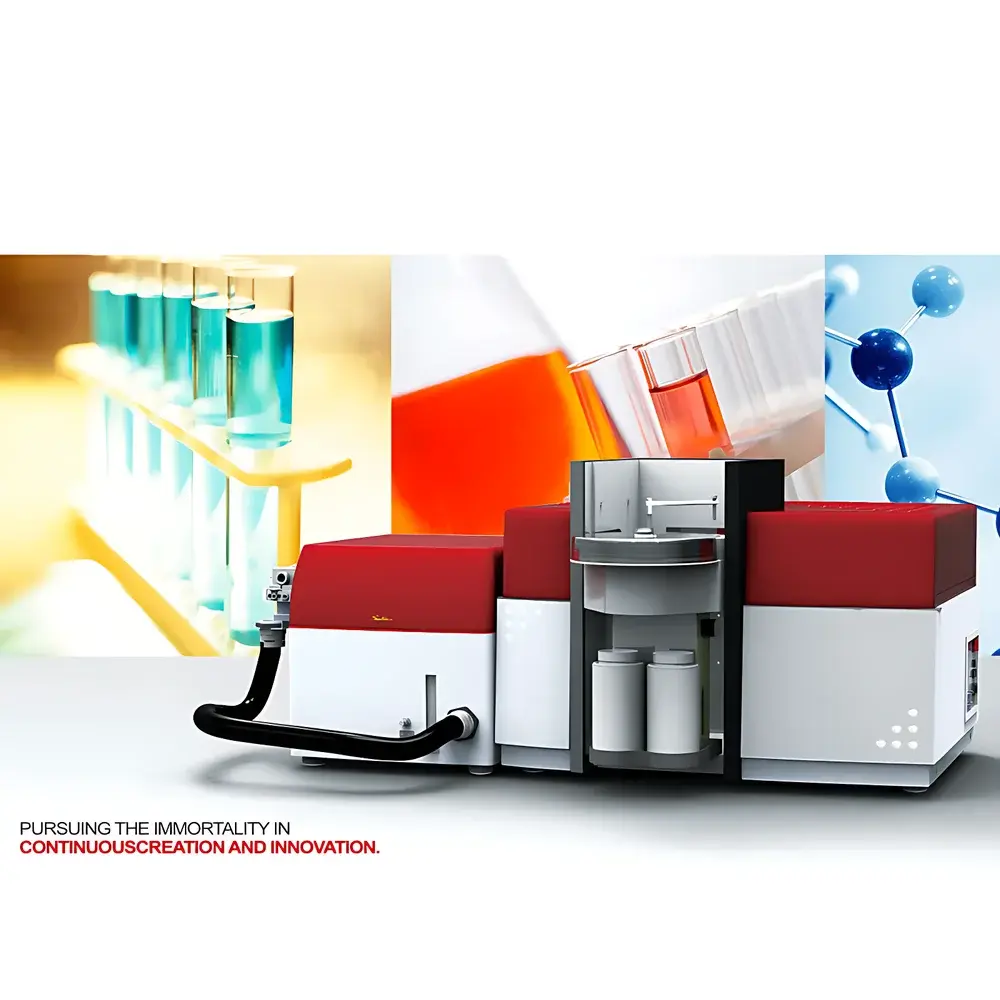
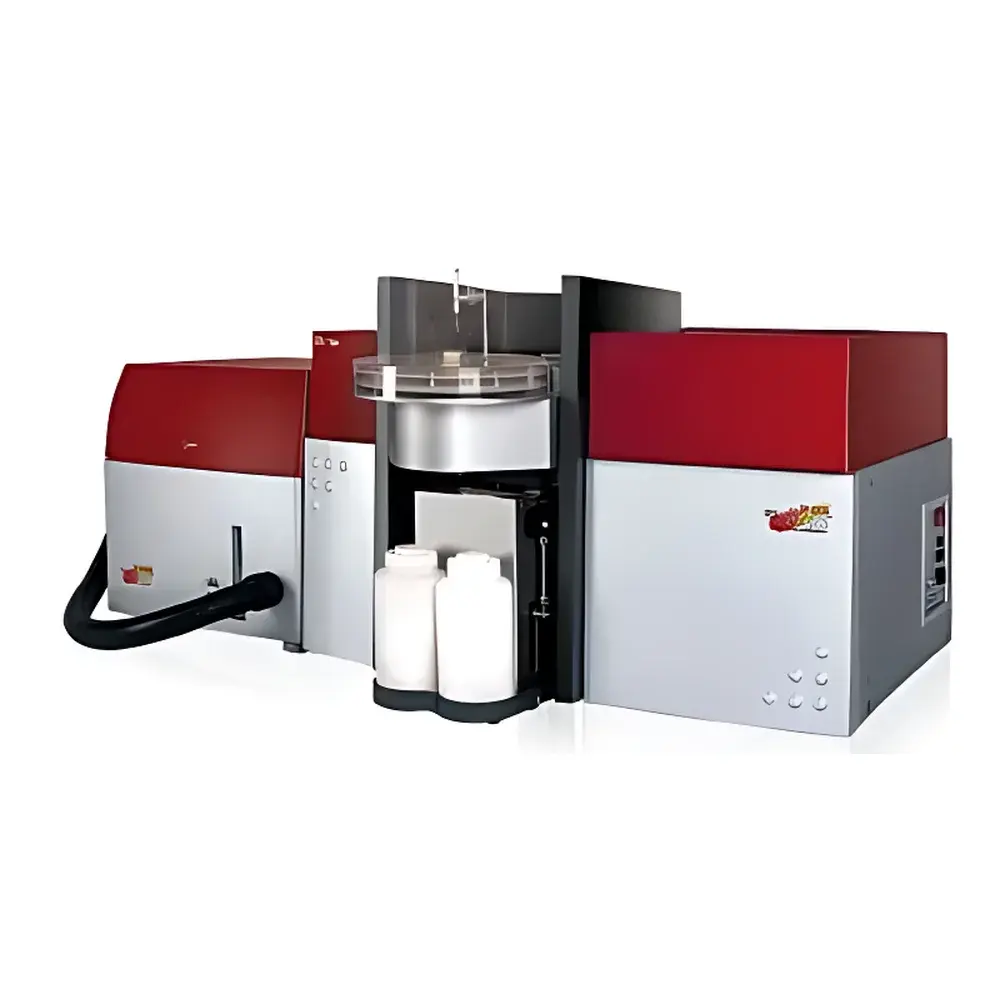
Shanghai Spectrum SP-3530AA Flame and Graphite Furnace Atomic Absorption Spectrometer
| Brand | Shanghai Spectrum |
|---|---|
| Origin | Shanghai, China |
| Model | SP-3530AA |
| Instrument Type | Flame and Graphite Furnace AAS |
| Monochromator | Concave Grating |
| Optical System | Single-Beam |
| Detector | Photomultiplier Tube (PMT) |
| Background Correction | D₂ Lamp + Self-Absorption Method |
| Background Correction Capacity | >80× |
| Software Platform | Win-AAS Workstation |
| Data Output Modes | Time-Averaged Signal, Peak Height, Peak Area, Statistical Summary |
Overview
The Shanghai Spectrum SP-3530AA is a dual-mode atomic absorption spectrometer engineered for high-precision elemental quantification in laboratory environments requiring both flame and electrothermal atomization capabilities. It operates on the fundamental principle of atomic absorption spectroscopy (AAS), wherein ground-state atoms in a gaseous state absorb characteristic wavelengths of light emitted by hollow cathode lamps (HCLs). The instrument measures the attenuation of this resonance radiation to determine analyte concentration via Beer–Lambert law correlation. Designed with a single-beam optical architecture and a concave grating monochromator, the SP-3530AA delivers stable spectral resolution and consistent wavelength selection across the 190–900 nm range. Its dual background correction system—combining deuterium (D₂) lamp continuum correction and high-efficiency self-absorption correction—enables reliable compensation for structured molecular absorption and scattering effects, particularly critical for complex matrices such as biological digests, environmental sludge extracts, and metallurgical solutions.
Key Features
- Dual atomization platform supporting both air-acetylene flame and graphite furnace operation, enabling flexible method development for trace (sub-pg) to major (mg/L) concentration ranges.
- Integrated D₂ lamp + self-absorption background correction with verified correction capacity exceeding 80×, significantly improving accuracy in high-background samples without compromising signal-to-noise ratio.
- Optimized optical path with sealed, thermally stabilized concave grating monochromator, minimizing thermal drift and ensuring long-term wavelength reproducibility.
- High-gain photomultiplier tube (PMT) detector with low dark current and linear dynamic response over four orders of magnitude.
- Modular lamp turret accommodating up to six hollow cathode lamps, with automatic lamp selection and alignment calibration routines embedded in firmware.
- Robust graphite furnace temperature programming with ramp rates up to 2000 °C/s and real-time temperature monitoring via integrated pyrometry.
Sample Compatibility & Compliance
The SP-3530AA supports aqueous, acid-digested, and organic solvent-based samples compatible with standard AAS sample introduction protocols. Flame mode accommodates flow rates from 3–8 mL/min; graphite furnace mode accepts 5–40 µL volumes with programmable drying, ashing, atomization, and cleaning steps. The system meets essential performance criteria outlined in ISO 8288:2022 (Nickel determination in ores), ASTM D1688 (Copper in water), and USP <731> (Heavy metals testing). While not pre-certified for FDA 21 CFR Part 11, the Win-AAS software architecture supports audit trail configuration, electronic signature enablement, and user access level management—facilitating alignment with GLP and GMP documentation requirements during internal validation.
Software & Data Management
The Win-AAS workstation provides a Windows-native interface designed for operational efficiency without specialized training. It incorporates an expert method database containing validated parameters for over 70 elements—including recommended lamp currents, slit widths, burner heights, and furnace temperature programs—reducing method development time and inter-operator variability. All measurements are stored with full metadata: lamp identity, integration mode (peak height, peak area, time-averaged), background correction type applied, and raw analog/digital signal traces. Data export supports CSV, TXT, and XML formats compatible with LIMS integration. The “Full-Information Measurement” function retains parallel results from multiple quantification algorithms per run, enabling retrospective re-evaluation of integration baselines or background subtraction strategies—critical for method validation and uncertainty budgeting per ISO/IEC 17025:2017 Annex A.
Applications
The SP-3530AA is routinely deployed in environmental monitoring laboratories for trace metal analysis in drinking water (Pb, Cd, As per EPA Method 7000B), soil leachates (Ni, Cr, Zn), and wastewater effluents. In food safety testing, it supports compliance with EU Commission Regulation (EC) No. 1881/2006 for cadmium in rice and lead in cocoa products. Academic and pharmaceutical research groups utilize its graphite furnace mode for speciation studies following hydride generation or chelation preconcentration. Its dual-atomizer design also supports comparative validation studies between flame and furnace techniques required under ISO/IEC 17025 method verification clauses.
FAQ
Does the SP-3530AA support sequential multi-element analysis?
No—it is a single-element AAS system requiring manual or automated lamp switching between analyses. Simultaneous multi-element capability requires ICP-OES or ICP-MS instrumentation.
Is the self-absorption background correction applicable in flame mode?
Yes—self-absorption correction is available in both flame and graphite furnace modes, though its primary utility lies in furnace analysis where structured background is most prevalent.
What maintenance intervals are recommended for the PMT and D₂ lamp?
PMT gain calibration is advised every 200 hours of operation; D₂ lamp replacement is typically required after 500–800 hours of cumulative use, depending on duty cycle and voltage settings.
Can Win-AAS generate reports compliant with ISO/IEC 17025 documentation requirements?
Yes—the software supports customizable report templates with embedded instrument metadata, analyst ID, date/time stamps, calibration curve statistics (r², LOD, LOQ), and electronic signature fields when configured with role-based authentication.
Is the graphite furnace autosampler included as standard equipment?
No—the autosampler is an optional accessory; the base configuration includes manual sample introduction via syringe or cup loader.







