
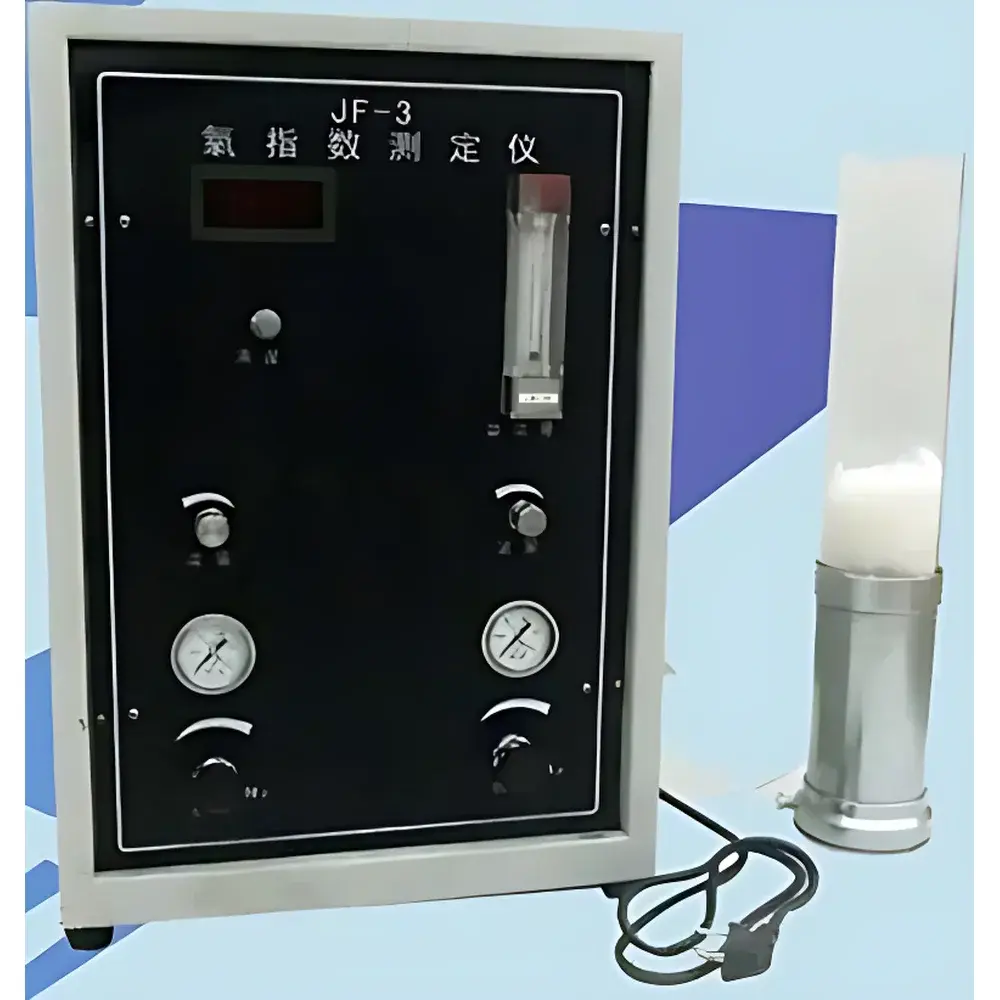
North Guangjing Precision Instrument JF-3 Oxygen Index Tester
| Brand | North Guangjing Precision Instrument |
|---|---|
| Origin | Beijing, China |
| Manufacturer Type | Manufacturer |
| Product Category | Domestic |
| Model | JF-3 |
| Price | USD 850 (FOB) |
| Standards Compliance | GB/T 2406, GB/T 8924, GB/T 5454, GB/T 10707, ASTM D2863, ISO 4589-2 |
| Oxygen Sensor | ENVITEC (Germany), High-Precision Paramagnetic Type |
| Oxygen Measurement Range | 0–100% vol. |
| Resolution | 0.1% O₂ |
| Pressure Control Range | 0.05–0.15 MPa |
| Operating Pressure | 0.15 MPa |
| Output Pressure | 0.25–0.4 MPa |
| Combustion Chamber ID | 100 mm |
| Combustion Chamber Height | 450 mm |
| Gas Supply | GB 3863 Oxygen, GB 3864 Nitrogen |
| Flowmeter Accuracy Class | 2.5 |
| Pressure Gauge Accuracy Class | 2.5 |
| Power Supply | 220 V AC, 50 Hz, 100 W |
| Ambient Temperature | −10 °C to +45 °C |
| Relative Humidity | <85% RH |
| Sample Types | Self-supporting & Non-self-supporting Materials |
Overview
The North Guangjing Precision Instrument JF-3 Oxygen Index Tester is a benchtop combustion analysis system engineered for precise determination of the limiting oxygen index (LOI) of solid polymeric materials. LOI is defined as the minimum volume percentage of oxygen in a nitrogen–oxygen mixture required to support candle-like combustion of a vertically oriented specimen under specified test conditions. This measurement is grounded in the fundamental principles of oxidative pyrolysis and flame propagation thermodynamics, where material flammability is quantified by its threshold oxygen concentration—directly correlating with inherent flame resistance and char-forming tendency. The instrument implements a standardized upward-flame propagation method per GB/T 2406 and ISO 4589-2, delivering repeatable, traceable, and inter-laboratory comparable results essential for regulatory compliance, formulation development, and fire safety qualification of plastics, elastomers, foams, textiles, and composite laminates.
Key Features
- High-stability German ENVITEC paramagnetic oxygen sensor ensures long-term calibration integrity, low drift (<0.05% O₂/year), and resolution of 0.1% across the full 0–100% measurement range
- Digital real-time oxygen concentration display eliminates manual calculation and reduces operator interpretation error
- Robust stainless-steel (304) front panel trim and matte-finish powder-coated enclosure provide corrosion resistance and ergonomic durability in QC lab environments
- Precision pressure regulation system maintains stable gas flow at 0.15 MPa working pressure, with dual-stage regulators and calibrated rotameters meeting ISO 5167 flow measurement guidelines
- Standardized 100 mm internal diameter × 450 mm height combustion column conforms strictly to dimensional tolerances specified in ASTM D2863 and ISO 4589-2
- Integrated ignition source with adjustable flame height (20 ± 2 mm) and ceramic-tipped burner ensures reproducible ignition energy delivery
- Modular sample holder assembly accommodates both self-supporting rods (e.g., injection-molded bars) and non-self-supporting films or fabrics via auxiliary clamping fixtures
Sample Compatibility & Compliance
The JF-3 supports a broad spectrum of solid combustible materials per international test protocol requirements. Self-supporting specimens—including rigid plastics (e.g., ABS, PC, PP), thermoset resins, and wood-based composites—are tested in standard 150 mm × 10 mm × 10 mm dimensions. Non-self-supporting materials—such as flexible foams, thin films, coated fabrics, and elastomeric sheets—are evaluated using supplemental support frames and weighted holders compliant with Clause 7.3 of ISO 4589-2. All testing adheres to GLP-aligned documentation practices: raw gas pressure logs, ambient temperature/humidity records, and operator-annotated flame behavior are retained for audit readiness. The system meets the metrological traceability requirements of ISO/IEC 17025 for accredited laboratories and supports validation against reference materials certified per NIST SRM 2891 (polyethylene) and SRM 2892 (polypropylene).
Software & Data Management
While the JF-3 operates as a standalone analog-digital hybrid instrument, its measurement architecture is fully compatible with laboratory information management systems (LIMS) via RS-232 serial output (optional USB-to-serial adapter). Oxygen concentration, chamber pressure, and elapsed time are transmitted as ASCII-formatted data packets at 9600 baud, enabling automated capture into Excel, LabVIEW, or enterprise QC platforms. All digital displays comply with IEC 61000-4-3 EMC immunity standards. For regulated environments, optional firmware upgrade provides 21 CFR Part 11–compliant audit trail functionality—including user login timestamps, parameter change history, and electronic signature fields—validated per Annex 11 and aligned with GMP Annex 15 requirements for pharmaceutical packaging flammability assessment.
Applications
- Quality control of halogen-free flame-retardant (HFFR) cable compounds and wire insulation formulations
- Comparative screening of intumescent additives in epoxy and polyester resin systems
- Regulatory submission support for UL 94 HB/V-2/V-0 equivalency claims
- Fire performance benchmarking of bio-based polymers (PLA, PHA) versus petroleum-derived analogs
- Failure analysis of thermal degradation-induced LOI reduction in aged polymer components
- Validation of oxygen barrier coatings on flexible packaging substrates
FAQ
What gases are required for operation, and what purity specifications apply?
Industrial-grade oxygen (GB 3863, ≥99.5% purity) and nitrogen (GB 3864, ≥99.99% purity) are mandatory. Moisture content must be ≤5 ppmv; hydrocarbon impurities must be below 1 ppmv to prevent sensor poisoning and flame instability.
Is calibration verification traceable to national standards?
Yes—calibration is performed using certified gas mixtures (e.g., 18.0 ± 0.1% O₂ in N₂) traceable to CNAS-accredited reference standards. A calibration certificate with uncertainty budget (k=2) is issued with each unit.
Can the JF-3 be used for research-grade kinetic modeling of combustion onset?
While not a dynamic calorimeter, the JF-3 provides robust LOI endpoints suitable for Arrhenius-type correlation studies when combined with TGA-FTIR or cone calorimetry data. Its high repeatability (RSD ≤1.2% per ISO 4589-2 Annex B) supports statistical modeling of structure–flammability relationships.
How is compliance with ASTM D2863 ensured during daily use?
The instrument includes pre-configured test templates aligned with ASTM D2863 Section 7 (specimen preparation), Section 9 (gas flow rates), and Section 11 (ignition criteria). Built-in pressure and flow diagnostics flag deviations exceeding ±5% of nominal setpoints before test initiation.
What maintenance intervals are recommended for sustained accuracy?
Oxygen sensor zero-check every 30 days; full calibration every 6 months; combustion column cleaning after every 50 tests; annual verification of regulator hysteresis and flowmeter linearity per ISO 4064-2.



