
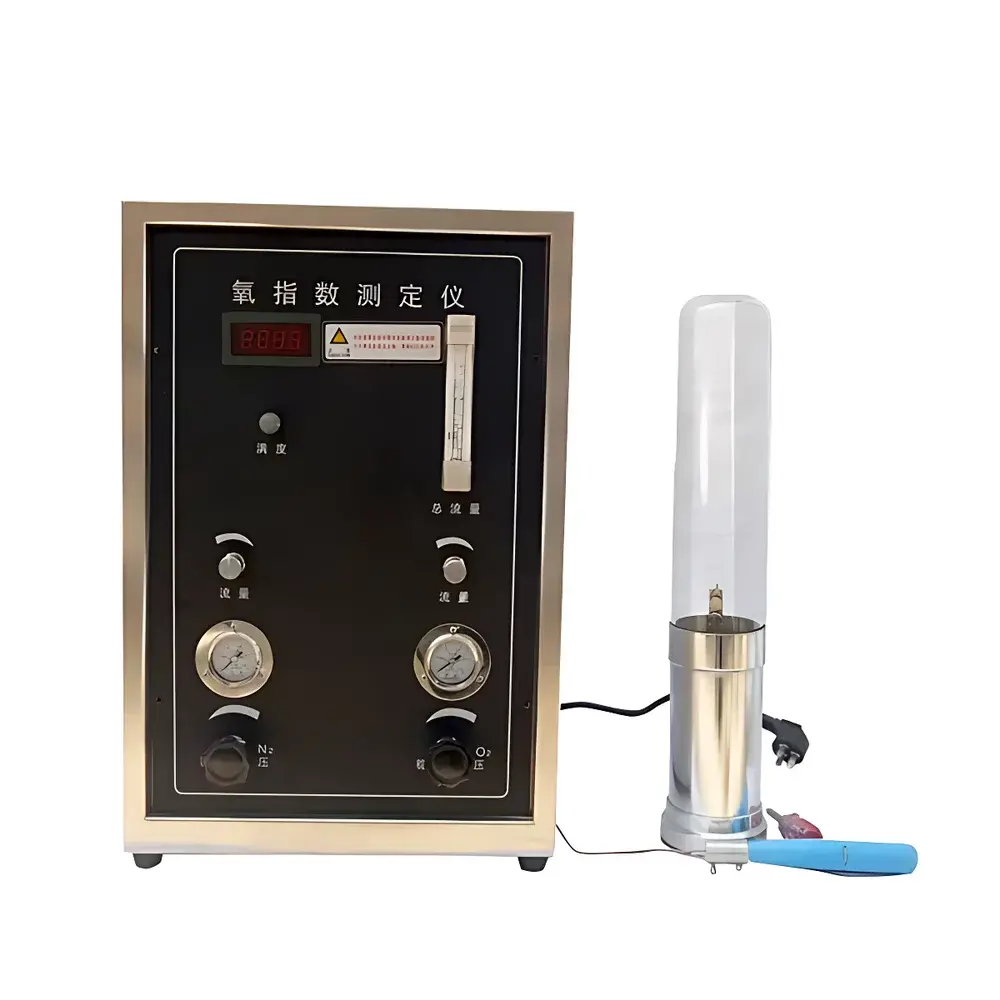
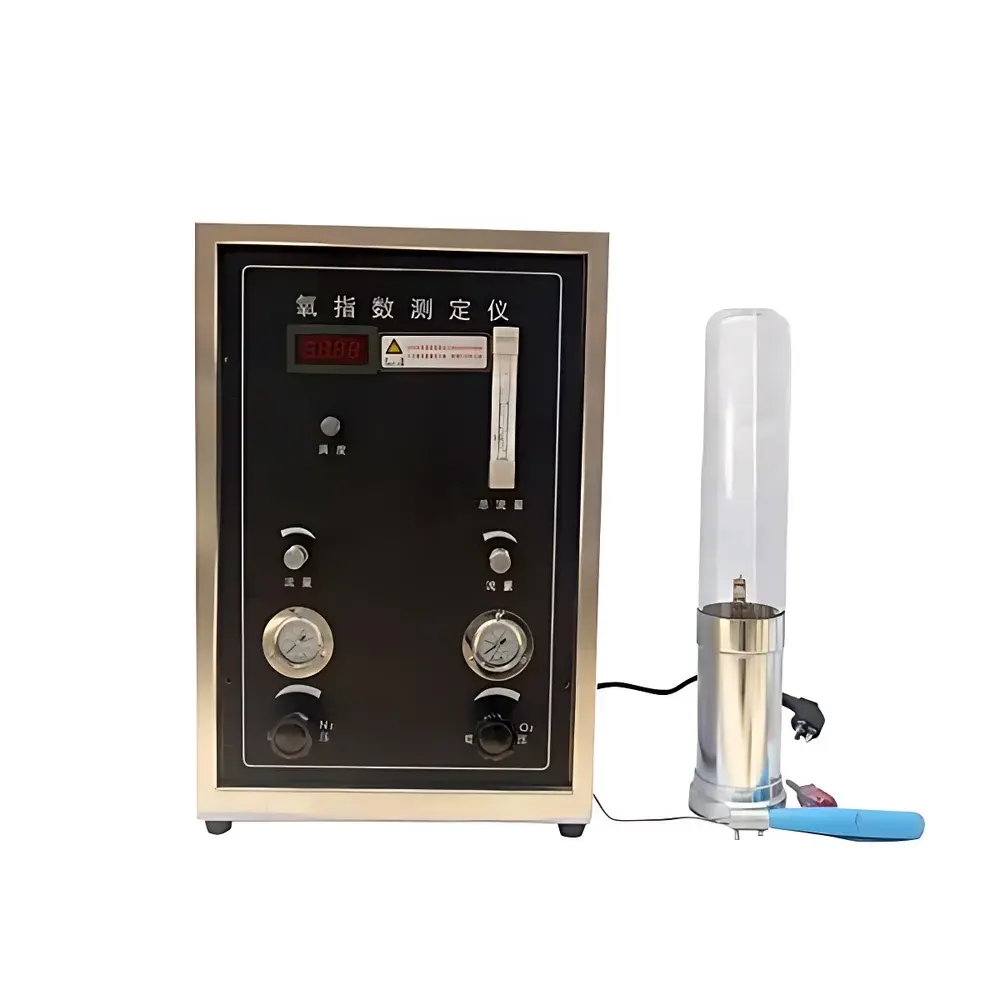
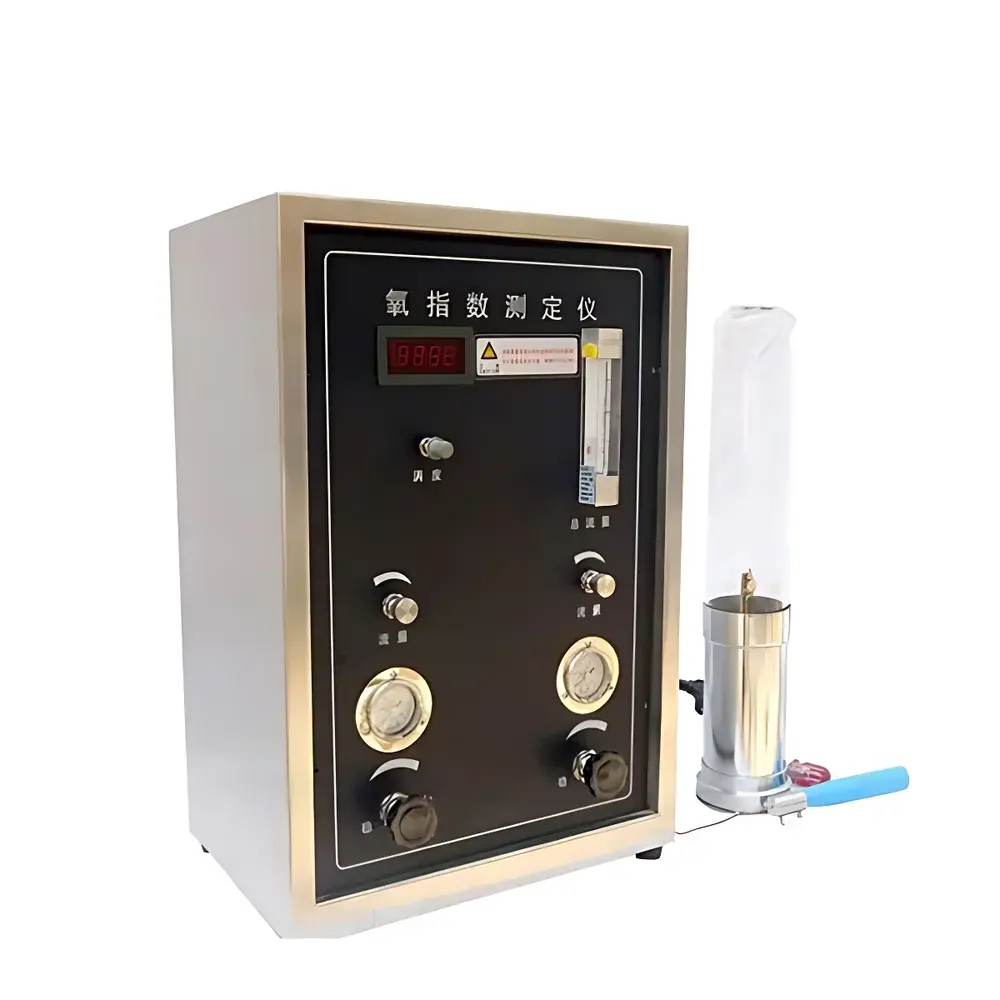
North Guangjingyi BYZS Intelligent Oxygen Index Tester
| Brand | North Guangjingyi / All Precision Instrument |
|---|---|
| Origin | Beijing, China |
| Manufacturer Type | Manufacturer |
| Product Origin | Domestic |
| Model | BYZS |
| Price | USD 1,800 (approx.) |
| Oxygen Measurement Range | 0–100 % vol O₂ |
| Accuracy | ±2.5 % vol O₂ |
| Response Time | <10 s |
| Zero Drift | <5 %/year |
| Operating Temperature | −10 °C to +45 °C |
| Relative Humidity | <85 % RH |
| Supply Gases | GB3863 Industrial Oxygen & GB3864 Industrial Nitrogen |
| Regulator Output Pressure | 0.25–0.4 MPa |
| Working Pressure | 0.1 MPa |
| Compliant Standards | ISO 4589-2, ASTM D2863, GB/T 2406.1–2008, GB/T 2406.2–2009, GB/T 5454–2014 |
Overview
The North Guangjingyi BYZS Intelligent Oxygen Index Tester is a precision benchtop instrument engineered for the quantitative determination of the limiting oxygen index (LOI) of solid polymeric materials under controlled combustion conditions. Based on the fundamental principle of upward flame propagation in a vertical specimen column within an oxygen–nitrogen mixture, the device measures the minimum volume fraction of oxygen in the gas stream required to sustain candle-like burning of a standardized test specimen for either a defined length (50 mm) or duration (180 s). This thermally driven, diffusion-controlled combustion metric serves as a critical benchmark for comparative flammability assessment and is widely adopted in material development, quality assurance, and regulatory compliance workflows across polymer science, textile engineering, and fire safety research.
Key Features
- High-stability electrochemical oxygen sensor with factory-calibrated traceability and real-time digital display (0.1 % resolution)
- Dual-gas manifold system with precision pressure regulators (0.25–0.4 MPa output), integrated back-pressure control, and fail-safe shut-off valves
- Bi-directional, mutually interlocked calibration/analysis valve assembly enabling rapid zero/span verification without system venting or purge delays
- Thermally insulated combustion chamber with standardized specimen holder (ASTM D2863-compliant dimensions), adjustable gas flow rate (0–10 L/min), and laminar flow stabilization
- Robust mechanical architecture with corrosion-resistant stainless-steel gas pathways, EMI-shielded electronics, and IP20-rated enclosure for laboratory use
- Compliance-ready design supporting audit trails, manual logbook entries, and operator-defined test sequences per GLP-aligned workflows
Sample Compatibility & Compliance
The BYZS tester accommodates rigid and semi-rigid specimens—including thermoplastics, thermosets, elastomers, laminates, foams (rigid and flexible), woven/nonwoven textiles, films, and thin sheets—within dimensional limits of 150 mm × 10 mm × 3–10 mm (L × W × T). Specimen preparation follows strict alignment with ISO 4589-2 Clause 6 and GB/T 2406.2–2009 Section 7 protocols, including conditioning at 23 °C ± 2 °C and 50 % ± 5 % RH for ≥48 h prior to testing. The instrument meets essential performance criteria specified in ASTM D2863 (2023 edition), ISO 4589-2:2017, GB/T 2406.1–2008, and GB/T 5454–2014. While not certified for IEC 61000-4 EMC immunity or ATEX hazardous area use, its gas-handling subsystem conforms to GB 3863 and GB 3864 industrial gas purity and delivery specifications.
Software & Data Management
The BYZS operates in standalone mode with embedded firmware controlling gas mixing ratio, flow stabilization, ignition timing, and endpoint detection (length or time-based). All measurement data—including O₂ concentration, elapsed time, burn length, ambient temperature/humidity, and operator ID—are recorded locally in non-volatile memory with timestamping (YYYY-MM-DD HH:MM:SS). Export is supported via USB 2.0 to CSV-formatted files compatible with Excel, MATLAB, or LIMS platforms. Audit trail functionality includes user login logs, calibration history (date, reference gas used, deviation values), and test session metadata—enabling full traceability in environments governed by ISO/IEC 17025 or internal QA/QC requirements. No cloud connectivity or proprietary software installation is required.
Applications
- Routine LOI screening of incoming raw materials (e.g., ABS, PC, PP, PET, PU foam) against specification limits
- Formulation optimization in flame-retardant additive development (e.g., brominated/phosphorus-based systems, mineral fillers, intumescents)
- Comparative evaluation of halogen-free vs. halogenated flame retardants under identical thermal exposure profiles
- Supporting UL 94 pre-screening and correlation studies with cone calorimetry (ISO 5660) and smoke density (ASTM E662) data
- Academic research on pyrolysis kinetics, char formation mechanisms, and gas-phase radical inhibition efficiency
- Regulatory documentation for CE marking (EN 13501-1), CPR classification, and RoHS-compliant material declarations
FAQ
What gases are required for operation, and what purity specifications must they meet?
Industrial-grade oxygen (GB3863, ≥99.5 % vol) and nitrogen (GB3864, ≥99.998 % vol) are mandatory. Both gases must be supplied through dedicated, oil-free, stainless-steel regulators with dual-stage pressure reduction to ensure stable 0.1 MPa working pressure at the chamber inlet.
Is the instrument suitable for testing coated fabrics or laminated composites?
Yes—provided the total specimen thickness falls within 3–10 mm and the coating or interlayer does not delaminate or blister during preheating. Specimens must be cut perpendicular to the surface plane and conditioned per GB/T 2918 prior to testing.
How often must the oxygen sensor be calibrated, and what reference gases are needed?
Initial two-point calibration (0 % O₂ in N₂ and 21 % O₂ in air) is performed at installation. Subsequent verification is recommended before each test series using certified 0 % and 21 % O₂ reference gas mixtures traceable to NIM (China National Institute of Metrology).
Does the BYZS comply with FDA 21 CFR Part 11 requirements for electronic records?
No—the device lacks electronic signature capability, automated audit trail generation, or role-based access control. It supports manual recordkeeping aligned with GLP but is not validated for GxP-regulated pharmaceutical or medical device applications.
Can test results be exported directly to LIMS or ERP systems?
Yes—via USB flash drive export of timestamped CSV files containing all measured and environmental parameters. Integration with enterprise systems requires third-party middleware or custom scripting.



