
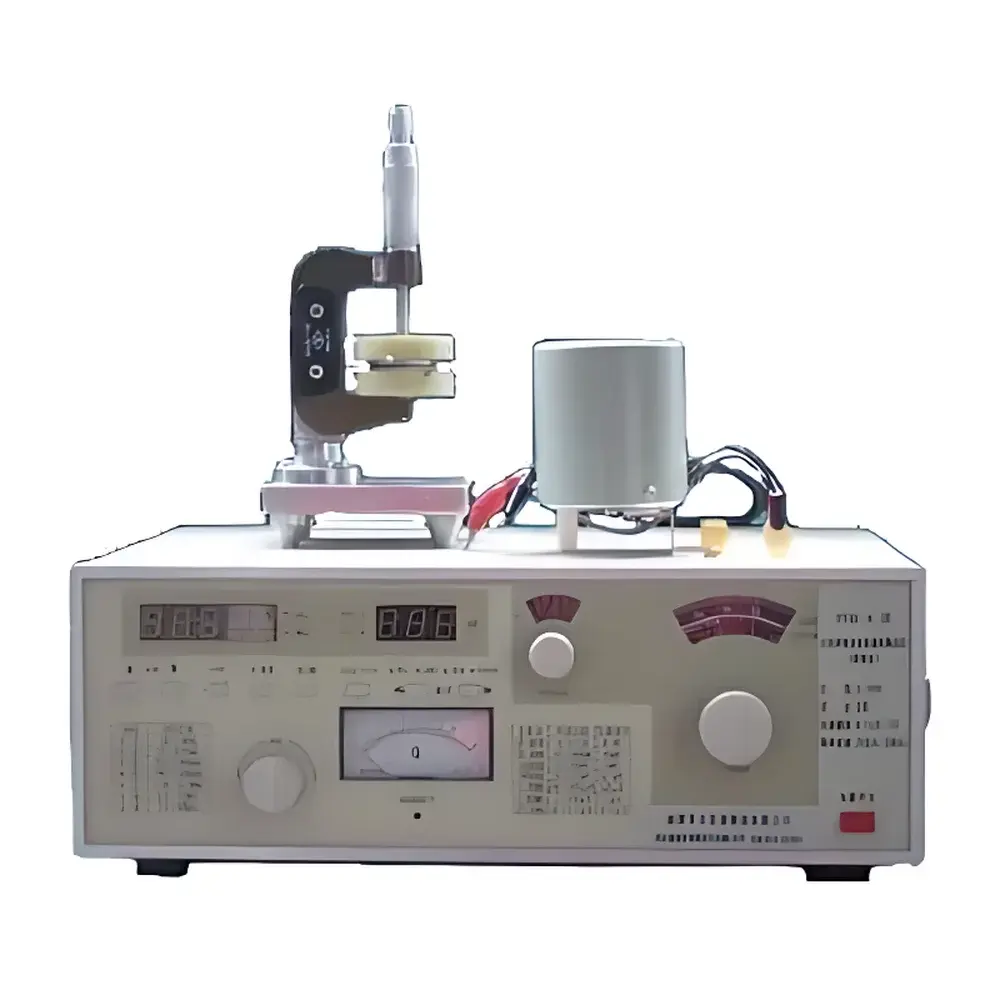
Beijing North Guang Precision Instruments GDAT-1 High-Frequency Q Meter for Dielectric Constant and Loss Tangent Measurement
| Brand | Beijing North Guang Precision Instruments |
|---|---|
| Origin | Beijing, China |
| Manufacturer Type | Original Equipment Manufacturer (OEM) |
| Country of Origin | China |
| Model | GDAT-1 |
| Pricing | Available upon request |
Overview
The Beijing North Guang Precision Instruments GDAT-1 High-Frequency Q Meter is a precision impedance measurement instrument engineered for the characterization of dielectric materials, passive RF components, and high-frequency resonant structures. It operates on the fundamental principle of series resonance, where the quality factor (Q) is derived from the ratio of resonant voltage across the reactive element to the applied excitation voltage — quantifying energy storage versus dissipation per oscillation cycle. This method enables direct, non-destructive evaluation of complex permittivity (εr) and loss tangent (tan δ) of solid and liquid dielectrics when used with standardized test fixtures (e.g., parallel-plate or coaxial cells), as well as accurate determination of inductance (L), capacitance (C), distributed capacitance (C0), and characteristic impedance of transmission lines. Designed for laboratory-grade reproducibility and industrial process verification, the GDAT-1 integrates digital synthesis, automatic resonance tracking, and real-time parameter computation — eliminating manual interpolation and minimizing operator-dependent error.
Key Features
- Digital Direct Synthesis (DDS) signal source delivering stable, low-distortion output across 10 kHz to 60 MHz (4 frequency bands: CH1–CH4), with frequency resolution down to 0.001 Hz and absolute accuracy of ±3×10⁻⁵ ±1 digit
- Automated resonance detection via dual search modes: frequency sweep (10 kHz–60 MHz) and capacitance sweep (40–500 pF), enabling rapid identification of fr, Ct, L, and Q without iterative tuning
- High-resolution digital display showing simultaneous readouts of Q value (2–1023), main tuning capacitance (4-digit, ±1.5 pF ≤150 pF; ±1% >150 pF), inductance (14.5 nH–8.14 H), frequency (6-digit), and operating status indicators
- Intelligent Q-range management with five fixed scales (30/100/300/1000) plus auto-ranging capability, ensuring optimal signal-to-noise ratio across wide dynamic ranges
- Embedded ATMega128 microcontroller for closed-loop amplitude stabilization, sensor-based capacitance sensing, stepper-motor-driven capacitor actuation, and full system coordination
- Q-pass/fail threshold preset function (adjustable 5–1000) with visual (OK/NO) and audible feedback — optimized for high-throughput QC screening in manufacturing environments
Sample Compatibility & Compliance
The GDAT-1 supports standardized dielectric measurements per ASTM D150, IEC 60250, and ISO 257, when paired with calibrated electrodes or fixture adapters compliant with IEEE Std 1757-2021. Its test interface accommodates both discrete components (inductors, capacitors, resonators) and bulk dielectric specimens using optional sample holders (not included). The instrument’s residual inductance (26 nH) and residual capacitance are factory-characterized and algorithmically compensated during Q and L calculations — satisfying traceability requirements under GLP and internal QA protocols. While not FDA 21 CFR Part 11–certified out-of-the-box, its data logging architecture (via RS232 or optional USB) permits integration into validated systems supporting audit trails and electronic signatures.
Software & Data Management
The GDAT-1 operates autonomously via front-panel controls and LCD interface; no host PC is required for core measurements. All operational parameters — including frequency setpoint, capacitance target, Q threshold, and auto/manual mode — are stored in non-volatile memory. For extended data handling, optional PC software (provided separately) enables ASCII export of time-stamped measurement sequences (Q, f, C, L), statistical analysis (mean, SD, Cp/Cpk), and report generation compatible with Microsoft Excel and LabVIEW. Raw analog outputs (frequency monitor, amplitude monitor) support oscilloscope-based waveform validation. Firmware updates are performed via serial interface using standard terminal emulation tools.
Applications
- Determination of relative permittivity (ε′) and dielectric loss factor (ε″) of polymer films, ceramics, composites, and insulating oils per ASTM D150-22 Section 11
- Quality control of RF chokes, baluns, and EMI filters through Q-value consistency checks at operational frequencies
- Characterization of magnetic core materials (ferrites, powdered iron) by measuring Q vs. frequency sweeps up to 60 MHz
- Verification of PCB substrate dielectric properties (e.g., FR-4, Rogers RO4000®) using microstrip or stripline fixtures
- Research on piezoelectric and ferroelectric materials where phase-resolved impedance analysis informs domain dynamics
- Calibration reference for secondary standards laboratories requiring traceable Q and C measurements in the VHF band
FAQ
What is the maximum measurable Q value, and how is accuracy maintained at high Q?
The GDAT-1 measures Q values from 2 to 1023. Accuracy is preserved via automatic gain control, harmonic rejection filtering, and dual-point Q calibration using NIST-traceable reference inductors (e.g., BQG-2). At Q > 300, measurement uncertainty remains within ±8% ±2% of full scale (10–60 MHz range).
Can the GDAT-1 measure dielectric constant of liquids?
Yes — when used with a temperature-controlled coaxial probe or guarded parallel-plate cell (sold separately), it calculates εr = Csample/Cvacuum and tan δ = 1/Q, provided electrode geometry and fringing corrections are applied per IEC 60250 Annex B.
Is firmware upgrade supported, and what interfaces are available?
Firmware updates are delivered via RS232 serial port using ASCII command protocol. No proprietary drivers are required; standard terminal software (e.g., PuTTY, Tera Term) suffices. USB-to-serial adapters are compatible.
How does the instrument handle distributed capacitance correction in inductor measurements?
The GDAT-1 implements two methods: natural frequency method (for precise C0 extraction) and double-frequency method (for rapid estimation). Both are documented in the user manual with step-by-step procedures and error propagation guidance.
What environmental conditions are required for metrological-grade measurements?
For compliance with ASTM D150 Annex A3, operate within 20 ±2°C ambient temperature, <50% RH, and stable 220 V ±10 V / 50 Hz ±1 Hz supply. Preheat for ≥30 minutes prior to calibration or critical measurements.



