
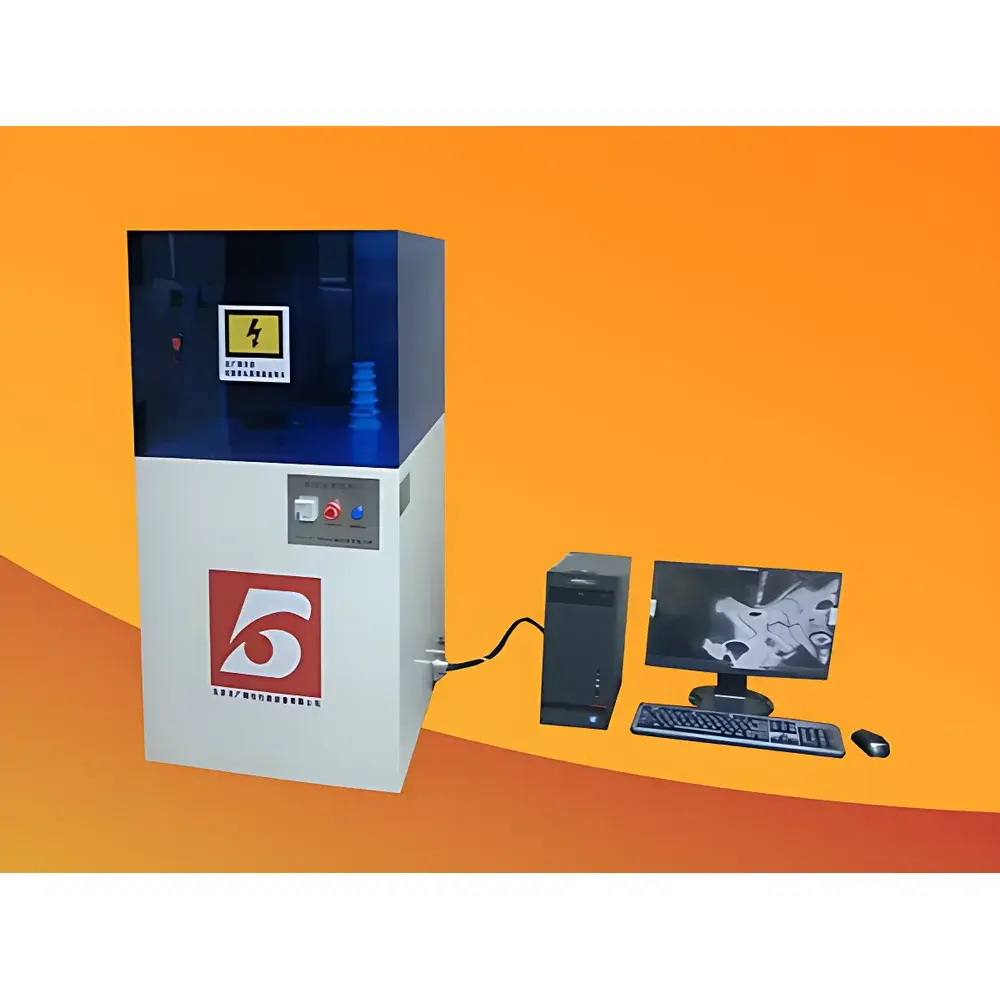
Beijing Guangjing Precision Instruments BJC-50000V Dielectric Breakdown Strength Tester for Rubber and Elastomeric Materials
| Brand | Beijing Guangjing Precision Instruments |
|---|---|
| Origin | Beijing, China |
| Manufacturer Type | Direct Manufacturer |
| Product Origin | Domestic (China) |
| Model | BJC-50000V |
| Output Voltage Range | AC/DC 0–50 kV |
| Power Rating | 3 kVA |
| Voltage Accuracy | ≤ ±1% |
| Rising Rate Adjustment | 0.1–5.0 kV/s |
| Test Modes | Ramp-up, Stepwise, and Hold-at-Voltage (with programmable duration up to 6 h) |
| Electrode Configurations | Two Φ25 mm × 25 mm flat electrodes |
| Compliance Standards | GB/T 1408.1–2006, GB/T 1695–2005, GB/T 3333–1999, HG/T 3330–2003, GB 12656–1990, ASTM D149–2022 |
| Protection Features | Overcurrent cutoff (<50 ms), overvoltage lockout, ground-fault detection, dual-level (hardware + software) alarm system |
| Data Acquisition | Real-time voltage/current logging (mA resolution), PC-based control and reporting |
Overview
The Beijing Guangjing BJC-50000V Dielectric Breakdown Strength Tester is a precision high-voltage test system engineered for quantitative evaluation of electrical insulation integrity in rubber compounds, elastomers, polymer sheets, and related dielectric materials. It operates on the principle of controlled voltage ramping across standardized electrode configurations until electrical breakdown occurs—defined as the irreversible loss of insulating capability under sustained electric stress. The instrument delivers both AC and DC output (0–50 kV) with traceable accuracy (≤ ±1%) and supports three fundamental test protocols: continuous ramp-up, stepwise incremental voltage application, and time-dependent dielectric strength holding (up to 6 hours). Its design adheres to internationally recognized dielectric testing methodologies, enabling reproducible measurement of dielectric strength (kV/mm) and comparative assessment of material formulation stability under electrical stress.
Key Features
- High-stability 50 kV dual-mode (AC/DC) high-voltage generation system with solid-state, contactless voltage regulation—eliminating mechanical wear and ensuring linear, jitter-free voltage rise.
- Integrated microprocessor-controlled stepping motor drive for precise, programmable voltage ramp rates (0.1–5.0 kV/s), fully compliant with ASTM D149 and GB/T 1408.1 test requirements.
- Dual-layer safety architecture: hardware-based overcurrent interruption (<50 ms response) combined with redundant software-monitored fault detection—including overvoltage, ground leakage, and arc initiation sensing.
- Standardized electrode set included per GB/T 1408.1–2006: two 25 mm diameter × 25 mm height brass electrodes and one 75 mm diameter × 25 mm height electrode—enabling consistent field geometry for thickness-normalized breakdown field calculation.
- Real-time data acquisition at millisecond resolution: simultaneous sampling of applied voltage (kV) and leakage current (mA), with timestamped export to CSV or XML for post-test statistical analysis.
- Full isolation enclosure with interlocked access door, grounded chassis, and <200 mm safe discharge clearance—designed to meet IEC 61010-1:2010 Class II laboratory safety requirements.
Sample Compatibility & Compliance
The BJC-50000V accommodates solid sheet, molded, or extruded rubber specimens (thickness range: 1–10 mm recommended) tested either in ambient air or transformer oil immersion—supporting both surface and bulk breakdown characterization. Electrode placement follows strict alignment tolerances defined in GB/T 1408.1 and ASTM D149 to minimize edge effects and ensure uniform field distribution. The system is validated for conformance with national and international standards including GB/T 1408.1–2006 (Electric Strength of Insulating Materials — Part 1: Tests at Power Frequencies), GB/T 1695–2005 (Determination of Dielectric Strength of Vulcanized Rubber), ASTM D149–2022 (Dielectric Breakdown Voltage of Solid Electrical Insulating Materials), and HG/T 3330–2003 (Rubber Insulating Gloves Testing Protocol). Calibration documentation includes traceable certification from CNAS-accredited metrology laboratories (e.g., Beijing Institute of Metrology), with optional user-specified third-party calibration reporting.
Software & Data Management
The proprietary Windows-based control software provides full test lifecycle management: parameter configuration (voltage mode, ramp rate, hold time, pass/fail thresholds), real-time waveform visualization, automated breakpoint detection, and ISO/IEC 17025-compliant report generation. All test sequences are logged with immutable audit trails—including operator ID, timestamp, environmental conditions (optional sensor integration), and raw acquisition metadata—ensuring compliance with GLP and GMP documentation requirements. Data export supports CSV, PDF, and XML formats compatible with LIMS integration. Software architecture incorporates role-based access control and electronic signature support aligned with FDA 21 CFR Part 11 Annex 11 principles for regulated environments.
Applications
This tester serves critical quality assurance and R&D functions across rubber compounding, cable insulation development, automotive sealing systems, aerospace elastomer qualification, and medical-grade polymer validation. Typical use cases include: comparative screening of carbon-black–filled vs. silica-filled EPDM formulations; aging studies evaluating ozone- or heat-induced degradation of dielectric performance; specification verification of silicone rubber gaskets for high-voltage switchgear; and regulatory submission testing for UL 94, IEC 60587, and GB/T 18380 compliance packages. Universities and national institutes—including Tsinghua University, Sichuan University, and the Chinese Academy of Sciences’ Lanzhou Institute of Chemical Physics—utilize the platform for fundamental research on charge transport mechanisms and partial discharge inception in heterogeneous elastomeric matrices.
FAQ
What voltage modes does the BJC-50000V support, and how is DC output achieved?
The instrument generates AC output natively; DC is derived via integrated high-voltage silicon stack rectification. A removable shorting rod in the HV tower determines mode: inserted for AC, withdrawn for pulsating DC. Front-panel selection only enables corresponding software alarms and display scaling.
Is the system suitable for testing thin elastomeric films (<1 mm thick)?
While optimized for 1–10 mm specimens per standard practice, custom electrode spacers and low-current sensitivity calibration (down to 10 µA) permit adapted testing of thinner samples—subject to pre-validation per ASTM D876 guidelines.
Does the software support automated pass/fail judgment against user-defined limits?
Yes. Thresholds for breakdown voltage, leakage current escalation rate, and time-to-failure can be configured per test sequence, triggering immediate halt and annotated result flagging.
Can test data be exported to external statistical analysis tools like JMP or Minitab?
All acquired waveforms and summary metrics export in standardized CSV format with column headers conforming to ASTM E1395 metadata conventions—ensuring direct import compatibility.
What maintenance is required to maintain voltage accuracy over time?
Annual recalibration against NIST-traceable reference dividers is recommended. The system includes self-diagnostic routines for HV transformer insulation resistance and grounding continuity verification—documented in the maintenance log module.
Related Products





