
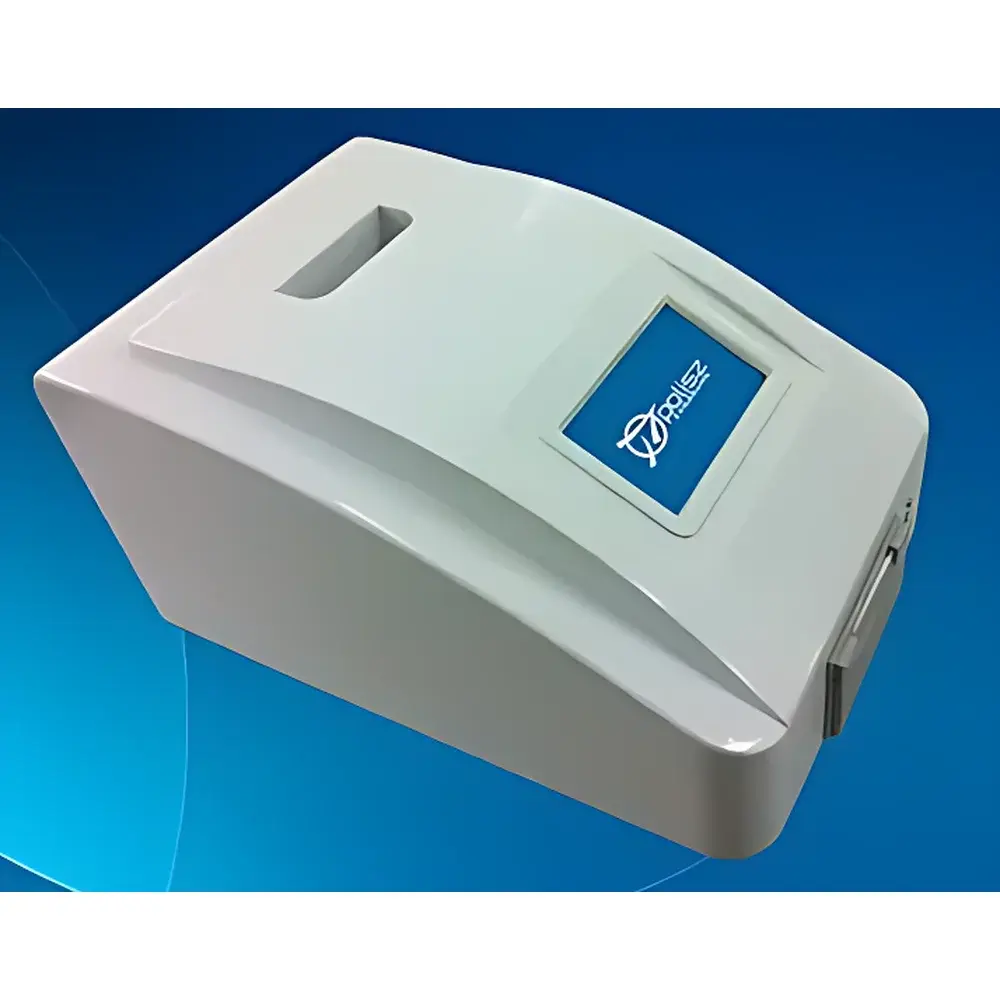
All Precision Instrument BC-40 Laboratory Total Organic Carbon (TOC) Analyzer
| Brand | All Precision Instrument |
|---|---|
| Origin | Beijing, China |
| Manufacturer Type | Manufacturer |
| Instrument Type | Laboratory TOC Analyzer |
| Model | BC-40 |
| Detection Principle | Membrane Conductivity Difference Method |
| Oxidation Method | UV Photolysis (185 nm) |
| Measurement Range | 0.001–1.5 mg/L |
| Accuracy | ±5% |
| Resolution | 0.001 mg/L |
| Detection Limit | 0.001 mg/L |
| Repeatability | ≤3% |
| Power Supply | AC 220 V ±22 V, 50 Hz ±1 Hz |
| Power Consumption | 95 W |
| Dimensions | 340 × 390 × 145 mm |
| Weight | 15 kg |
| Response Time | ≤6 min |
| Sample Temperature Range | 1–95 °C |
| Operating Environment | 10–40 °C, ≤85% RH |
Overview
The All Precision Instrument BC-40 Laboratory Total Organic Carbon (TOC) Analyzer is a dedicated, regulatory-compliant instrument engineered for precise quantification of organic carbon in ultrapure water systems. It operates on the fundamental principle of differential conductivity measurement following UV photolytic oxidation—a method widely recognized in pharmacopeial and industrial water quality standards. In this process, organic carbon compounds are oxidized to CO₂ under 185 nm ultraviolet irradiation in the presence of hydroxyl radicals (•OH), generated via photolysis of water. The resulting CO₂ dissolves to form carbonic acid, altering the solution’s electrical conductivity. By measuring conductivity before (representing inorganic carbon, IC) and after oxidation (representing total carbon, TC), the analyzer calculates TOC as the difference: TOC = TC − IC. This differential approach eliminates interference from inorganic carbon species—critical for high-purity water matrices where IC concentrations may fluctuate significantly. The BC-40 implements a dual-conductivity electrode configuration with dedicated flow paths for IC and TC measurement, ensuring robust baseline stability and minimizing carryover effects. Its design aligns with the core technical requirements outlined in the Chinese Pharmacopoeia (ChP) 2015 Edition, USP , and EP 2.2.44, particularly regarding system suitability, detection sensitivity (≤0.05 mg/L), and discrimination between organic and inorganic carbon forms.
Key Features
- UV photolysis oxidation at 185 nm—no chemical reagents, carrier gases, or consumable catalysts required, supporting low-maintenance operation and reduced operational cost.
- Integrated dual-conductivity detection architecture with dedicated electrodes for IC and TC measurement, enabling true differential TOC calculation without calibration drift compensation.
- Embedded ARM-based controller with 7-inch color capacitive touchscreen interface; supports intuitive workflow navigation, one-touch analysis initiation, and automated system rinse cycles.
- Modular service design: UV lamp and peristaltic pump tubing can be replaced without disassembling the main chassis—minimizing downtime and technician dependency.
- User-configurable TOC upper limit alarm with relay output signal for integration into facility monitoring or PLC-controlled water purification systems.
- Onboard data storage capacity supports ≥10,000 test records with timestamp, sample ID, operator ID, and full audit trail metadata.
- Compliant with IQ/OQ/PQ validation protocols; factory-supplied documentation includes traceable calibration certificates, system suitability test procedures, and electronic signature-ready reports.
Sample Compatibility & Compliance
The BC-40 is validated for use with low-conductivity aqueous samples (<10.0 µS/cm), including purified water (PW), water for injection (WFI), ultra-pure water (UPW), and deionized water (DIW). It meets ChP 2015 Appendix VIII R requirements for pharmaceutical water testing, specifically addressing the three mandatory criteria: (1) accurate TOC = TC − IC calculation, (2) successful system suitability testing (e.g., sucrose and 1,4-benzoquinone recovery within 85–115%), and (3) demonstrated detection sensitivity ≤0.05 mg/L. While not inherently 21 CFR Part 11 compliant out-of-the-box, its firmware architecture supports optional secure user authentication, electronic audit trails, and encrypted data export—enabling qualification under GMP/GLP environments when deployed with appropriate procedural controls. The analyzer is also suitable for clean-in-place (CIP) verification in biopharmaceutical manufacturing and semiconductor fab UPW loop monitoring.
Software & Data Management
The BC-40 runs proprietary embedded firmware with configurable data logging intervals (1–60 min), real-time trend visualization, and CSV-formatted export via USB port. All stored records include immutable timestamps, operator login credentials, system status flags (e.g., “Oxidation Active”, “Rinse Complete”), and raw conductivity values for both IC and TC channels. Optional PC software enables advanced report generation—including ChP-mandated system suitability summaries—and batch-level statistical analysis (mean, SD, %RSD). Data integrity safeguards include write-protected memory partitions, automatic checksum validation on power-up, and tamper-evident file headers. For regulated laboratories, the device supports integration with LIMS via RS-232 or Bluetooth 4.2 (BLE) interfaces, transmitting structured JSON payloads containing TOC result, QC flag status, and instrument health metrics.
Applications
- Pharmaceutical water systems: Routine offline TOC verification of PW, WFI, and steam condensate per ChP/USP/EP monographs.
- Cleanliness validation: Quantitative assessment of residual organics on equipment surfaces post-CIP, supporting risk-based validation strategies.
- Semiconductor manufacturing: Monitoring TOC breakthrough in UPW distribution loops and point-of-use sub-loops to prevent wafer defect mechanisms.
- Biotechnology process water: TOC trending during buffer preparation, media formulation, and final fill operations.
- Environmental compliance labs: Analysis of low-TOC surface waters and treated effluents where regulatory thresholds fall below 1 mg/L.
FAQ
Does the BC-40 require external gas supply or chemical oxidants?
No. It relies solely on 185 nm UV photolysis for oxidation and membrane conductivity detection—eliminating need for persulfate, ozone, or compressed air.
Can the BC-40 perform online monitoring?
Yes. It offers optional flow-cell integration for continuous inline measurement at sampling points up to 100 mL/min flow rate, with analog 4–20 mA output for SCADA linkage.
What is the recommended maintenance schedule?
UV lamp replacement every 12 months (or after 8,000 hours); pump tubing every 6 months under continuous operation; quarterly conductivity electrode calibration using certified KCl standards.
Is the BC-40 compatible with FDA 21 CFR Part 11 requirements?
Out-of-the-box functionality supports ALCOA+ data integrity principles. Full Part 11 compliance requires implementation of documented procedural controls, role-based access, and electronic signature workflows—available through optional software modules and validation support services.
How is system suitability verified?
Using ChP-recommended challenge solutions: 500 ppb sucrose (organic carbon recovery) and 500 ppb sodium bicarbonate (inorganic carbon recovery), both tested in triplicate with acceptance criteria of 85–115% recovery for each.
Related Products







