
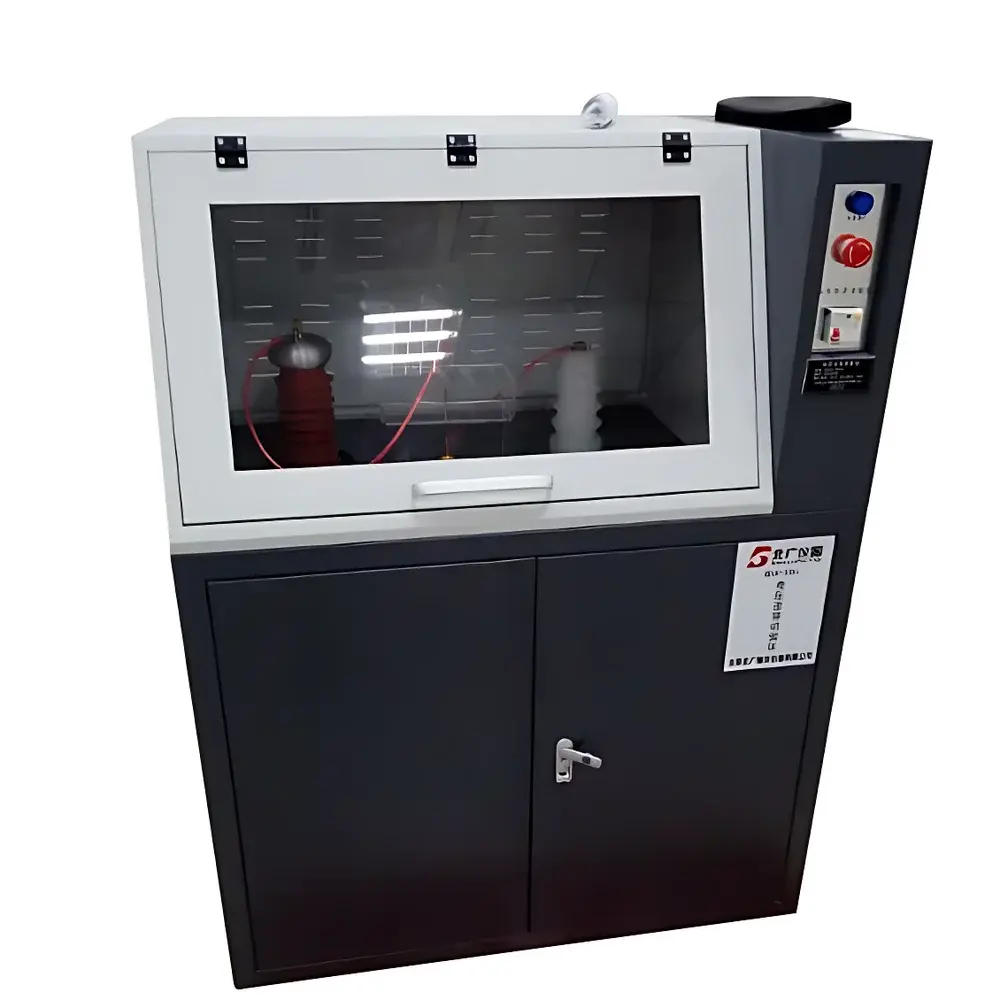
North Guang Precision BDJC Series Voltage Breakdown Tester – Safety-Engineered Dielectric Strength Testing System
| Brand | North Guang Precision Instrument |
|---|---|
| Origin | Beijing, China |
| Manufacturer Type | OEM Manufacturer |
| Model | BDJC-50KV |
| Rated Breakdown Voltage | 50 kV |
| Safety Protection Levels | 9-stage integrated safety architecture |
| Compliance Standards | GB/T 1408.1, ASTM D149, IEC 60243-1 |
| Test Medium Options | Air or insulating oil |
| Control System | PLC-based with PC interface |
| Voltage Accuracy | ≤1% of full scale |
| Ramp Rate Range | 10 V/s to 5 kV/s |
| Test Modes | AC / DC / stepwise / withstand |
| Electrode Configurations | 25 mm, 6 mm, and 75 mm diameter stainless steel electrodes |
| Power Rating | 3 kVA / 5 kVA / 10 kVA variants |
| Enclosure Dimensions (L×W×H) | 1000×600×1400 mm or 1700×600×1400 mm |
| Weight | 100 kg / 200 kg |
| Warranty | 3 years standard, lifetime technical support |
| Calibration & Certification | Available from CNAS-accredited institutes (e.g., No. 514 Institute, No. 304 Institute, China Academy of Sciences) |
Overview
The North Guang Precision BDJC Series Voltage Breakdown Tester is an industrial-grade dielectric strength testing system engineered for precise, repeatable, and inherently safe evaluation of electrical insulation performance under high-voltage stress. Operating on the principle of controlled voltage ramping—either AC or DC—the instrument measures the minimum voltage at which a solid or liquid insulating material undergoes catastrophic electrical breakdown, thereby determining its dielectric strength (kV/mm) and comparative electrical robustness. Designed in strict accordance with international test standards—including GB/T 1408.1 (China), ASTM D149 (USA), and IEC 60243-1 (IEC)—the BDJC-50KV variant delivers a maximum test voltage of 50 kV with ≤1% measurement accuracy, enabling reliable qualification of insulating materials used in power transmission components, aerospace composites, automotive wiring harnesses, medical device encapsulants, and high-reliability PCB substrates.
Key Features
- 9-level hierarchical safety architecture: interlocked enclosure door, grounding supervision, overvoltage cutoff, overcurrent limiting, leakage current detection, short-circuit protection, electromagnetic discharge monitoring, DC residual charge alarm, and automatic electro-mechanical discharge actuation.
- Fail-safe test chamber design: when the access door is open, the high-voltage transformer input is physically de-energized; for the BDJC-50KV model, minimum clearance between high-voltage electrode and chamber wall exceeds 250 mm—ensuring operator safety even during proximity exposure.
- Dedicated protective earth (PE) terminal: reduces electromagnetic interference (EMI) during breakdown events and prevents control system instability or computer lockup.
- Integrated DC discharge management: upon completion of DC tests, the system triggers an audible/visual alarm when the door is opened; alarm suppression requires manual activation of the electromagnet-driven discharge rod—enforcing mandatory residual charge dissipation prior to electrode handling.
- Modular high-voltage generation core: utilizes imported solid-state switching modules and precision feedback-controlled ramp circuitry to sustain stable voltage rise rates from 10 V/s to 5 kV/s across full output range.
- Multi-mode operation capability: supports AC sinusoidal, DC polarity-selectable, step-stress, and time-limited withstand protocols—all programmable via PLC logic with optional PC-based supervisory control.
Sample Compatibility & Compliance
The BDJC platform accommodates a broad spectrum of non-conductive specimens—including elastomeric polymers (e.g., silicone rubber, EPDM), thermoplastics (e.g., polyethylene, PTFE), ceramic substrates, glass insulators, varnish-coated windings, laminated composites, and dielectric fluids (e.g., transformer oil, silicone dielectric fluid). Sample thickness ranges from 0.1 mm to 25 mm depending on electrode configuration. All test procedures conform to the physical test conditions, specimen conditioning requirements, and reporting formats specified in GB/T 1408.1–2016, ASTM D149–22, and IEC 60243-1:2020. The system’s mechanical and electrical design supports GLP-compliant operation when paired with audit-trail-enabled software and calibrated traceable instrumentation.
Software & Data Management
While the base BDJC-50KV operates via embedded PLC logic with local HMI, optional Windows-compatible software enables real-time voltage/current waveform capture, automatic pass/fail classification per ASTM thresholds, statistical analysis of multiple breakdown events (Weibull distribution fitting), and export of CSV/PDF reports compliant with internal QA documentation requirements. The software architecture supports 21 CFR Part 11 readiness when deployed with user role assignment, electronic signature logging, and immutable audit trails—facilitating regulatory submissions for medical or aerospace applications. Data integrity is preserved through timestamped storage, checksum validation, and non-volatile memory backup.
Applications
This tester serves critical functions across R&D laboratories, quality assurance departments, and third-party certification bodies. Typical use cases include: qualification of new polymer formulations for high-voltage cable jacketing; verification of batch-to-batch consistency in insulating varnishes for motor windings; comparative dielectric screening of ceramic substrates in EV power modules; accelerated aging studies involving thermal-electrical stress coupling; and failure analysis of field-failed insulators where root cause must be correlated with intrinsic breakdown behavior rather than surface contamination alone.
FAQ
Is the BDJC-50KV suitable for testing liquid dielectrics such as transformer oil?
Yes—it supports both air-gap and oil-immersed test configurations using standardized brass or stainless-steel electrodes, per ASTM D877 and IEC 60156 methodologies.
What safety certifications does the unit carry?
The system meets CE marking requirements for low-voltage directive (2014/35/EU) and EMC directive (2014/30/EU); factory calibration certificates are issued by CNAS-accredited metrology institutes.
Can test parameters be locked to prevent unauthorized modification?
Yes—PLC firmware includes password-protected parameter sets and configurable operator privilege levels to enforce SOP adherence.
Does the system support automated electrode cleaning or environmental conditioning?
No—these are external processes; however, the instrument provides digital I/O interfaces for integration with humidity/temperature chambers and robotic sample handlers.
Is remote diagnostics supported?
Standard Ethernet port enables secure remote access for firmware updates and diagnostic log retrieval—subject to customer network security policies.



