
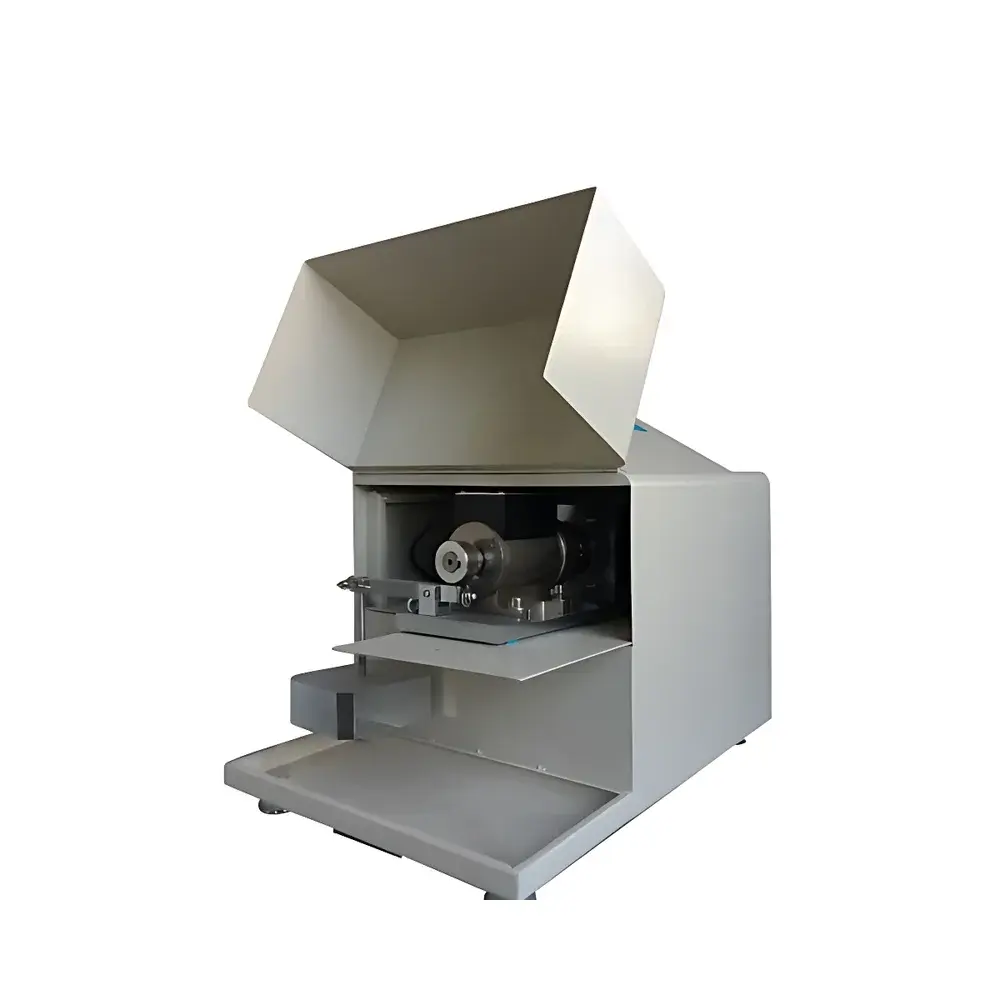
Beijing North Guang Precision Instruments M-200 GB3960 Compliant Sliding Friction and Wear Tester for Plastics and Elastomers
| Brand | Beijing North Guang Precision Instruments |
|---|---|
| Origin | Beijing, China |
| Manufacturer Type | Direct Manufacturer |
| Model | M-200 |
| Instrument Category | Coefficient of Friction Tester |
| Max. Normal Load | 196 N ±0.2% (expandable to 392 N) |
| Friction Torque Range | 0–4 N·m ±0.5% |
| Max. Test Temperature | 40 °C |
| Specimen Dimensions | 30 mm × 7 mm × 6 mm ±0.1 mm |
| Rotational Speed | 0–500 rpm (continuous, stepless adjustment) |
| Torque Sensor Accuracy | ±1% FS |
| Load Accuracy | ±0.5% |
| Speed Accuracy | ±1% |
| Timer Range | 1 s – 9999 min |
| Rotation Counter Range | 1–999999 rev |
| Friction Ring Dimensions | Ø40 mm × 10 mm, 0.5×45° chamfer, concentricity <0.01 mm |
Overview
The Beijing North Guang M-200 Sliding Friction and Wear Tester is a precision-engineered tribological instrument designed in strict compliance with GB/T 3960–2016, the Chinese national standard for determining the coefficient of friction and wear rate of plastics and elastomeric materials under dry sliding conditions. It operates on the principle of controlled reciprocating or unidirectional sliding contact between a stationary flat specimen and a rotating annular counterface—typically hardened steel—under precisely regulated normal load, rotational speed, and environmental temperature. The system employs high-stability torque transduction and real-time digital signal acquisition via a 16-bit microcontroller-based control architecture, enabling repeatable quantification of frictional force, dynamic coefficient of friction (μ), and volumetric wear loss. Its mechanical rigidity, low thermal drift, and integrated load calibration routine ensure metrological consistency across long-duration tests (up to 9999 minutes), making it suitable for comparative material screening, formulation development, and quality assurance in polymer R&D and production environments.
Key Features
- GB/T 3960–2016–compliant test configuration with standardized specimen geometry (30 mm × 7 mm × 6 mm) and friction ring (Ø40 mm × 10 mm, concentricity <0.01 mm)
- Stepless rotational speed control from 0 to 500 rpm, with preset selectable speeds (e.g., 200 rpm and 400 rpm) for method reproducibility
- Adjustable normal load up to 196 N (±0.2%), expandable to 392 N using modular weight stacks (4 kg + four 1 kg weights)
- High-resolution torque measurement (0–4 N·m, ±0.5% accuracy) via calibrated strain-gauge sensor with full-scale linearity verification
- Integrated timer and revolution counter (1 s–9999 min; 1–999999 rev) with automatic test termination and data freeze upon completion
- Rigid cast-iron frame (≈45 kg total mass) minimizing vibration coupling and ensuring mechanical stability during high-load operation
- Real-time display of time–torque, time–coefficient of friction, and time–wear depth curves via dedicated HX software suite
Sample Compatibility & Compliance
The M-200 is validated for testing thermoplastics (e.g., POM, PA6, PTFE), thermosets (e.g., phenolic, epoxy composites), elastomers (e.g., natural rubber, SBR), and filled polymer systems. Specimens must be machined to dimensional tolerances per GB/T 3960 (±0.1 mm). The instrument supports both ASTM D3702 (for plastic bearing materials) and ISO 8295 (plastics—determination of coefficient of friction) test protocols when configured with appropriate fixtures and calibration certificates. All load cells and torque sensors are traceable to national standards (CNAS-accredited calibration reports available upon request). The system meets basic GLP documentation requirements, including audit-trail-capable test logs, operator ID tagging, and timestamped raw data export (CSV, TXT).
Software & Data Management
The proprietary HX Control & Analysis Software runs on Windows-based host PCs and provides synchronized acquisition of torque, rotational speed, elapsed time, and cycle count at ≥10 Hz sampling rate. It enables user-defined test profiles (ramp-up, dwell, step-load), real-time curve overlay, and post-test calculation of average μ, wear volume (mm³), specific wear rate (mm³/N·m), and friction energy dissipation. Data files include embedded metadata (operator, date, specimen ID, load/speed settings) and support export to Excel-compatible formats for statistical analysis (e.g., ANOVA, Weibull fitting). Software validation documentation (IQ/OQ templates) is provided for regulated labs operating under ISO/IEC 17025 or internal QA frameworks.
Applications
- Evaluation of anti-wear additives in engineering plastics for automotive bushings and gears
- Comparative ranking of UHMWPE, PEEK, and PTFE composites in orthopedic implant tribology studies
- Quality control of rubber seals and gaskets subjected to cyclic sliding in sealing applications
- Screening of lubricant-infused polymer formulations for low-friction bearing surfaces
- Accelerated wear life prediction under constant-load, variable-speed conditions per ASTM G99 guidelines
- Supporting failure analysis of plastic components exhibiting premature surface scuffing or transfer film formation
FAQ
Does the M-200 comply with international standards beyond GB/T 3960?
Yes—it accommodates ASTM D3702, ISO 8295, and ISO 20808 test configurations with minor fixture adaptations. Calibration certificates reference JJG 391–2019 (China) and are cross-traceable to NIST SRMs.
Can the system operate above 40 °C?
No—the current design limits ambient test chamber temperature to 40 °C. For elevated-temperature tribology, supplementary environmental enclosures (not included) must be integrated externally.
Is the torque sensor field-replaceable and recalibratable?
Yes—sensor modules are plug-and-play with factory-installed calibration coefficients stored in EEPROM. On-site recalibration requires certified deadweight kits and HX diagnostic firmware.
What data security features does the software provide for regulated environments?
The software supports password-protected user roles, electronic signatures, and immutable audit trails compliant with FDA 21 CFR Part 11 Annex 11 principles when deployed on validated IT infrastructure.
Are custom specimen holders or non-standard friction rings available?
Yes—Beijing North Guang offers OEM mechanical customization (e.g., ball-on-disk, pin-on-plate variants) under NRE agreement, subject to structural integrity review and recalibration.



