
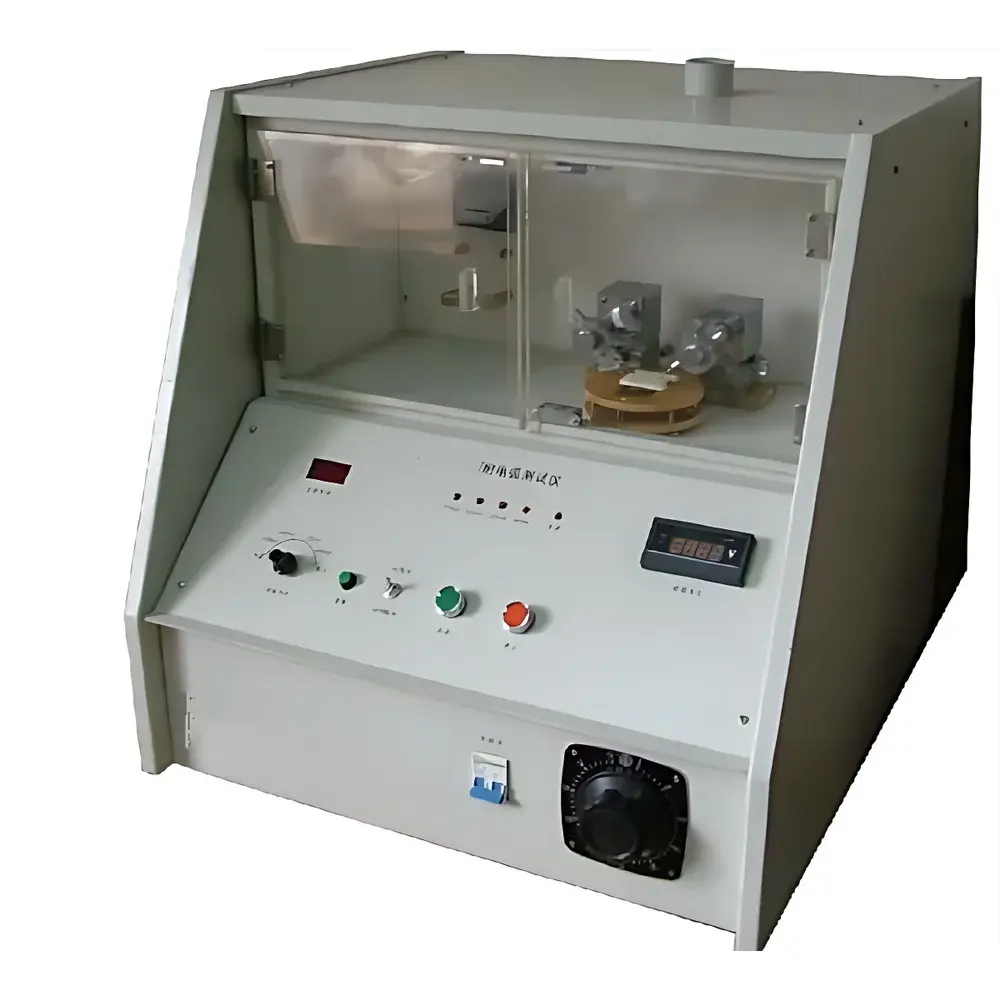
Beiguang Jingyi BDH-20kV Fully Automated Intelligent Arc Resistance Tester
| Brand | Beiguang Jingyi / All Precision Instrument |
|---|---|
| Origin | Beijing, China |
| Manufacturer Type | Manufacturer |
| Country of Origin | China |
| Model | BDH-20kV |
| Pricing | Upon Request |
Overview
The Beiguang Jingyi BDH-20kV Fully Automated Intelligent Arc Resistance Tester is an advanced physical property testing instrument engineered for precise evaluation of arc resistance—defined as the ability of insulating materials to withstand high-voltage surface discharges without forming conductive carbonized tracks. Based on the principle of controlled intermittent or continuous electric arcing between tungsten-carbide or platinum electrodes under standardized pressure and geometry, the system quantifies material degradation through measurable parameters including tracking index, erosion depth, char length, and time-to-failure under defined current steps (10–40 mA). Designed in strict compliance with GB/T 1411–2002 (equivalent to IEC 61621 and ASTM D495), the instrument delivers traceable, reproducible results essential for quality assurance in electrical insulation R&D, component qualification, and regulatory submission workflows across polymer, ceramic, composite, and elastomeric material sectors.
Key Features
- Fully automated PC-controlled architecture featuring a proprietary Siemens-based embedded CPU unit for real-time closed-loop voltage regulation and current acquisition at millisecond resolution.
- High-fidelity voltage control: 0–20 kV AC output with ≤1% accuracy; continuously adjustable ramp rate (0–50 kV/s) via contactless solid-state stepping technology—eliminating mechanical variac drift and hysteresis.
- Real-time mA-level leakage current sampling at up to 3 MB/s data throughput via USB 2.0 interface—enabling synchronized waveform capture and dynamic arc event logging.
- Dual-layer safety architecture: hardware-triggered cut-off (<50 ms response) combined with software-enforced interlocks—including overvoltage, overcurrent, short-circuit, door-open, zero-voltage reset, grounding fault, and post-test discharge protection.
- Modular electrode system supporting interchangeable configurations: stainless steel plate electrodes (25.4 × 12.7 × 0.15 mm), tungsten carbide rods (Ø2.4 × 70 mm, 110° included angle), and platinum tips—ensuring material-specific test repeatability per standard requirements.
- Stainless steel (SUS304) enclosure with EMI-shielded internal layout, rated for 1.5 kVA load capacity and stable operation under ±10% input voltage fluctuation (optional voltage stabilizer available for ±30% tolerance).
Sample Compatibility & Compliance
The BDH-20kV accommodates rigid and semi-rigid dielectric specimens—including thermoplastics, thermosets, laminates, ceramics, glass, mica sheets, paperboard, insulating varnishes, and transformer oils—within standardized thickness and surface flatness tolerances. Test protocols conform to GB/T 1411–2002 (identical technical content to IEC 61621:1997 and ASTM D495–18), supporting both Method A (intermittent arc) and Method B (continuous arc) sequences. The system meets fundamental electrical safety requirements for laboratory instrumentation per IEC 61010-1 and supports audit-ready documentation for GLP and ISO/IEC 17025-accredited laboratories. Optional calibration certification is available from nationally accredited metrology institutes (e.g., CNAS-accredited labs) or customer-designated third-party providers.
Software & Data Management
The proprietary Windows-based control software provides full experimental lifecycle management: user role assignment with password-protected access levels, parameter configuration (arc current step selection, dwell time, voltage ramp profile, trip thresholds), live curve plotting (voltage vs. time, current vs. time), and automated pass/fail classification per standard-defined criteria. All raw and processed data—including timestamps, operator ID, environmental metadata, and digital signatures—are stored in encrypted binary format with optional export to CSV, PDF, or XML. The system supports multi-sample comparative analysis with up to five overlayable color-coded curves, statistical summary generation (mean, SD, min/max), and customizable report templates compliant with internal QA templates or external regulatory submissions (e.g., FDA 21 CFR Part 11–ready when deployed with validated electronic signature modules).
Applications
This instrument serves critical functions in materials development labs, quality control departments, and third-party testing facilities engaged in: formulation optimization of flame-retardant polymers; validation of insulating coatings for high-voltage connectors; qualification of PCB substrate materials (e.g., FR-4, polyimide); assessment of ceramic insulator performance in switchgear; verification of transformer oil aging resistance; and compliance testing for UL 746A, IEC 60695-2-10, and GB/T 5169.11 standards. Its high temporal resolution and deterministic control make it suitable for failure mechanism studies—including tracking initiation kinetics, carbonization propagation rates, and thermal runaway onset thresholds—supporting root-cause analysis in field-failure investigations.
FAQ
What standards does the BDH-20kV comply with?
It fully implements GB/T 1411–2002, which is technically aligned with IEC 61621 and ASTM D495. Optional firmware updates may extend support to IEC 60695-2-10 and UL 746A upon customer request.
Can the system operate remotely or with human-machine separation?
Yes—via secure USB, RS-232, or Bluetooth 5.0 wireless interface; remote operation mode enables full control and monitoring from isolated locations while maintaining data integrity and audit trail continuity.
Is calibration documentation provided with delivery?
A factory calibration report is included. National-level metrological certification (e.g., CNAS or customer-specified lab) is available as an optional service prior to shipment.
What electrode materials are supplied as standard?
Tungsten carbide rod electrodes (Ø2.4 mm × 70 mm) and stainless steel plate electrodes are standard; platinum electrodes and custom geometries are available on request.
How is data integrity ensured during long-duration tests?
All measurements are timestamped and logged to non-volatile memory with cyclic redundancy check (CRC) validation; automatic backup occurs at configurable intervals, and power-loss recovery resumes from last valid checkpoint.



