
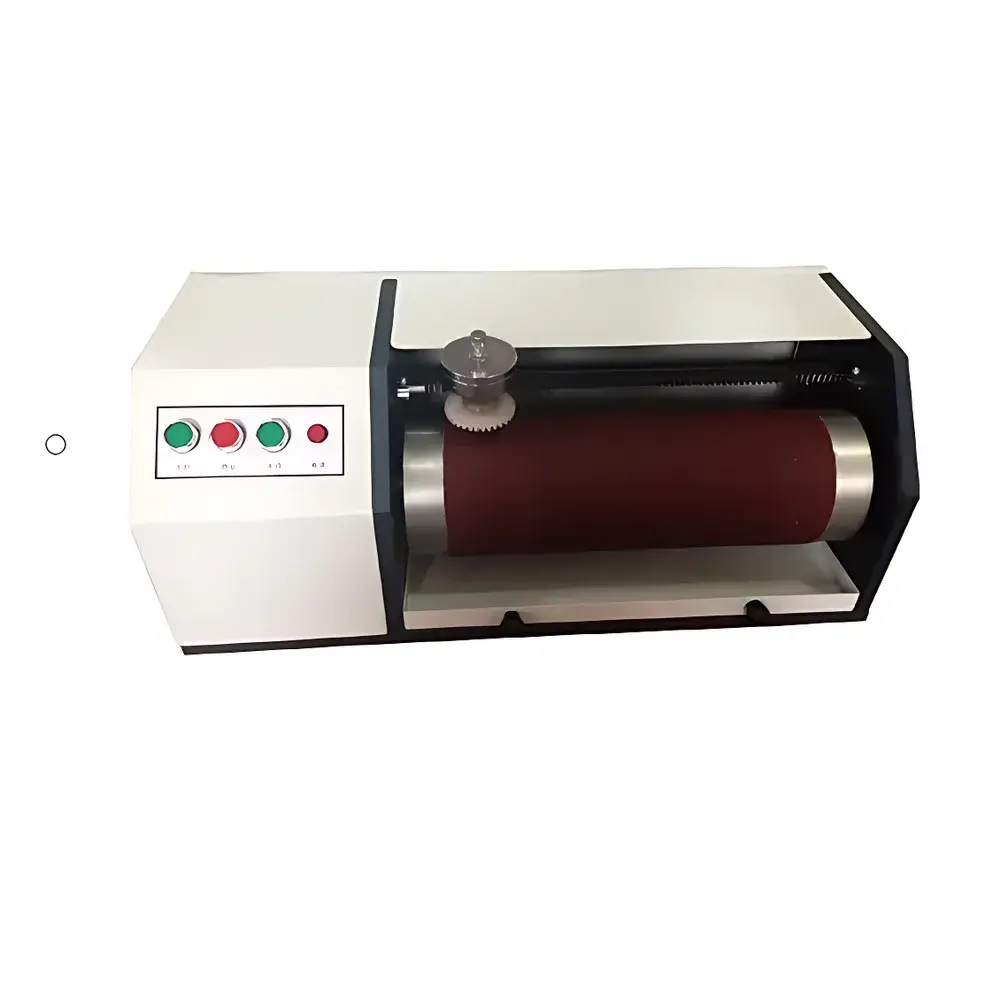
North Guang Precision Instrument BG-8121 Rotary Drum Abrasion Tester for Vulcanized Rubber
| Key | Brand: North Guang Precision Instrument |
|---|---|
| Model | BG-8121 |
| Drum Diameter | 150 ± 0.2 mm |
| Drum Length | 460 mm |
| Drum Speed | 40 ± 1 rpm |
| Specimen Dimensions | Ø16 ± 0.2 mm × ≥6 mm thick |
| Traverse Speed | 4.2 ± 0.06 mm/rev |
| Abrasion Travel | 20 m or 40 m |
| Specimen Load Options | 2.5 N (dead weight), 5–20 N (adjustable in 2.5 N increments) |
| Power Supply | AC 220 V, 50 Hz |
| Motor Speed | 3000 rpm |
| Compliance | GB/T 9867–1988, ISO 4649:2006, DIN 53516:1987 |
Overview
The North Guang Precision Instrument BG-8121 Rotary Drum Abrasion Tester is an engineered precision instrument designed to quantify the wear resistance of vulcanized rubber and thermoplastic elastomers under standardized rolling contact conditions. It operates on the principle of controlled abrasive interaction between a cylindrical test specimen and a rotating drum wrapped with calibrated abrasive cloth (typically grade P100 or equivalent). The specimen is mounted in a cantilevered holder and traverses axially across the drum surface at a fixed linear speed while subjected to a precisely defined normal load. Wear is quantified gravimetrically: mass loss is measured before and after abrasion, then converted to volume loss using the material’s known density. Results are reported either as absolute volume loss (mm³) or—more commonly—as relative abrasion resistance, normalized against a reference standard rubber (e.g., IRB No. 6) tested under identical conditions. This method ensures inter-laboratory reproducibility and enables comparative ranking of compound formulations for industrial quality control and R&D.
Key Features
- High-precision machined steel drum (Ø150 ± 0.2 mm × 460 mm length) with hardened, ground surface for dimensional stability and rotational uniformity.
- Adjustable vertical loading system offering discrete weights: 2.5 N (inherent dead load), plus user-selectable loads of 5 N, 7.5 N, 10 N, 12.5 N, 15 N, 17.5 N, and 20 N—enabling systematic load-dependent wear profiling per ISO 4649 Annex A.
- Motor-driven traverse mechanism with gear-and-rack actuation, delivering consistent axial motion at 4.2 ± 0.06 mm per drum revolution—critical for maintaining constant track overlap and eliminating edge effects.
- Dual-travel capability: programmable total abrasion distances of either 20 m or 40 m, selectable via mechanical stop or timer-based termination.
- Integrated dust collection chamber with sealed filtration interface, minimizing airborne particulate dispersion and ensuring operator safety and environmental compliance.
- Rigid welded steel base frame with vibration-damping feet, providing mechanical stability during prolonged operation at 40 rpm.
- Compliance-ready mechanical design—no software dependency required for core test execution—facilitating auditability under GLP and GMP environments where firmware validation is constrained.
Sample Compatibility & Compliance
The BG-8121 accommodates cylindrical specimens conforming to ISO 4649 and GB/T 9867 requirements: diameter 16.0 ± 0.2 mm, minimum thickness 6 mm, with parallel end faces and surface roughness ≤3.2 µm Ra. Specimens must be cured per applicable compound specifications and conditioned at 23 ± 2 °C and 50 ± 5 % RH for ≥16 h prior to testing. The instrument fully satisfies the mechanical and procedural requirements of GB/T 9867–1988 (identical to ISO 4649:1999), ISO 4649:2006 (Rubber, vulcanized or thermoplastic — Determination of abrasion resistance using a rotary drum device), and DIN 53516:1987 (Testing of raw rubber and elastomers — Determination of abrasion). Its physical construction—including drum geometry, speed tolerance, load accuracy, and traverse fidelity—has been validated against these standards’ metrological clauses. While not a digital data-logging platform, its mechanical repeatability supports traceable calibration per ISO/IEC 17025 when paired with certified analytical balances and calibrated load masses.
Software & Data Management
The BG-8121 is a fully mechanical, analog-operated tester with no embedded microprocessor, touchscreen, or proprietary software. All operational parameters—drum rotation, traverse feed, load application, and cycle termination—are governed by precision gears, calibrated springs, and mechanical limit switches. This architecture eliminates firmware dependencies, cybersecurity concerns, and software validation overhead—making it suitable for regulated laboratories operating under FDA 21 CFR Part 11 Annex 11 or EU GMP Annex 11 where legacy mechanical instrumentation is explicitly permitted for endpoint-critical physical tests. Data acquisition is manual: users record start/end times, initial/final specimen mass (using Class I or II analytical balances per OIML R76), ambient temperature/humidity, and applied load. Completed test records may be entered into LIMS or ELN systems following internal SOPs. Optional accessories—including certified calibration weights, traceable mass standards, and NIST-traceable micrometers—support full metrological traceability.
Applications
The BG-8121 serves critical roles across rubber compounding, tire manufacturing, conveyor belt development, footwear sole formulation, and automotive NVH component qualification. It is routinely deployed to: compare carbon black/silica filler efficiency in tread compounds; evaluate antioxidant and wax package performance under dynamic shear; assess the effect of polymer architecture (e.g., BR vs. SBR vs. EPDM) on abrasive wear kinetics; validate production lot consistency against master batch specifications; and support failure analysis of field-failed components exhibiting premature wear. In academic research, it enables structure–property correlation studies linking crosslink density (measured via swelling or DSC), filler dispersion (via TEM or XRD), and macroscopic abrasion resistance. Its robust, deterministic operation makes it especially valuable in high-volume QC labs where uptime, operator training simplicity, and long-term calibration stability outweigh the benefits of automated data capture.
FAQ
What standards does the BG-8121 directly comply with?
It meets all mechanical and procedural requirements of GB/T 9867–1988, ISO 4649:2006, and DIN 53516:1987 for rotary drum abrasion testing.
Is electrical or pneumatic automation available?
No—the BG-8121 is a purely electromechanical system. Drum drive, traverse motion, and load application rely on AC induction motor, gear trains, and calibrated dead weights.
Can the instrument be used for non-rubber materials?
It is validated only for vulcanized rubber and thermoplastic elastomers. Use with plastics, composites, or coated substrates requires method adaptation and independent verification of specimen geometry retention and wear mechanism relevance.
What maintenance is required to ensure long-term accuracy?
Monthly inspection of drum surface finish, gear train lubrication, traverse rack cleanliness, and load weight calibration; annual verification of drum concentricity and rotational speed with a certified tachometer.
Does the system include abrasive cloth or specimen preparation tools?
No—abrasive cloth (P100-grade woven cotton), specimen cutting dies (e.g., Ø16 mm cylindrical cutters), and conditioning ovens must be sourced separately per laboratory SOPs.





