
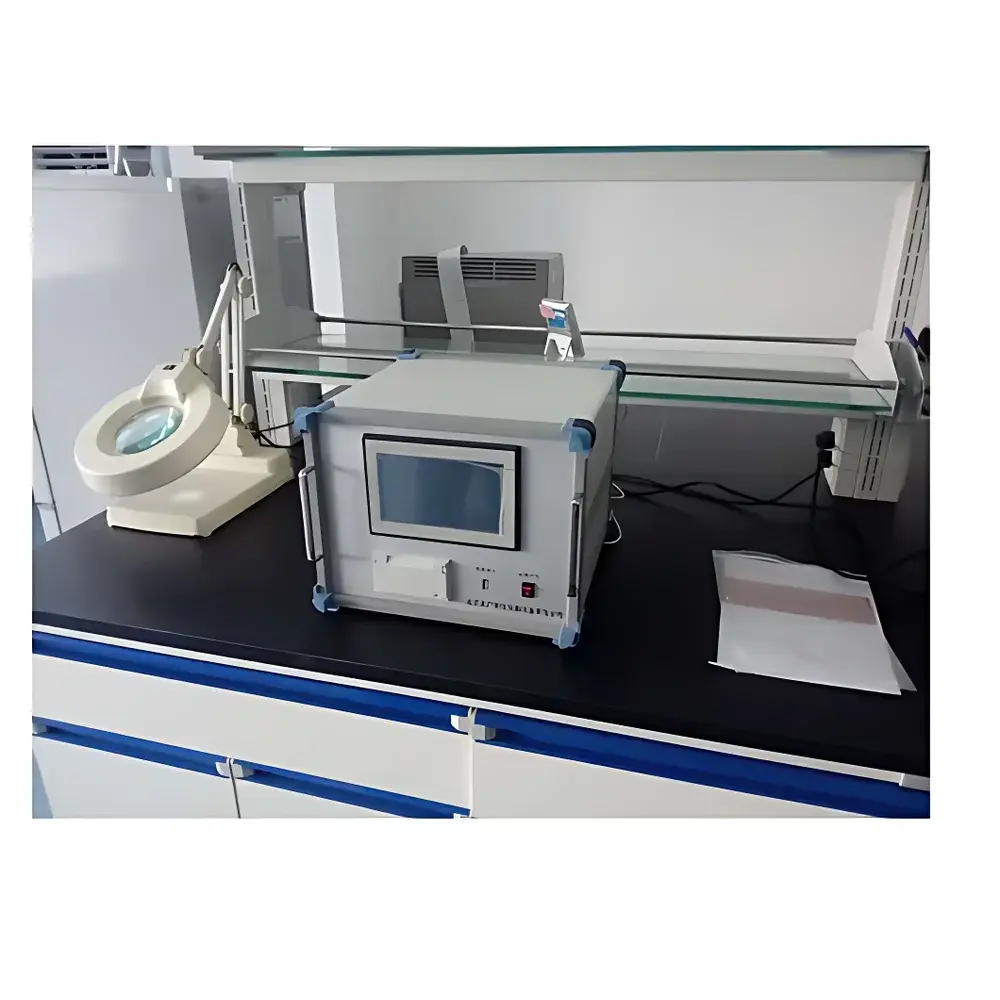
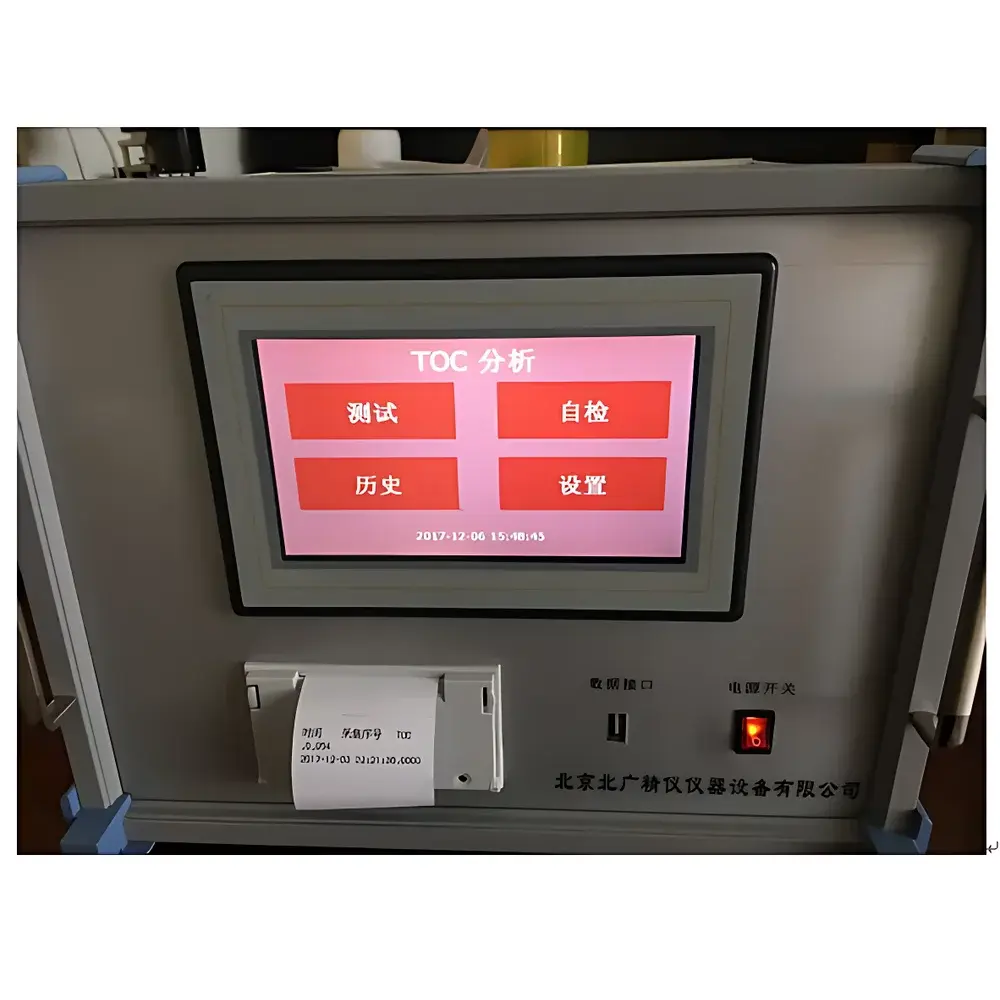
All Precision Instrument BC-40A Portable Total Organic Carbon (TOC) Analyzer
| Brand | All Precision Instrument |
|---|---|
| Origin | Beijing, China |
| Manufacturer Type | Direct Manufacturer |
| Instrument Type | Portable TOC Analyzer |
| Detection Principle | Membrane Conductivity Differential Method |
| Oxidation Method | UV/Persulfate Oxidation |
| Measurement Range | 0.001–1.0 mg/L (customizable up to 1000 mg/L via sensor configuration) |
| Accuracy | ±4% |
| Resolution | 0.001 mg/L |
| Detection Limit | 0.001 mg/L |
| Repeatability | ≤3% |
| Sample Temperature Range | 1–95 °C |
| Analysis Time | <4 minutes per sample |
| Display | 640×480 color touchscreen |
| Data Storage | 6-month history (≥10,000 records) |
| Interface | RS232 |
| Compliance | Chinese Pharmacopoeia 2010 Edition, Appendix VIII R |
Overview
The All Precision Instrument BC-40A Portable Total Organic Carbon (TOC) Analyzer is a laboratory- and field-deployable instrument engineered for precise quantification of organic carbon content in ultrapure water systems. It operates on the fundamental principle of differential conductivity measurement following complete oxidation of organic compounds to CO₂. The system employs dual-stage analysis: first measuring total inorganic carbon (TIC) in the native sample, then oxidizing all organic carbon to CO₂ using synchronized UV irradiation (185/254 nm) and sodium persulfate catalysis under controlled acidic conditions, followed by conductivity-based detection of the resulting CO₂-derived carbonate species. This TC–TIC subtraction methodology strictly adheres to pharmacopeial requirements (e.g., Chinese Pharmacopoeia 2010, Appendix VIII R; USP ; EP 2.2.44), ensuring regulatory traceability for GMP-compliant water quality verification. Designed for operation across 1–95 °C, the BC-40A maintains analytical integrity in both cold purified water loops and thermally stabilized injection water distribution systems.
Key Features
- True portable architecture with integrated power supply (220 V AC), enabling direct deployment at sampling points without external gas cylinders, reagent reservoirs, or compressed air sources.
- UV lamp and peristaltic pump tubing accessible without disassembly—no tools required—reducing scheduled maintenance downtime and technician dependency.
- Embedded high-performance CPU with 640×480 true-color touchscreen interface supporting one-touch method execution, automated rinse cycles, and real-time system diagnostics.
- User-configurable upper concentration limit with programmable alarm output (dry contact relay) for out-of-specification event notification and integration into facility SCADA or BMS systems.
- No consumable gases or liquid oxidants beyond standard-grade sodium persulfate solution; membrane conductivity sensor exhibits long-term stability with minimal drift (<0.5% per 30 days under routine calibration).
- Compliance-ready firmware architecture supporting IQ/OQ/PQ documentation packages aligned with FDA 21 CFR Part 11 data integrity expectations (audit trail, electronic signature support, user role management).
Sample Compatibility & Compliance
The BC-40A is validated for use with pharmaceutical-grade water matrices including Purified Water (PW), Water for Injection (WFI), and Ultrapure Water (UPW) per ISO 8573-1 Class 1 particulate and conductivity specifications. Its low detection limit (0.001 mg/L) and sub-3% repeatability meet the sensitivity threshold mandated by global pharmacopeias for cleanroom utility monitoring and cleaning validation. The instrument conforms to Chinese National Standard GB/T 5750.7–2006 for drinking water TOC testing and supports GLP/GMP-aligned workflows through configurable audit trails, password-protected method editing, and tamper-evident raw data export (CSV/Excel). All wetted materials—including flow path tubing, reaction chamber, and conductivity cell—are constructed from pharmaceutical-grade PFA and quartz to prevent extractables and ensure compatibility with aggressive oxidant chemistries.
Software & Data Management
Data acquisition and reporting are managed via an embedded Linux-based operating system with local storage capacity exceeding 10,000 test records (timestamped, operator-ID tagged, and method-version logged). Historical datasets are retrievable via USB export or RS232 serial transmission to LIMS or centralized QA databases. The onboard software provides automated system suitability testing (SST) per pharmacopeial protocols—including sucrose and 1,4-benzoquinone challenge tests—with pass/fail flagging and deviation logging. Calibration curves are stored with metadata (date, analyst, standard lot number), and all modifications to calibration parameters trigger immutable audit entries. Optional PC-based desktop software enables advanced trend analysis, SPC charting (X-bar/R), and automated report generation compliant with ALCOA+ principles.
Applications
- Pharmaceutical manufacturing: Continuous monitoring of PW/WFI loops during production campaigns and post-sanitization verification.
- Cleaning validation: Quantitative assessment of organic residue carryover on stainless-steel process equipment and single-use systems.
- Biotechnology facilities: Feedwater qualification for chromatography skids and cell culture media preparation systems.
- Electronics-grade water plants: Monitoring TOC excursions in UPW distribution networks serving semiconductor wafer fabrication lines.
- Environmental laboratories: Regulatory compliance testing of treated effluent and source water per EPA Method 415.3 and ISO 8245.
- Food & beverage R&D: Verification of rinse water purity in aseptic filling environments and CIP validation.
FAQ
Does the BC-40A require carrier gas or external oxidant delivery systems?
No. It operates exclusively on ambient air and pre-measured sodium persulfate solution—eliminating gas cylinder logistics and high-pressure plumbing.
Can the instrument be integrated into a plant’s DCS or MES?
Yes. Its RS232 interface supports Modbus RTU protocol for seamless read-only data streaming and alarm status polling.
Is method validation support available for FDA or EMA submissions?
Yes. All Precision Instrument provides full IQ/OQ/PQ documentation templates, URS alignment services, and on-site protocol execution support.
What is the recommended calibration frequency under GMP conditions?
Daily system suitability testing is required; full multi-point calibration is recommended weekly or after maintenance—per internal SOPs aligned with USP Analytical Instrument Qualification.
How is sensor fouling mitigated during high-particulate or high-silica water analysis?
The integrated automatic rinse cycle (programmable duration and frequency) uses deionized water to flush the conductivity cell between analyses, minimizing deposition artifacts.







