
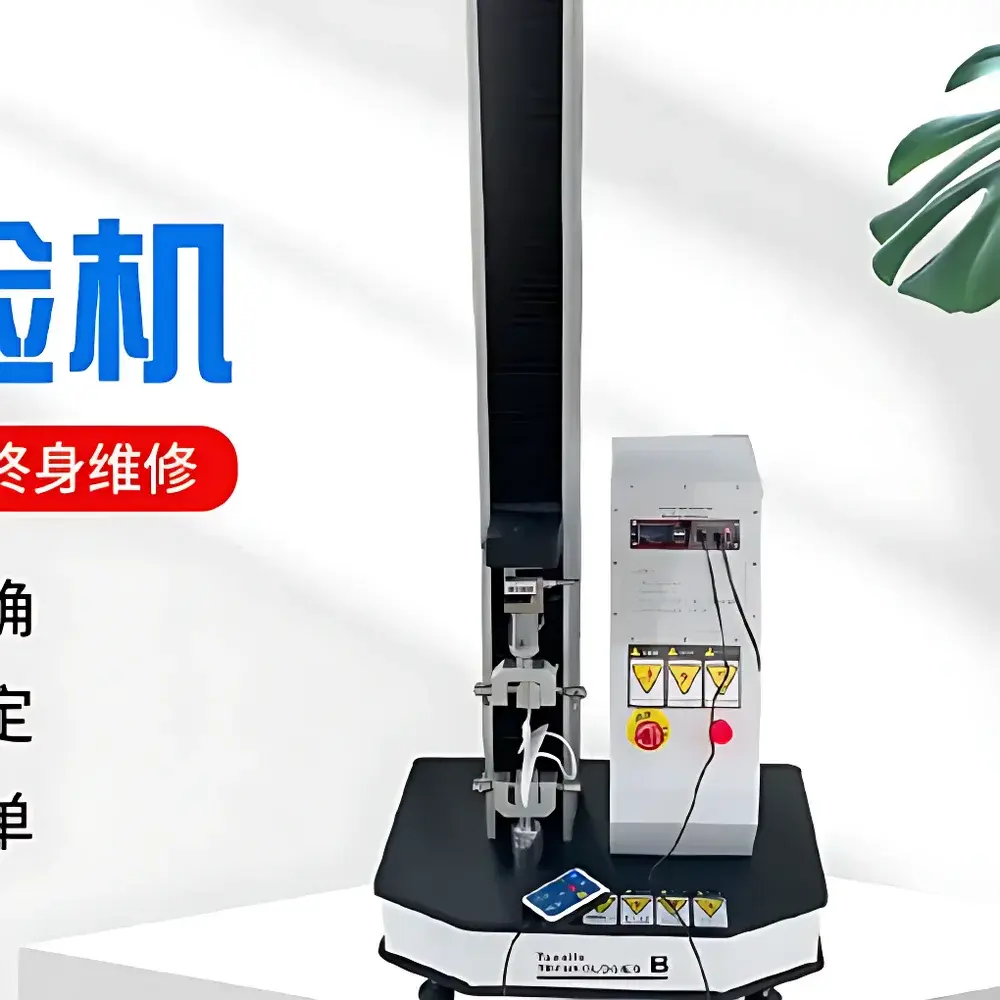
Beijing Guangjing BW-100KN Electronic Universal Testing Machine for Fiber-Reinforced Resin Composites
| Key | Brand: Beijing Guangjing / All Precision Instrument |
|---|---|
| Origin | Beijing, China |
| Manufacturer Type | Direct Manufacturer |
| Instrument Type | Electronic Universal Testing Machine |
| Model | BW-100KN |
| Max Test Force | 100 kN (100,000 N) |
| Force Range | 2%–100% of full scale |
| Force Accuracy | ±1% FS |
| Force Repeatability | ≤1% RSD |
| Displacement Resolution | 0.01 mm |
| Crosshead Speed Range | 0.05–500 mm/min |
| Speed Accuracy | ±1% |
| Effective Tensile Stroke | 600 mm |
| Power Supply | 220 V ±10%, 50 Hz, 0.5 kW |
| Dimensions (W×D×H) | 400 × 400 × 1300 mm |
| Compliance Standards | GB/T 16491, GB/T 1040, ASTM D412, ASTM D3574, ISO 37, ISO 527, EN ISO 527-2, DIN 53455, JIS K6251 |
Overview
The Beijing Guangjing BW-100KN Electronic Universal Testing Machine is a precision-engineered mechanical testing system designed specifically for the tensile, compressive, flexural, and peel characterization of fiber-reinforced resin composites, polymer matrices, textile reinforcements, and hybrid laminates. It operates on the principle of controlled electromechanical force application via a high-resolution servo-controlled drive train coupled with a precision ball-screw actuation system. The machine delivers traceable, repeatable mechanical property data—including tensile strength, modulus, elongation at break, yield point, and stress–strain hysteresis—under strict adherence to international test standards. Its architecture integrates real-time closed-loop control of load, displacement, and strain, enabling both open-loop rate control and feedback-driven ramp-hold sequences essential for evaluating viscoelastic behavior in thermoset and thermoplastic composites.
Key Features
- Automatic stop function upon specimen failure: crosshead halts or returns to initial position without operator intervention.
- Intelligent auto-range switching: dynamically selects optimal load cell range based on applied force to maintain measurement fidelity across 2%–100% of full-scale capacity (100 kN).
- Modular test method library: users define, store, and recall standardized test templates—including loading profiles, hold durations, and calculation rules—for rapid re-execution of repetitive protocols.
- Programmable multi-segment motion control: supports user-defined displacement or load-rate profiles (e.g., pre-load → ramp → dwell → unload), fully editable pre- or post-test.
- Real-time dynamic visualization: synchronized graphical display of load–displacement, stress–strain, and time-based curves during active testing.
- Dual protection architecture: hardware-based mechanical limit switches complement software-enforced travel boundaries to prevent over-travel damage.
- Overload safety cutoff: automatic shutdown triggered at ≥103–105% of nominal load cell rating to protect transducers and structural integrity.
- High-fidelity data acquisition: 100 kHz sampling rate ensures accurate capture of transient events such as crack initiation or interfacial debonding in composite specimens.
- Multi-clamp compatibility: accommodates pneumatic, wedge, hydraulic, and custom fixtures for flat, round, tubular, and irregular geometries—including ASTM D3039-compliant composite coupons and ISO 527-4 dog-bone specimens.
Sample Compatibility & Compliance
The BW-100KN is validated for mechanical evaluation of continuous-fiber composites (carbon, glass, aramid), prepreg laminates, injection-molded thermoplastics, fiber-reinforced resins (epoxy, vinyl ester, polyurethane), nonwovens, geotextiles, and hybrid metal-polymer assemblies. It conforms to over 40 national and international standards including GB/T 1040 (plastics tensile), GB/T 3354 (composites tensile), ASTM D3039 (unidirectional composites), ASTM D3574 (flexible cellular materials), ISO 527-2 (plastics – tensile properties), EN ISO 14129 (composite interlaminar shear), and JIS K7073 (carbon fiber tensile). All force and displacement measurements are traceable to national metrological standards, and the system supports audit-ready documentation for GLP and GMP environments per FDA 21 CFR Part 11 when configured with electronic signature and audit trail modules.
Software & Data Management
The embedded Windows-based testing software provides full compliance with ISO/IEC 17025 data integrity requirements. It features modular standard selection (GB, ASTM, ISO, DIN, JIS, BS), customizable formula editing for derived parameters (e.g., specific strength, toughness index), and dual-report export (Microsoft Word and Excel) with embedded metadata (operator ID, timestamp, environmental conditions, calibration status). Real-time Auto Scale curve rendering enables dynamic zoom and point interrogation; post-test curve traversal allows extraction of modulus at any strain interval (e.g., secant modulus at 0.1–0.3% strain). Data backup is configurable to network drives or NAS devices; historical test archives support version-controlled comparison and trend analysis across material batches. Software includes built-in validation tools for system verification per ASTM E4 and ISO 7500-1.
Applications
This system serves R&D laboratories, QC departments, and certification bodies engaged in composite material development, aerospace component qualification, automotive lightweighting initiatives, wind turbine blade material validation, and biomedical polymer characterization. Typical use cases include: tensile testing of carbon-fiber/epoxy laminates per ASTM D3039; peel adhesion assessment of fiber-resin interfaces using 90°/180° peel fixtures; compression-after-impact (CAI) specimen preparation support; interlaminar shear strength (ILSS) via short-beam shear (ASTM D2344); and creep/recovery profiling under constant load. Its versatility extends to quality control of industrial textiles, geomembranes, battery separator films, and structural adhesives where fiber orientation, resin cure state, and interfacial bonding critically influence macroscopic performance.
FAQ
What is the maximum allowable test speed for high-accuracy modulus measurement?
For reliable elastic modulus determination, speeds between 0.5–5 mm/min are recommended to minimize inertial effects and ensure quasi-static equilibrium conditions.
Can the system perform closed-loop strain control using an extensometer?
Yes—when equipped with a contact or non-contact extensometer (optional), the controller supports true strain-controlled ramp-hold tests per ISO 527-1 Annex B.
Is the software compliant with FDA 21 CFR Part 11 for regulated industries?
Out-of-the-box functionality meets ALCOA+ principles; full Part 11 compliance requires optional electronic signature, audit trail, and role-based access modules.
How is calibration traceability maintained across force ranges?
Each load cell is supplied with a UKAS-accredited calibration certificate; internal verification routines verify zero offset, linearity, and repeatability prior to each test session.
What mechanical safety redundancies are implemented?
Two independent systems: programmable software limits (configurable per test method) and fail-safe mechanical end-stop switches mounted at upper/lower crosshead travel extremes.
Related Products



