
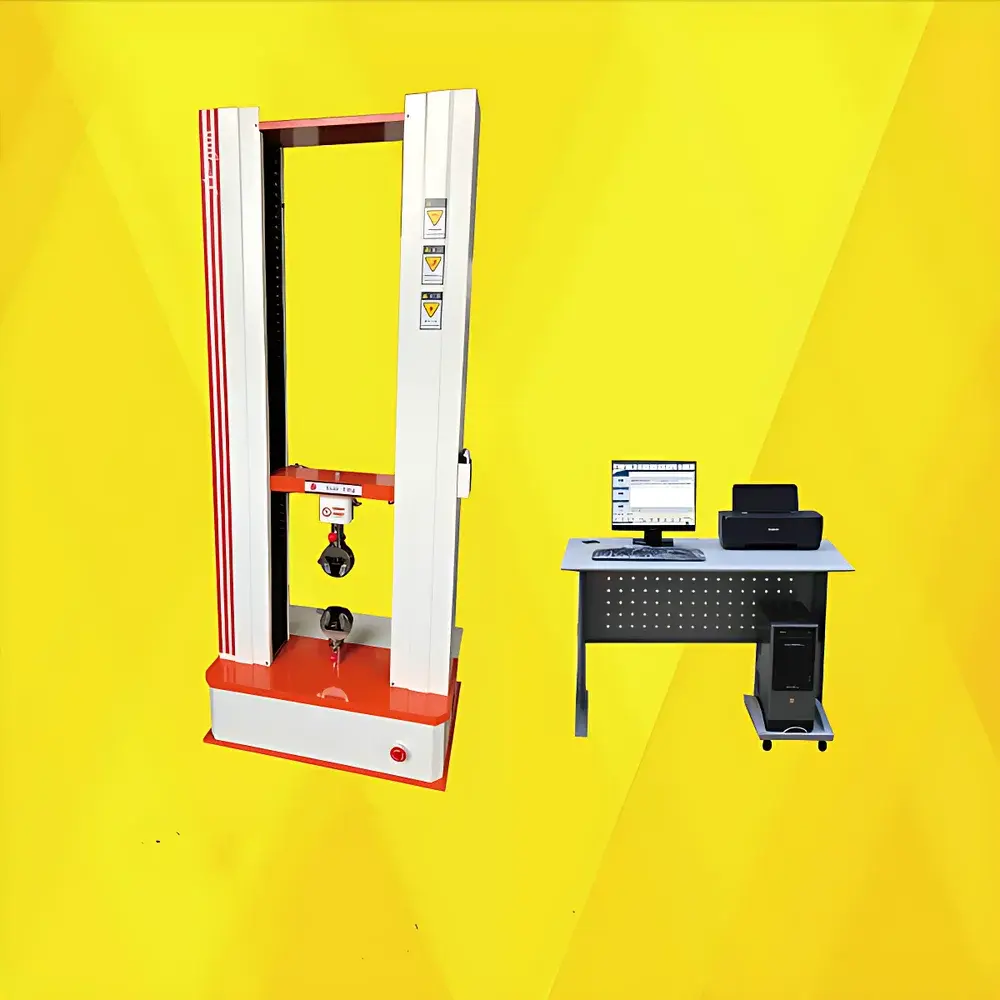
Beijing North Guang Precision Instruments BWN-20KN Dual-Column Computer-Controlled Universal Testing Machine
| Brand | Beijing North Guang Precision Instruments |
|---|---|
| Origin | Beijing, China |
| Manufacturer Type | Direct Manufacturer |
| Instrument Type | Electromechanical Universal Testing Machine |
| Model | BWN-20KN |
| Maximum Load Capacity | 20 kN |
| Compliance Standards | GB/T 6344–1996, GB/T 10808–2006, ISO 8067:1989 |
Overview
The Beijing North Guang Precision Instruments BWN-20KN is a dual-column, electromechanical universal testing machine engineered for precision mechanical property evaluation of both metallic and non-metallic materials under static tensile, compressive, flexural, peel, shear, and tear loading conditions. It operates on the principle of controlled displacement actuation via a high-rigidity mechanical train—comprising preloaded ball screws, hardened ground columns, and a Taiwan-sourced servo motor system—coupled with closed-loop force feedback from a calibrated S-type load cell (1000 N nominal capacity). The system implements real-time PID-controlled crosshead motion to maintain target strain or load rates per ASTM E4, ISO 7500-1, and GB/T 228.1 requirements. Designed specifically for R&D labs, QC departments, and third-party testing facilities in polymer, automotive, packaging, textile, and biomedical material sectors, it delivers repeatable, traceable mechanical data suitable for regulatory submissions and internal quality audits.
Key Features
- Dual-column rigid frame architecture with high-strength ground steel columns and preloaded ball screw drive for minimal deflection and high axial alignment stability
- Microprocessor-based controller with backlit LCD interface and full Chinese-language menu navigation—no PC dependency for basic operation
- Automatic range switching across multiple force channels to ensure optimal signal-to-noise ratio and measurement linearity per ISO 7500-1 Class 1 accuracy class
- Programmable test profiles including constant-rate, step-load, and hold-and-relax sequences; user-defined trigger conditions for auto-stop upon specimen failure or preset displacement limit
- Integrated dual-stage safety system: mechanical end-limit switches plus software-enforced travel boundaries to prevent over-travel damage
- Overload protection circuitry that halts motion within 20 ms when applied load exceeds 103–105% of selected range, safeguarding sensor integrity and structural components
- Modular fixture interface compatible with standardized wedge-action, pneumatic, and custom-designed grips for films, fibers, foams, composites, and elastomers
Sample Compatibility & Compliance
The BWN-20KN accommodates specimens ranging from thin polymer films (≥25 µm thickness) to structural metal coupons (up to 20 mm thick), including viscoelastic soft foams (e.g., polyurethane, latex, silicone sponges), reinforced thermoplastics, fiber-reinforced composites, woven/nonwoven textiles, adhesive tapes, and elastomeric safety straps. Its test protocols align with internationally recognized standards including GB/T 6344–1996 (tensile properties of flexible cellular polymeric materials), GB/T 10808–2006 (tensile strength and elongation at break of rubber and plastic foams), and ISO 8067:1989 (determination of tear resistance of cellular plastics). While not certified to ISO/IEC 17025, the system supports GLP-compliant documentation workflows when paired with external audit-ready reporting modules.
Software & Data Management
The embedded controller stores raw test data—including time-stamped force, displacement, and strain values—at configurable sampling rates up to 100 Hz. All results are exportable via USB to CSV or Excel-compatible formats. Optional Windows-based PC software (sold separately) provides advanced post-processing capabilities: curve overlay comparison, modulus calculation (secant/tangent), yield point detection per ASTM D638/D882, statistical batch analysis, and customizable report templates compliant with internal QA templates or customer-specific formats. Audit trail functionality—including operator ID logging, parameter change timestamps, and digital signature fields—is available upon request for regulated environments operating under GMP or ISO 9001 frameworks.
Applications
- Tensile strength and elongation-at-break characterization of low-density polyurethane foams per GB/T 10808–2006
- Peel adhesion testing of pressure-sensitive tapes (90° and 180° configurations) per ASTM D3330
- Compression set and stress-relaxation behavior of elastomeric gaskets and seals
- Mechanical screening of biodegradable packaging films under ambient and elevated temperature conditions
- Quality conformance verification of automotive interior trim components (seat belts, airbag fabrics, door panel substrates)
- Validation of additive-manufactured polymer parts for anisotropic mechanical response
- Research-grade investigation of nanocomposite reinforcement efficiency in thermoplastic matrices
FAQ
What is the maximum recommended stroke length for the BWN-20KN?
The standard effective travel is 800 mm between upper and lower platens, adjustable via firmware limits to accommodate extended gauge lengths required for high-elongation polymers.
Does the system support ASTM E8/E21 high-temperature tensile testing?
No—the base configuration lacks environmental chamber integration or high-temp extensometry; however, third-party furnace and clip-on extensometer adapters may be mechanically mounted with prior validation.
Can test methods be saved and recalled as reusable templates?
Yes—up to 100 condition modules can be stored onboard, each containing predefined speed, load range, stop criteria, and output format settings.
Is the load cell calibration certificate included with shipment?
A factory calibration report traceable to CNAS-accredited reference standards is provided; users requiring ISO/IEC 17025-certified calibration must arrange third-party service post-installation.
What maintenance intervals are recommended for long-term repeatability?
Lubrication of ball screws and inspection of grip jaw inserts are advised every 6 months or after 500 test cycles; annual verification of load cell linearity and zero drift is strongly recommended.
Related Products



