
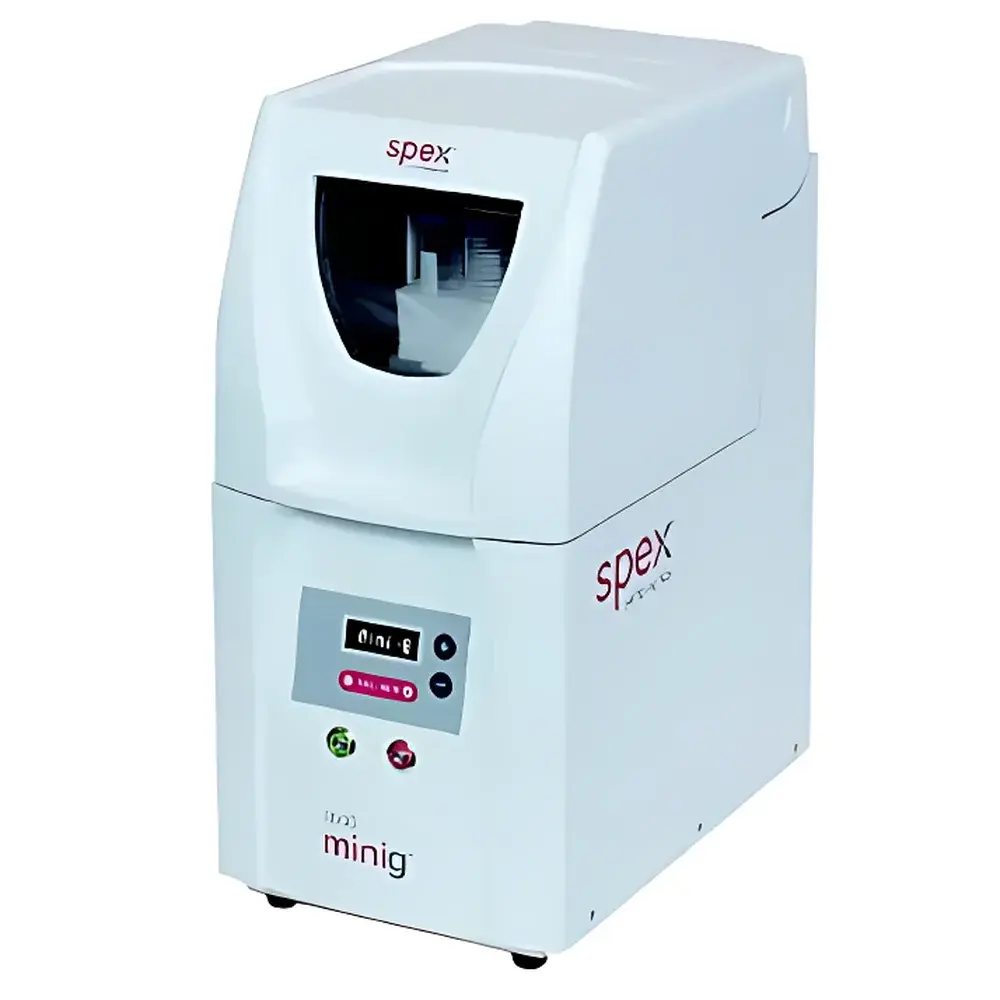
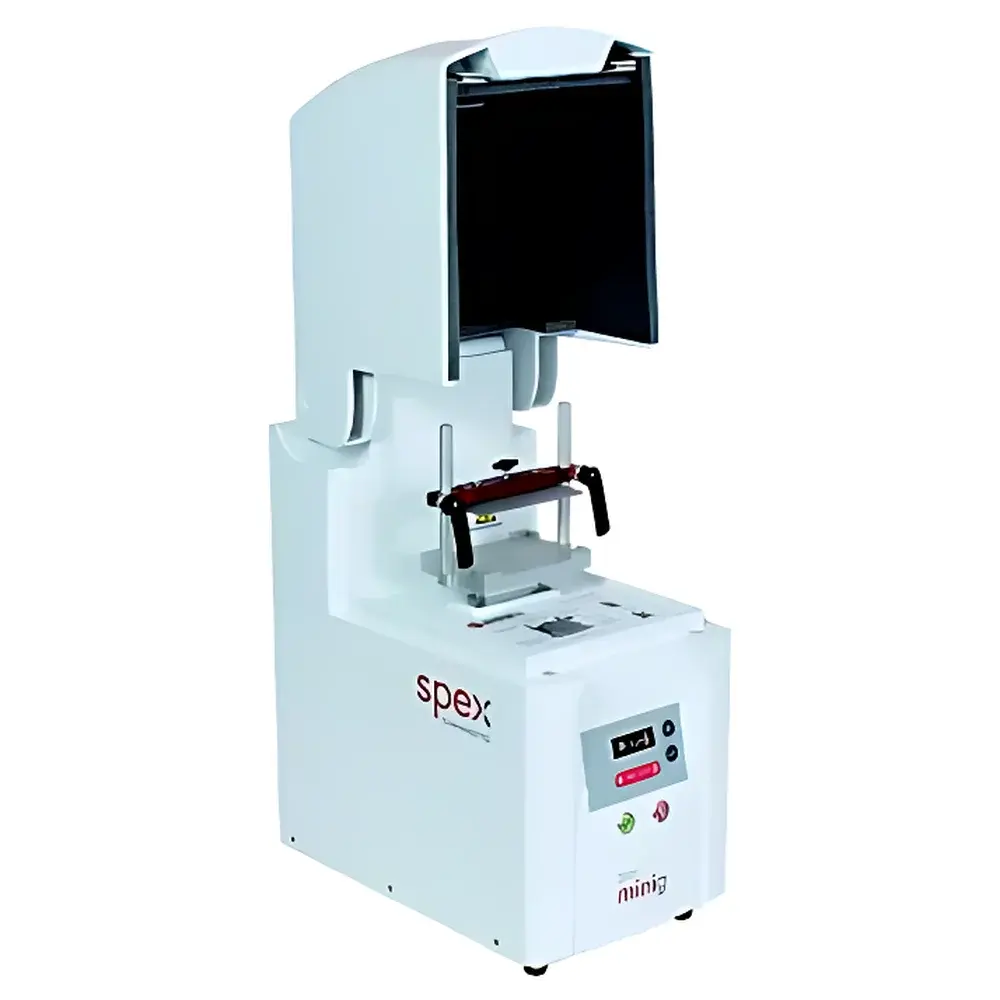
SPEX SamplePrep 1600 MiniG Automated Tissue Homogenizer and Cell Disruptor
| Brand | SPEX SamplePrep |
|---|---|
| Origin | USA |
| Model | 1600 MiniG |
| Amplitude | 3.2 cm |
| Vibration Speed | 500–1750 rpm |
| Timer | Digital, up to 20:00 (mm:ss) |
| Power Supply | 230 V / 50 Hz |
| Dimensions (W×D×H) | 35.6 × 57.2 × 71.1 cm |
| Net Weight | 45.5 kg |
| Motor | 0.5 HP |
| Data Port | Built-in history data export interface |
Overview
The SPEX SamplePrep 1600 MiniG Automated Tissue Homogenizer and Cell Disruptor is a benchtop high-energy vibrational homogenization system engineered for reproducible, scalable, and contamination-free disruption of biological samples. It operates on the principle of high-frequency orbital vibration coupled with bead-beating mechanics—where kinetic energy is transferred from stainless steel, ceramic, or silica beads to the sample matrix via rapid vertical oscillation. This mechanism enables efficient lysis of tough cellular structures—including Gram-positive bacteria, yeast cell walls, plant tissues with high cellulose content, and fibrous animal organs—without significant thermal degradation when used with optional cryogenic accessories. Designed for laboratories requiring robust nucleic acid and protein recovery from limited or heterogeneous samples, the 1600 MiniG delivers consistent mechanical shear across all positions in the clamp assembly, eliminating positional bias common in rotary or rotor-stator systems.
Key Features
- Compact footprint (35.6 cm W × 57.2 cm D × 71.1 cm H) optimized for space-constrained labs while maintaining full-scale processing capability.
- Adjustable vertical-clamp design accommodating a broad range of container formats: 2–50 mL centrifuge tubes, skirted or non-skirted 96-well deep-well plates (up to two plates simultaneously), and custom vial holders.
- Precisely controlled vibration frequency (500–1750 rpm) with fixed 3.2 cm amplitude ensures uniform energy input across all sample positions—critical for inter-sample comparability in quantitative omics workflows.
- Digital timer with 1-second resolution and maximum duration of 20 minutes supports precise protocol standardization; elapsed time and cycle count are stored in non-volatile memory.
- Kryo-Tech® accessory compatibility enables sub-zero operation using dry ice or liquid nitrogen-cooled adapters, preserving labile analytes (e.g., phosphorylated proteins, short RNA isoforms, or enzymatic activity) during lysis.
- CE-certified 0.5 HP brushless motor provides sustained torque at high loads, minimizing speed drift during extended runs and supporting GMP/GLP-aligned validation protocols.
Sample Compatibility & Compliance
The 1600 MiniG is validated for use with diverse biological matrices including mammalian and avian tissues (liver, brain, muscle), plant material (leaves, seeds, roots), microbial cultures (E. coli, Bacillus spp., Saccharomyces cerevisiae), and environmental samples (soil, compost, biofuel feedstocks). Its closed-tube processing architecture minimizes aerosol generation and cross-contamination risk—supporting ISO 15189 and CLIA requirements for clinical specimen handling. When paired with certified RNase/DNase-free consumables and validated bead sets, the system meets analytical requirements outlined in ASTM D7780 (standard guide for nucleic acid extraction), USP <1043> (ancillary materials for biologics), and FDA 21 CFR Part 11 for electronic record integrity where data port export functionality is employed.
Software & Data Management
While the 1600 MiniG operates as a standalone instrument with embedded digital controls, its built-in data port allows export of run logs—including date/time stamp, speed setting, duration, and total cycle count—to external storage devices or LIMS via USB interface. This audit-trail capability supports traceability in regulated environments. No proprietary software installation is required; exported logs are saved in CSV format for direct import into Excel, ELN platforms (e.g., LabArchives, Benchling), or statistical analysis suites (R, Python pandas). The system’s firmware supports firmware version tracking and user-defined parameter presets—facilitating SOP-driven operation across multi-user facilities.
Applications
- High-yield genomic DNA and total RNA isolation for NGS library preparation and qPCR assay development.
- Proteome-wide extraction of soluble and membrane-associated proteins under native or denaturing conditions.
- Metabolite recovery from plant tissues for LC-MS-based metabolomics, particularly for thermally labile secondary metabolites.
- QuEChERS- and SweEt-method-compliant pesticide residue extraction from fruits, vegetables, and herbal matrices prior to GC-MS/MS analysis.
- Cell wall disruption in biofuel research for enzymatic saccharification efficiency studies on lignocellulosic biomass.
- Routine QC testing of cell culture lysates in biopharmaceutical upstream process monitoring.
FAQ
What types of beads are compatible with the 1600 MiniG?
Stainless steel, zirconium oxide, silicon carbide, and glass beads (0.1–2.0 mm diameter) are routinely used; bead selection must be matched to sample type and downstream application to avoid metal leaching or nucleic acid shearing.
Can the 1600 MiniG be integrated into automated liquid handling workflows?
Yes—its standardized footprint and programmable timer allow synchronization with robotic arms equipped with gripper modules; third-party API integration is not supported, but hardware-triggered start/stop signals can be implemented via auxiliary I/O ports (optional module).
Is validation documentation available for GMP environments?
SPEX SamplePrep provides IQ/OQ documentation templates aligned with ASTM E2500 and ISO/IEC 17025; final PQ execution remains facility-specific due to variable consumables and sample matrices.
How does the 1600 MiniG compare to rotor-stator homogenizers for soft tissue processing?
Unlike rotor-stator systems that generate localized high-shear zones and heat, the 1600 MiniG applies uniform kinetic energy across the entire sample volume, resulting in lower batch-to-batch variability and reduced protein denaturation—particularly advantageous for co-immunoprecipitation and native complex isolation.
What maintenance is required for long-term reliability?
Biannual inspection of clamp alignment, motor coupling integrity, and vibration dampening mounts is recommended; no routine lubrication is required due to sealed bearing design and brushless motor architecture.



