
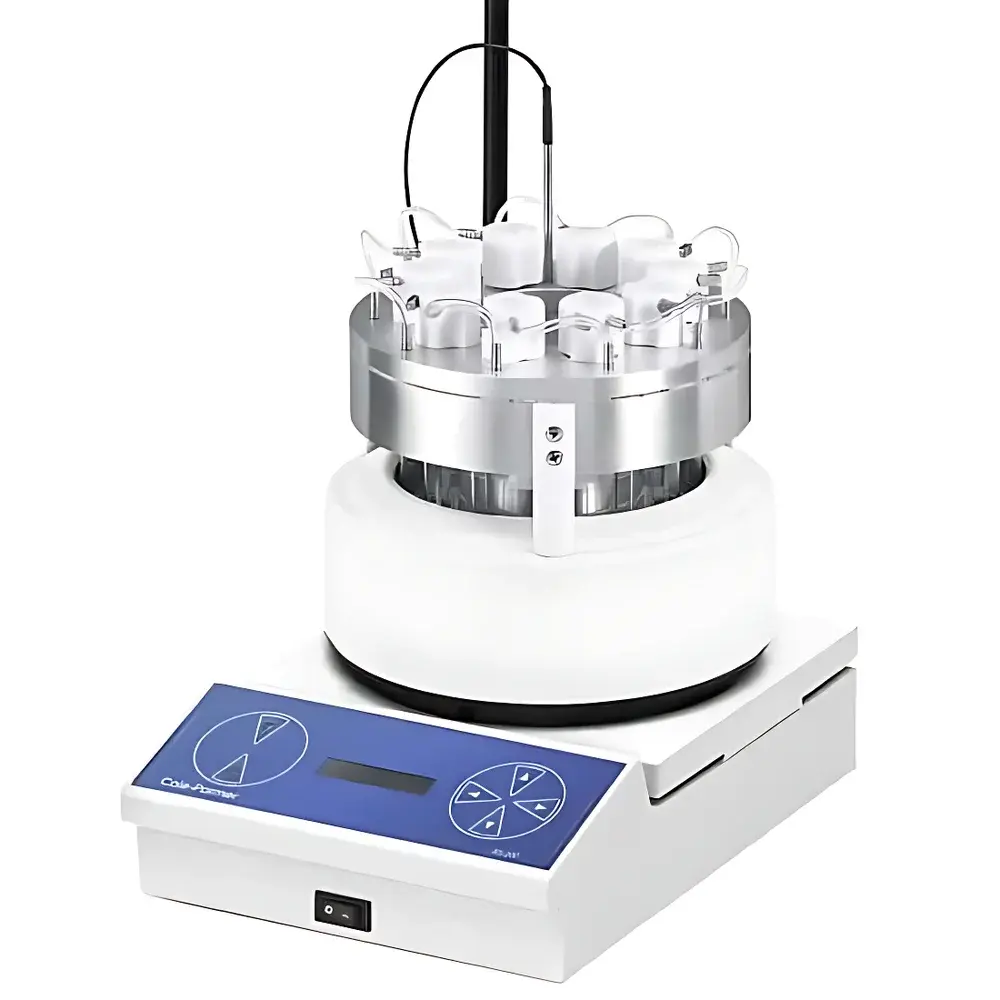
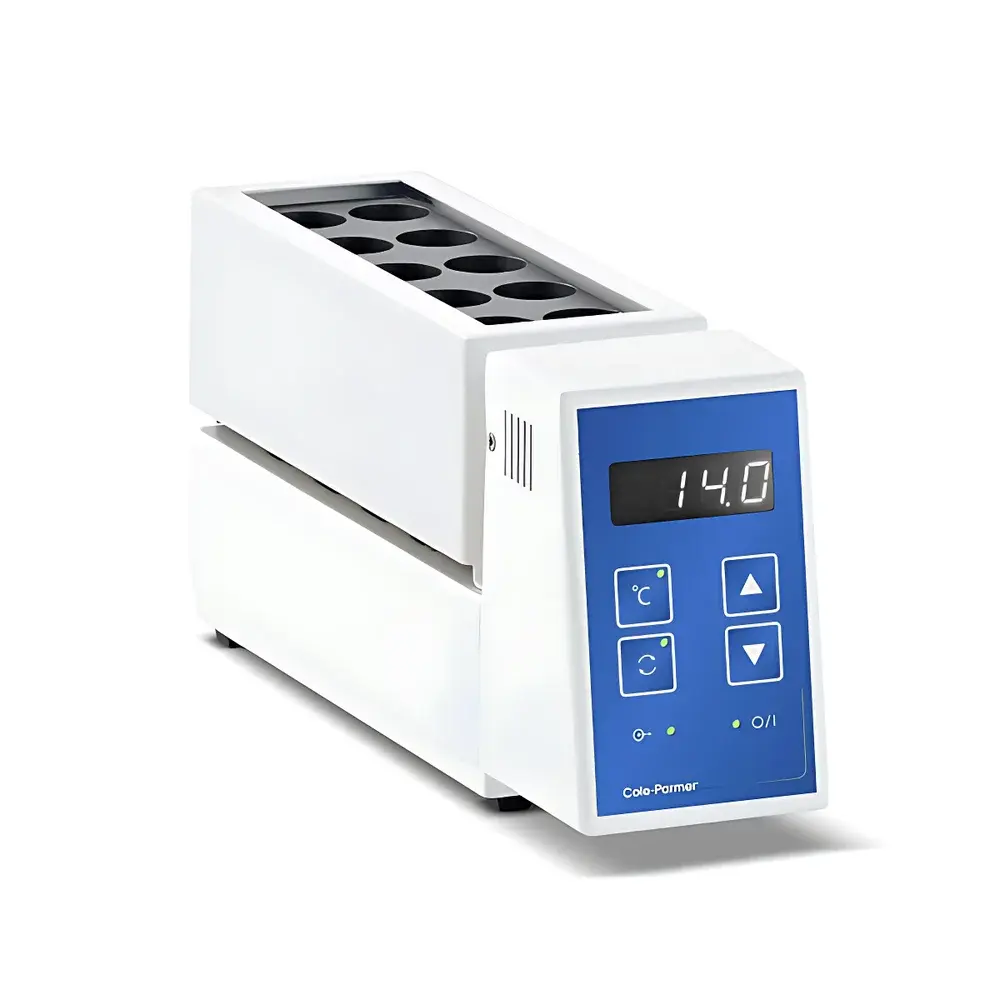
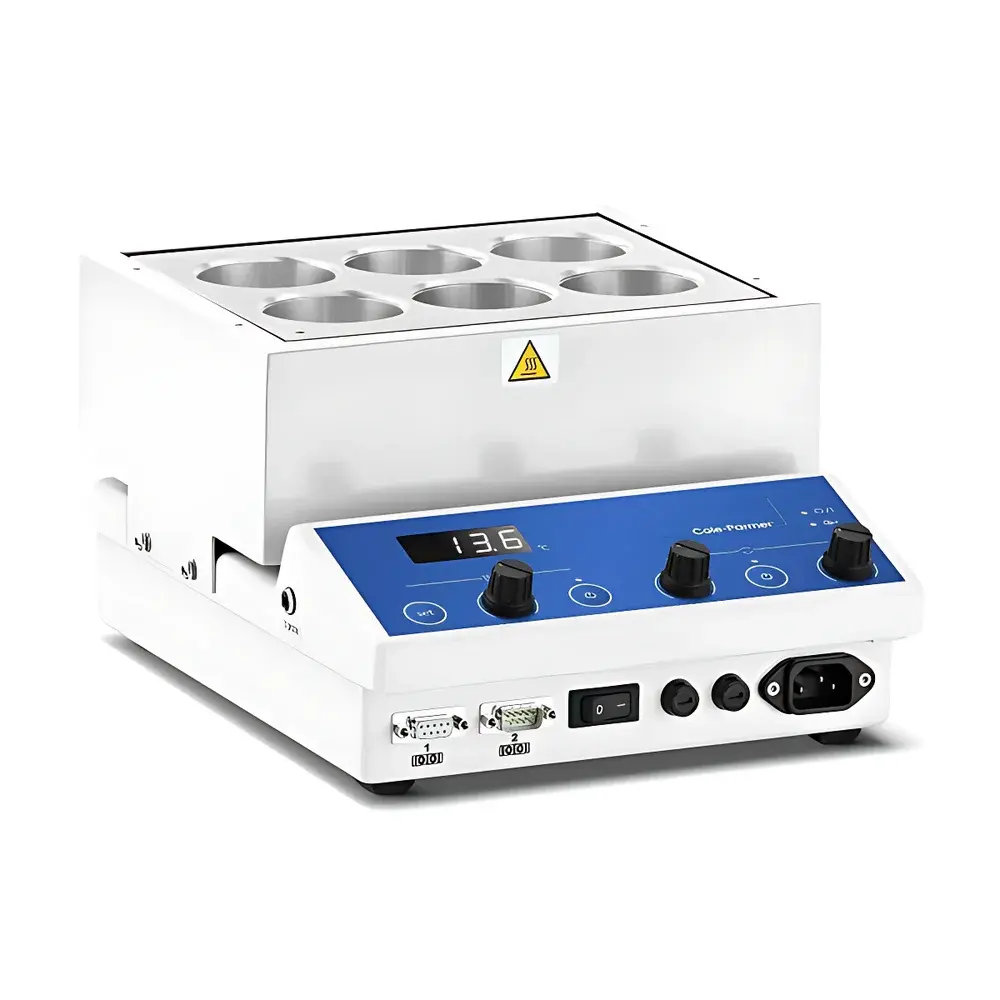
Cole-Parmer Integrity 10 Parallel Reaction Station / Crystallization Screening System
| Brand | Cole-Parmer |
|---|---|
| Origin | USA |
| Model | RS-200D |
| Temperature Range | −30 °C to 150 °C |
| Stirring Speed | 350–1200 rpm |
| Vessel Capacity | 2–25 mL |
| Control Interface | Touchscreen with microprocessor-based automation |
| Gas Environment Compatibility | Vacuum and inert gas (N₂, Ar) via PTFE tubing |
| Optional Accessories | Reflux condensers, Clarity™ Solubility & Crystallization Monitoring System, Multi-channel IR probes |
Overview
The Cole-Parmer Integrity 10 Parallel Reaction Station (Model RS-200D) is a precision-engineered platform for high-throughput reaction screening and crystallization process development. Based on parallelized jacketed vessel architecture with independent thermal and mechanical actuation per position, it enables statistically robust experimental design under controlled, reproducible conditions. Each of the ten reaction vessels operates as an autonomous unit—equipped with individual PID-controlled heating/cooling circuits and digitally regulated overhead stirring—allowing simultaneous execution of distinct kinetic, thermodynamic, or phase-transition experiments. The system is fundamentally designed for applications requiring systematic variation of critical process parameters: temperature ramp profiles, agitation intensity, solvent composition, supersaturation level, and nucleation induction timing. Its modular construction supports integration into GLP-compliant laboratories and early-stage process R&D workflows in pharmaceutical, fine chemical, and materials science domains.
Key Features
- 10 independently controlled reaction positions with dedicated temperature and stirring actuators
- Wide operational temperature range: −30 °C to +150 °C (extendable to +220 °C with optional cooling module)
- Precise stirring control from 350 to 1200 rpm, with torque feedback for viscosity-sensitive reactions
- Reaction vessel capacity: 2–25 mL, compatible with standard glass vials and custom reactor inserts
- Integrated touchscreen interface with embedded microprocessor logic for method programming, real-time monitoring, and event-triggered logging
- Gas-tight operation enabled by PTFE inlet/outlet lines—supports vacuum application and inert atmosphere maintenance (N₂, Ar)
- Modular accessory ecosystem including reflux condensers, temperature gradient blocks, and Clarity™ infrared solubility monitoring probes
Sample Compatibility & Compliance
The Integrity 10 accommodates a broad spectrum of sample types—including organic solutions, aqueous suspensions, polymer melts, and protein formulations—without cross-contamination risk due to physical isolation of all ten vessels. Vessel materials (borosilicate glass, PTFE seals, stainless-steel stirrers) ensure chemical compatibility with aggressive reagents and low-adsorption performance for biomolecules. The system complies with general laboratory safety standards (ANSI Z9.5, IEC 61000-6-3) and supports audit-ready data integrity when paired with validated software configurations. While not inherently 21 CFR Part 11 compliant out-of-the-box, its automated logging architecture—capturing timestamped temperature setpoints, actual readings, stirring speed, and user-defined events—provides foundational traceability required for GMP-aligned crystallization development per ICH Q5C and Q8(R2).
Software & Data Management
The onboard firmware enables creation and storage of multi-step temperature programs (e.g., ramp-hold-cool cycles), stirring profiles synchronized to thermal events, and conditional alarms. All sensor data—including real-time vessel temperature (±0.3 °C accuracy), stir speed (±5 rpm), and runtime—are logged at user-selectable intervals (1–60 seconds) to internal memory or external USB storage. Export formats include CSV and Excel-compatible .xlsx for downstream statistical analysis (DoE, PCA, kinetic modeling). When interfaced with third-party LIMS or ELN platforms via RS-232 or Ethernet (optional), the system supports structured metadata tagging—critical for regulatory submissions and technology transfer documentation.
Applications
- Crystallization screening: determination of metastable zone width (MSZW), nucleation kinetics, polymorph selection, and desupersaturation profiling using integrated Clarity™ IR probes
- Reaction optimization: DoE-based evaluation of catalyst loading, stoichiometry, solvent effects, and residence time across parallel conditions
- Thermal stability assessment: forced degradation studies of APIs under controlled heating/cooling gradients
- Lysozyme and monoclonal antibody crystallization: reproducible generation of diffraction-quality crystals for structural biology
- Process intensification studies: correlation of mixing energy input with particle size distribution (PSD) in antisolvent crystallizations
- Early-phase route scouting: rapid evaluation of alternative synthetic pathways for lead compound synthesis
FAQ
Can the Integrity 10 be used for exothermic reaction calorimetry?
No—it does not provide heat flow measurement capability. For reaction calorimetry, consider dedicated RC1 or EasyMax systems.
Is remote monitoring supported?
Yes, via optional Ethernet module and Cole-Parmer’s LabLink software for live parameter viewing and method upload.
What is the maximum allowable pressure inside the vessels?
Vessels are rated for ambient pressure operation only; use only with atmospheric venting or controlled inert/vacuum headspace.
Are validation documents (IQ/OQ) available?
Factory-verified IQ/OQ protocols are provided upon request and may be executed on-site by certified field engineers.
How is temperature uniformity verified across all 10 positions?
Each vessel includes a calibrated Pt100 RTD sensor; inter-vessel deviation is ≤ ±0.5 °C under steady-state conditions at 25 °C and 100 °C.



