
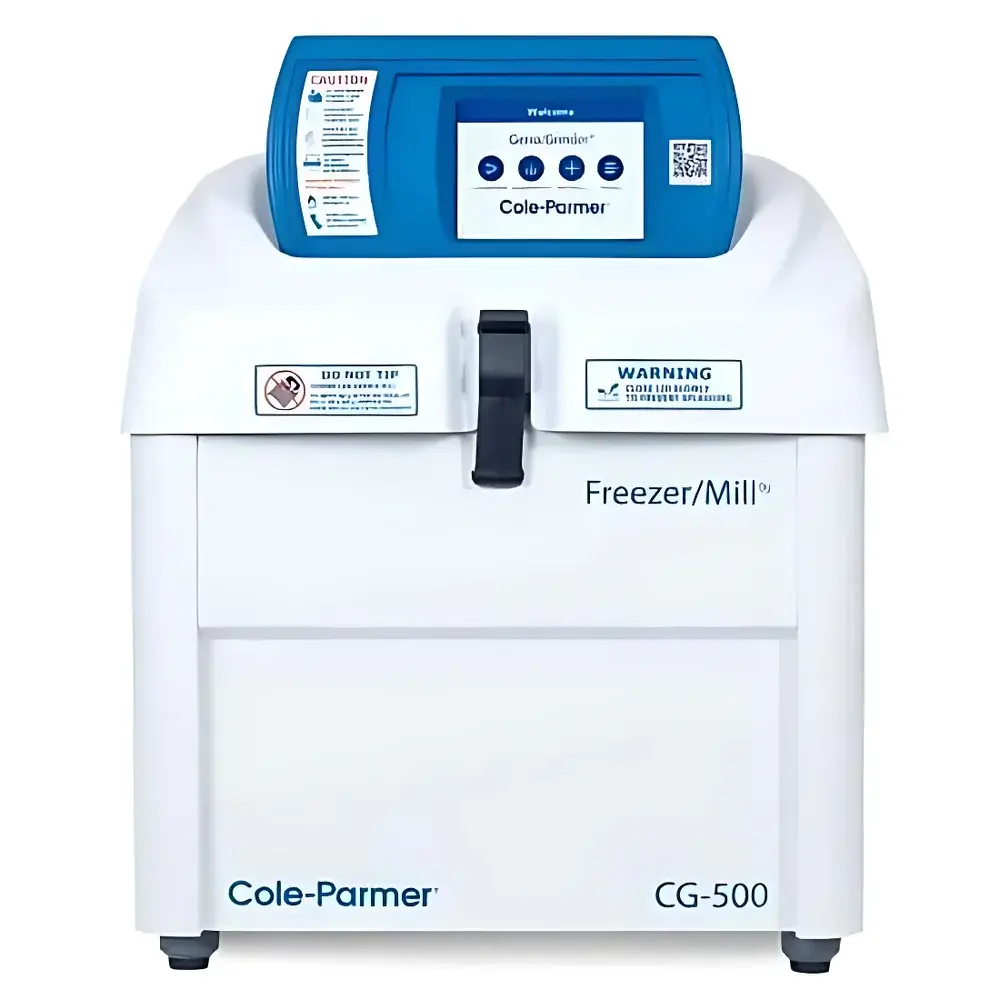
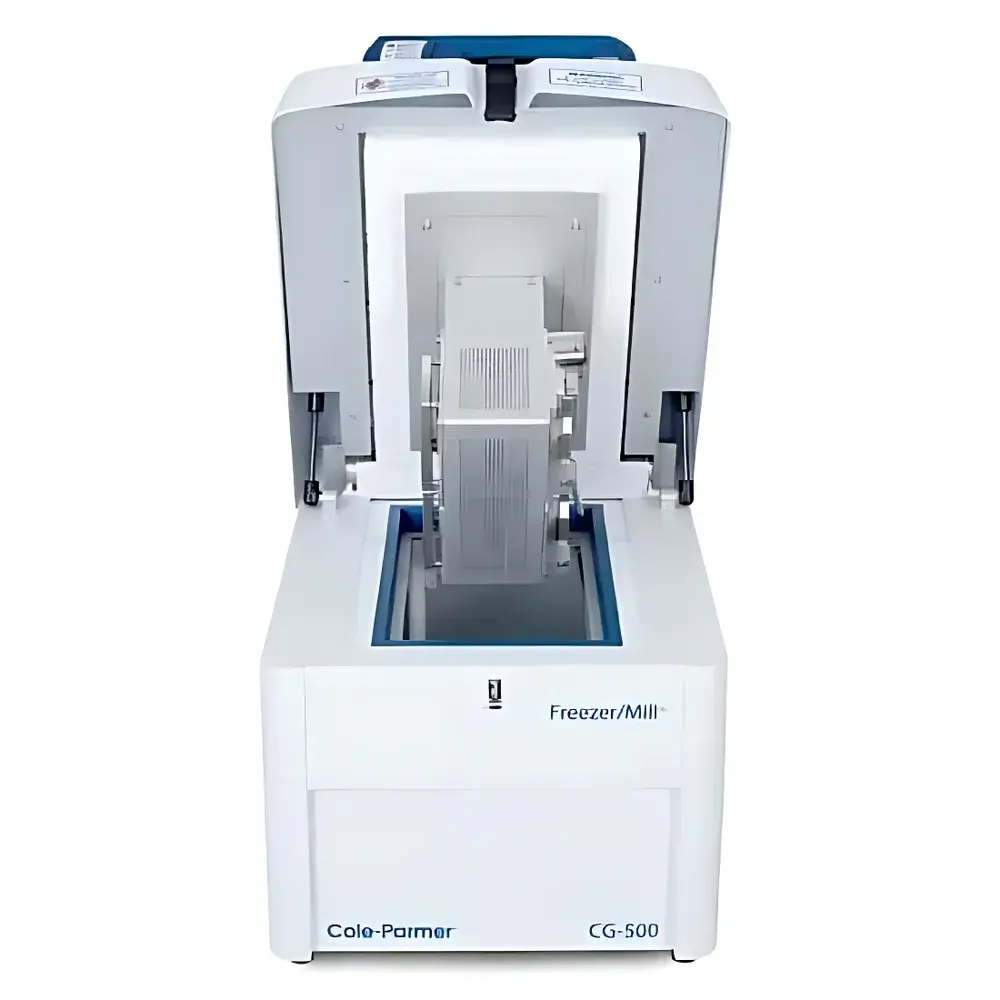
Cole-Parmer Freezer/Mill® CG-500 Cryogenic Grinder (formerly Model 6875D)
| Brand | Cole-Parmer |
|---|---|
| Origin | USA |
| Manufacturer Type | Authorized Distributor |
| Product Category | Imported Instrument |
| Model | CG-500 (formerly 6875D) |
| Instrument Type | Cryogenic Grinder |
| Sample Compatibility | Frozen and Temperature-Sensitive Samples |
Overview
The Cole-Parmer Freezer/Mill® CG-500 Cryogenic Grinder is an electromagnetic-driven, liquid nitrogen–cooled mechanical pulverizer engineered for reproducible, low-temperature sample disruption. Unlike conventional ball mills or rotor-stator grinders, the CG-500 operates on the principle of cryogenic impact milling: samples are sealed inside stainless steel grinding vials, which are fully immersed in a liquid nitrogen bath during operation. The absence of direct contact between liquid nitrogen and the sample eliminates contamination risk while maintaining sub-196 °C thermal stability throughout the grinding cycle. This ultra-low temperature environment suppresses molecular mobility, reduces ductility, and promotes brittle fracture—enabling efficient comminution of otherwise intractable materials such as keratin-rich tissues (hair, feathers), elastomers (rubber, silicone), calcified matrices (bone, teeth), and thermolabile biomolecules (proteins, nucleic acids). Developed from the original SPEX Freezer/Mill® platform—first introduced in the 1960s—the CG-500 represents over six decades of refinement in cryo-mechanical sample preparation for analytical, forensic, and life science applications.
Key Features
- Electromagnetic drive system with patented reciprocating impact pin: delivers high-energy collisions without rotating shafts, gears, or belts—minimizing heat generation and mechanical wear.
- Full immersion cryogenic chamber: grinding vials remain continuously submerged in liquid nitrogen during pre-cooling and grinding phases, ensuring consistent thermal control below −196 °C.
- Intuitive touchscreen interface: programmable parameters include pre-cool duration (0–300 s), impact frequency (1–10 Hz), grind time per cycle (1–10 min), inter-cycle cooling delay (0–300 s), and total cycle count (1–99).
- Integrated safety interlocks: dual-level liquid nitrogen level sensor triggers audible/visual alarm and automatic shutdown when LN₂ falls below operational threshold—preventing thermal degradation of samples.
- No direct LN₂–sample contact: vial sealing design preserves sample integrity, avoids volatilization loss, and complies with containment requirements for hazardous or regulated substances.
- Low-noise, maintenance-light architecture: absence of lubricated moving parts enables GLP-compliant operation with minimal downtime and calibration drift.
Sample Compatibility & Compliance
The CG-500 accommodates a broad spectrum of temperature-sensitive and mechanically resilient specimens—including biological tissues (muscle, liver, brain), forensic evidence (bone fragments, hair shafts), polymers (PTFE, nylon, polyethylene), pharmaceutical excipients, plant matter (roots, seeds), and geological samples (minerals, ores). Its cryogenic processing meets methodological prerequisites for ASTM E2937-21 (forensic DNA recovery), ISO 17025-accredited labs performing RoHS-compliant polymer screening, and FDA 21 CFR Part 11–aligned workflows requiring audit-trail-enabled parameter logging. Vial options (e.g., 0.5 mL, 2 mL, 7 mL, 14 mL) support scalable throughput from single-cell isolates to gram-scale bulk materials—all traceable via user-defined program IDs stored in non-volatile memory.
Software & Data Management
The onboard controller stores up to 100 user-defined grinding protocols with timestamped execution logs, including start/stop times, LN₂ consumption estimates, and real-time temperature proxy indicators. Exportable CSV reports facilitate integration with LIMS platforms and support 21 CFR Part 11 compliance when paired with networked authentication and electronic signature modules (optional). No external PC dependency is required for routine operation; however, optional USB data export enables retrospective analysis of cycle consistency across batches and operators—critical for method validation under ICH Q5C and USP guidelines.
Applications
- Genomic and proteomic sample prep: high-yield extraction of intact RNA, DNA, and native proteins from frozen tissues without enzymatic or thermal denaturation.
- Forensic anthropology: pulverization of calcified remains for mitochondrial DNA profiling—validated in high-profile identifications including the Tyrolean Iceman (Ötzi) and World Trade Center victim recovery efforts.
- Materials science: homogenization of composite polymers prior to FTIR, DSC, or XRD analysis; reduction of ceramic precursors to sub-150 µm particle size distributions.
- Pharmaceutical QA/QC: batch-wise grinding of tablet formulations for content uniformity testing per USP , or RoHS screening of plastic housings for restricted heavy metals.
- Agricultural research: cell-wall disruption in fibrous plant biomass for metabolite profiling or pesticide residue analysis by GC-MS/MS.
FAQ
How does the CG-500 differ from ambient-temperature grinders?
It uses electromagnetic impact within a continuously LN₂-cooled chamber to induce brittle fracture at cryogenic temperatures—eliminating thermal degradation pathways inherent in friction-based grinding.
Can the CG-500 process hazardous or biohazardous samples?
Yes—when used with hermetically sealed, certified grinding vials and appropriate PPE, it supports BSL-2 containment protocols for infectious tissue homogenization.
Is method transfer possible between CG-400/CG-450 and CG-500 models?
Parameter sets are largely interchangeable due to shared Freezer/Mill® architecture; however, vial capacity and cooling kinetics vary—requiring minor optimization for reproducible particle size distribution.
What regulatory standards does the CG-500 support?
It aligns with ISO/IEC 17025 documentation requirements, ASTM E2937-21 for forensic sample prep, and GLP/GMP expectations for audit-trail generation and instrument qualification.
Does the system require routine calibration?
No scheduled calibration is mandated; however, performance verification using NIST-traceable reference materials (e.g., certified polymer powders) is recommended quarterly per laboratory quality management systems.



