
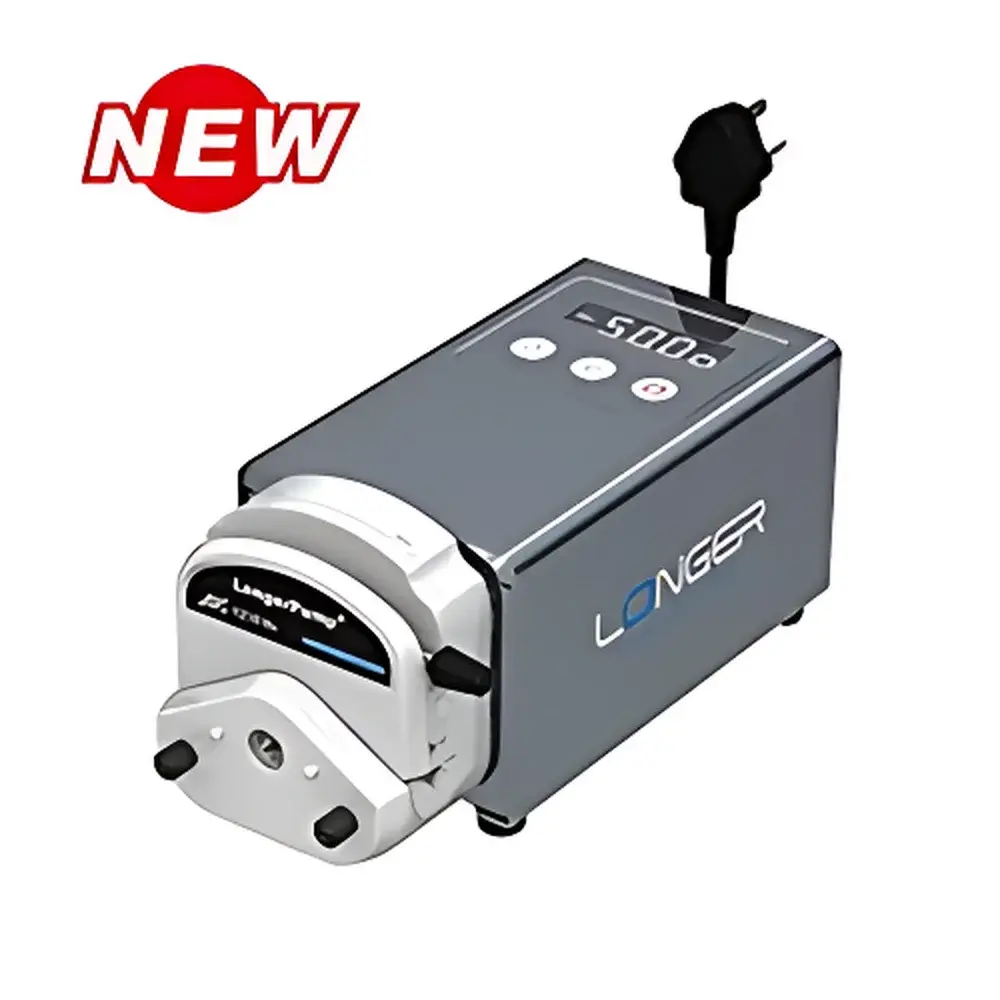
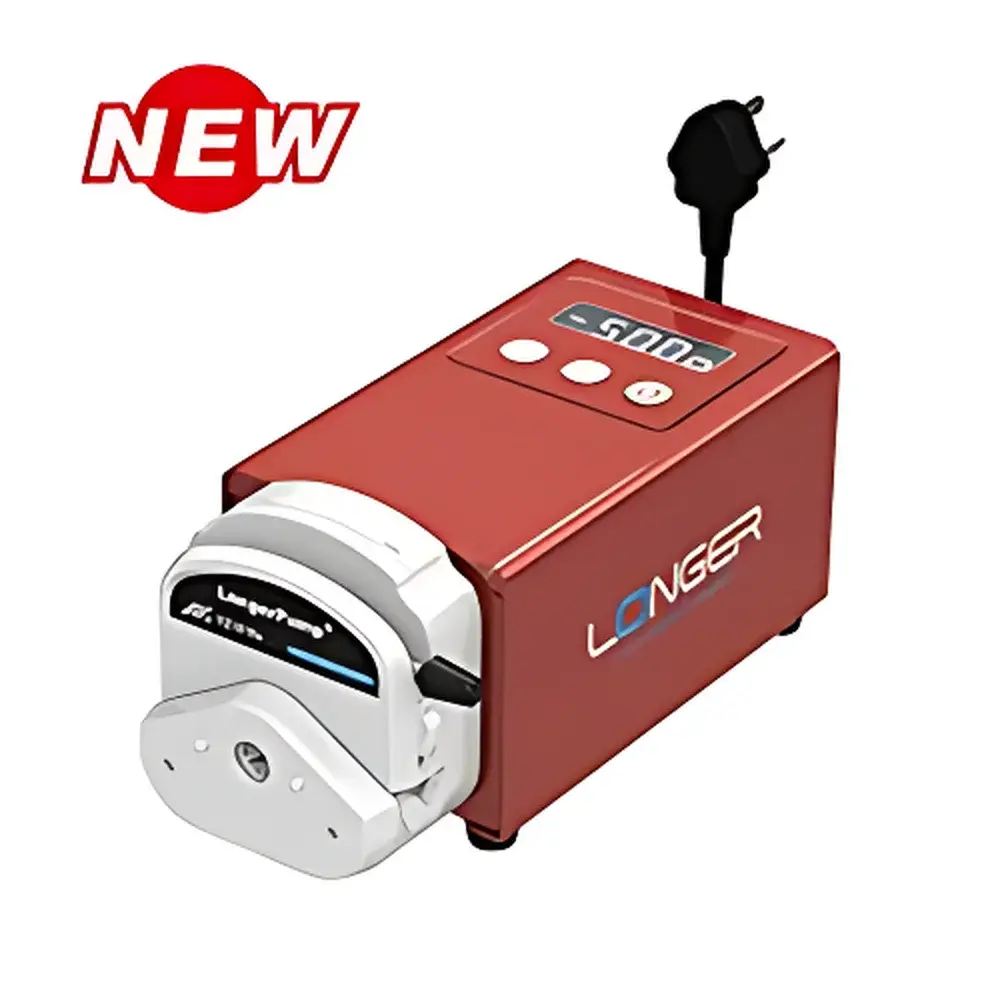
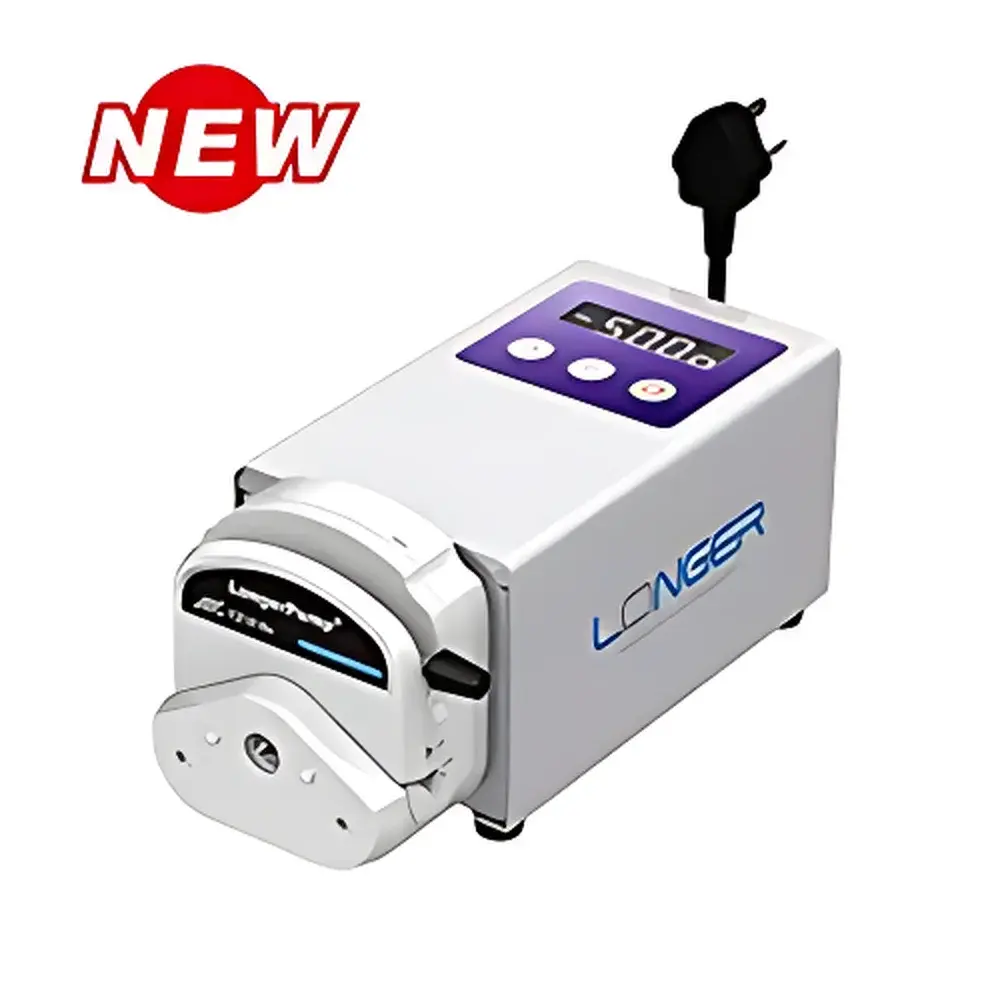
Longer L100-1E Micro Peristaltic Pump
| Brand | LongerPump |
|---|---|
| Origin | Hebei, China |
| Model | L100-1E |
| Flow Rate Range | 0.0002–380 mL/min |
| Speed Range | 0.1–100 rpm |
| Speed Resolution | 0.1 rpm |
| Control Method | Keypad |
| Power Loss Memory | Yes |
| Dimensions (L×W×H) | 197 × 110 × 91 mm |
| Operating Temperature | 0–40 °C |
| IP Rating | IP31 |
| Weight | 2.3 kg |
Overview
The Longer L100-1E Micro Peristaltic Pump is a compact, precision-engineered peristaltic pump designed for low-to-moderate flow applications in research laboratories, analytical instrumentation integration, and small-scale process development. Based on the principle of positive displacement via roller compression of flexible tubing, the L100-1E delivers pulse-free, contamination-free fluid transfer without exposing internal components to the pumped medium—ensuring sample integrity and eliminating cross-contamination risks. Its robust mechanical architecture supports continuous operation under variable load conditions, making it suitable for use with a wide range of chemically compatible tubing materials (e.g., silicone, Viton®, PharMed® BPT) across diverse solvents and biological fluids. The pump’s fixed-roller head design ensures consistent occlusion and long-term flow stability, critical for reproducible dosing in titration, cell culture media feeding, reagent delivery, and microfluidic system priming.
Key Features
- Compact footprint (197 × 110 × 91 mm) optimized for benchtop integration and space-constrained environments including fume hoods, glove boxes, and automated workstations.
- Wide adjustable speed range from 0.1 to 100 rpm with 0.1 rpm resolution, enabling precise control over flow rates spanning four orders of magnitude (0.0002–380 mL/min, dependent on tubing ID and material).
- Bi-directional rotation capability for bidirectional fluid handling, essential for recirculation loops, backflushing protocols, and reversible dosing sequences.
- Keypad-based local control with intuitive interface; no external software or driver required for basic operation.
- Power-loss memory function retains operational parameters (speed, direction, run status) during unexpected power interruption, resuming pre-failure state upon restoration—supporting unattended overnight runs and GLP-compliant workflows.
- Durable metal housing with corrosion-resistant powder coating enhances mechanical rigidity and extends service life in humid or mildly aggressive lab environments.
- Electromagnetic compatibility (EMC) certified to IEC 61326-1 standards, ensuring stable performance alongside sensitive detection equipment such as spectrophotometers, pH meters, and mass spectrometers.
Sample Compatibility & Compliance
The L100-1E is inherently compatible with any fluid that does not degrade standard peristaltic tubing—enabling safe handling of aqueous buffers, organic solvents (with appropriate tubing selection), cell suspensions, enzyme solutions, and low-viscosity polymers. It is not intended for abrasive slurries, high-pressure systems (>1 bar), or gases. While the pump itself carries no regulatory certification (e.g., FDA 510(k), CE medical device classification), its design aligns with general laboratory safety practices outlined in ISO/IEC 17025 and supports compliance with Good Laboratory Practice (GLP) and Good Manufacturing Practice (GMP) when integrated into validated processes. Tubing selection must conform to relevant chemical compatibility charts and, where applicable, USP Class VI or ISO 10993 biocompatibility requirements.
Software & Data Management
The L100-1E operates as a standalone instrument with no native PC connectivity or embedded data logging. However, its keypad interface supports manual protocol setup and real-time parameter adjustment. For automated integration, users may employ optional third-party digital I/O modules (e.g., TTL-level start/stop and direction signals) to synchronize pump operation with programmable logic controllers (PLCs), LabVIEW-based DAQ systems, or Python-controlled Raspberry Pi platforms. Audit trails and electronic records are maintained externally; the pump’s lack of onboard storage or network interface means all data management responsibilities fall to the host system—facilitating alignment with 21 CFR Part 11 requirements when paired with compliant software architectures.
Applications
- Continuous reagent addition in spectrophotometric and colorimetric assays.
- Controlled nutrient or inducer delivery in microbial and mammalian cell culture bioreactors.
- Mobile phase delivery in preparative HPLC and low-pressure liquid chromatography systems.
- Calibration standard dilution and dispensing in environmental and clinical testing labs.
- Fluid circulation in temperature-controlled reaction vessels and electrochemical cells.
- Integration into custom-built analytical instruments requiring silent, low-shear fluid transport.
FAQ
Does the L100-1E support analog or digital communication protocols (e.g., RS-485, Modbus)?
No—the L100-1E features only local keypad control and basic digital I/O (start/stop, direction). Communication protocols require external signal conditioning hardware.
What tubing sizes are recommended for optimal performance?
Tubing inner diameters from 0.5 mm to 4.8 mm are supported; flow accuracy and pressure tolerance depend on wall thickness, material elasticity, and occlusion geometry. Refer to Longer’s official tubing compatibility guide for validated configurations.
Can the pump be mounted vertically or inverted?
Yes—its mechanical design allows orientation flexibility, though tubing strain and gravity-assisted priming should be considered during installation.
Is firmware upgradable?
No—firmware is fixed at manufacture and not user-modifiable.
What maintenance intervals are recommended?
Roller assembly lubrication and tubing replacement frequency depend on operating hours and chemical exposure; typical tubing lifespan ranges from 100–1,000 hours under continuous use with compatible fluids.



