
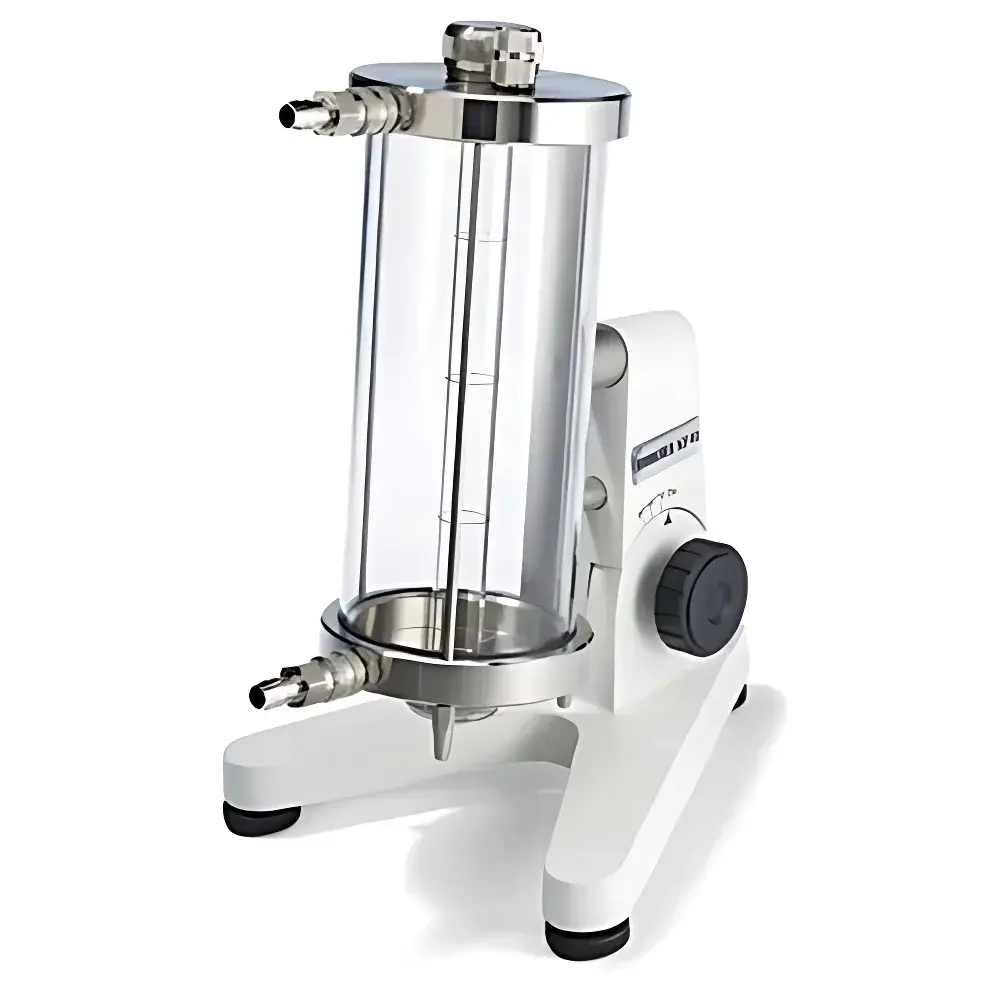
Brookfield KF40 Höppler Falling Ball Viscometer
| Brand | Brookfield |
|---|---|
| Origin | USA |
| Model | KF40 |
| Viscosity Range | 0.5–70,000 mPa·s (cP) |
| Accuracy | 0.5–2.0% (dependent on ball selection) |
| Inclination Angles | 50°, 60°, 70°, 80° |
| Ball Set | 6 precision spheres (borosilicate glass, Ni-Fe alloy, stainless steel |
| Measuring Tube Length | 100 mm |
| Fall Time Range | 30–300 s |
| Sample Volume | 40 mL |
| Temperature Range | −60 °C to +150 °C |
| Dimensions (H×W×D) | 180 × 220 × 330 mm |
Overview
The Brookfield KF40 Höppler Falling Ball Viscometer is a precision mechanical instrument engineered for the accurate and repeatable determination of dynamic viscosity in transparent Newtonian liquids. It operates strictly in accordance with the Höppler principle—a well-established capillary-independent method defined in ISO 12058-1 and ASTM D7483. In this technique, viscosity is derived from the terminal velocity of a calibrated sphere descending under gravity through a vertically inclined, temperature-controlled sample tube filled with the test fluid. The KF40’s modular design integrates a central pivot bearing that enables rapid 180° inversion of the measuring tube, allowing immediate repetition of measurements without manual repositioning—critical for minimizing operator-induced variability and supporting GLP-compliant workflows.
Key Features
- Four programmable inclination angles (50°, 60°, 70°, 80°) to optimize measurement sensitivity across wide viscosity ranges
- Integrated high-precision digital thermometer probe with ±0.1 °C resolution for real-time sample temperature monitoring
- Dedicated water bath port compatible with standard external circulators (e.g., Julabo, Huber), enabling stable thermal control per ISO 5626 and USP <911>
- Patented central pivot bearing mechanism ensures reproducible 180° tube inversion within <0.5 s—eliminating timing drift between consecutive runs
- Comprehensive ball set of six spheres: two borosilicate glass (low-density), two Ni-Fe alloy (medium-density), and two stainless steel (high-density), each traceably calibrated and certified per NIST-traceable protocols
- Robust aluminum chassis with vibration-damped base plate minimizes environmental interference during fall-time acquisition
- No electronic sensors or moving parts in the measurement path—ensuring long-term metrological stability and minimal calibration drift
Sample Compatibility & Compliance
The KF40 is validated for use with optically clear, particle-free Newtonian fluids—including solvents, monomers, liquid polymers, pharmaceutical excipients, edible oils, and low-viscosity resins. Its mechanical architecture inherently excludes non-Newtonian or opaque suspensions, aligning with its intended scope as defined in ISO 12058-1 Annex A. All components contacting samples are chemically inert (borosilicate glass tubing, PTFE-sealed joints, stainless-steel ball carriers) and compliant with FDA 21 CFR 177.2420 for indirect food contact. The instrument supports full audit trails when paired with Brookfield’s optional ViscoQC software (v3.2+), satisfying 21 CFR Part 11 requirements for electronic records and signatures in regulated environments.
Software & Data Management
While the KF40 operates as a standalone analog-timing instrument, it is fully interoperable with Brookfield ViscoQC software via USB-connected stopwatch interface. The software logs raw fall times, applies Höppler correction factors (inclination angle, ball density, fluid density), computes kinematic and dynamic viscosity, and generates ISO/IEC 17025-compliant calibration reports. All data entries include timestamp, operator ID, ambient conditions, and thermal stabilization status—enabling retrospective review for QA/QC audits. Export formats include CSV, PDF, and XML for LIMS integration. Firmware updates maintain alignment with latest ISO 12058 revisions and ASTM D7483-22a methodology amendments.
Applications
- Quality control of thin-film lubricants and hydraulic fluids in automotive manufacturing (ASTM D445 correlation)
- Batch release testing of ethanol-based sanitizers and glycol-water antifreezes per USP <911> Chapter
- R&D viscosity profiling of acrylic monomers and epoxy prepolymers during polymerization kinetics studies
- Stability assessment of pharmaceutical syrups and ophthalmic solutions under accelerated aging protocols
- Viscosity grading of edible oils (olive, canola, sunflower) in compliance with Codex Alimentarius STAN 210-1999
- Validation of cleaning agent formulations in semiconductor wet processing lines (SEMI F21-0218)
- Calibration verification of rotational viscometers using reference oils certified to ISO 8771
FAQ
What standards does the KF40 comply with?
The KF40 conforms to ISO 12058-1:2021, ASTM D7483-22a, and DIN 53015 for falling-ball viscometry. Its traceable calibration protocol follows ISO/IEC 17025:2017 requirements.
Can the KF40 measure non-Newtonian fluids?
No. The Höppler principle assumes constant shear rate and linear stress–strain response. Non-Newtonian behavior introduces velocity profile distortion and invalidates the terminal velocity assumption.
How is temperature controlled during measurement?
Via external recirculating bath connected through the rear-mounted quick-coupling port. The integrated Pt100 probe continuously monitors sample temperature at the measurement zone.
Is density correction required for viscosity calculation?
Yes. The Höppler equation requires both ball density and fluid density. Density must be measured separately (e.g., using a digital densitometer per ISO 12185) for accuracy better than ±1.0%.
What maintenance is required for long-term accuracy?
Annual verification of ball diameters (micrometer), tube bore uniformity (optical interferometry), and inclination angle (digital inclinometer). No routine recalibration of electronics is needed—only mechanical verification.



