
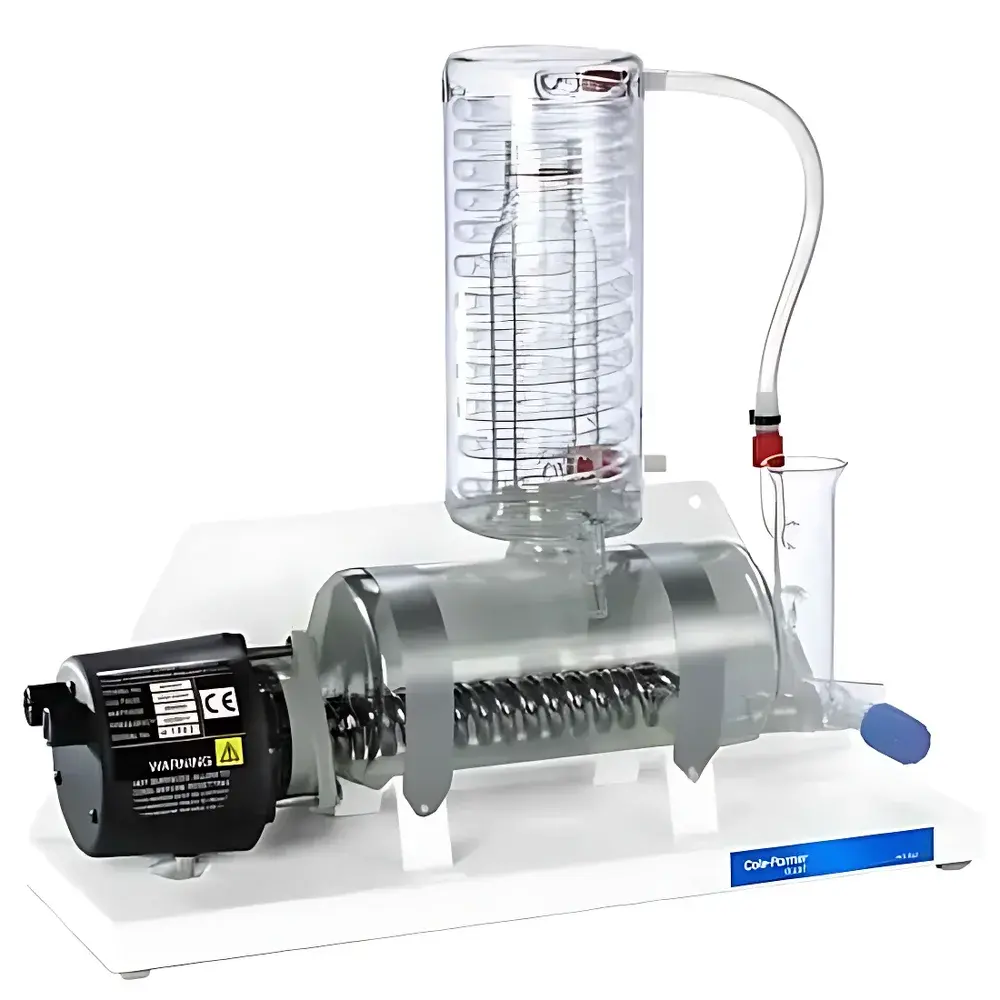
Cole-Parmer Stuart WS-100 (W4000) Pure Water Distillation Apparatus
| Brand | Cole-Parmer |
|---|---|
| Origin | USA |
| Manufacturer Type | Authorized Distributor |
| Origin Category | Imported |
| Model | WS-100 |
| Output Rate | 4 L/h |
| Distillation Type | Single-stage |
| pH Range of Distillate | 5.0–6.5 |
| Conductivity | 3.0–4.0 µS/cm |
| Resistivity | 0.25–0.3 MΩ·cm |
| Temperature of Distillate | 25–35 °C |
| Endotoxin Content | Non-pyrogenic |
| Feed Water Flow Rate | 1 L/min |
| Feed Water Pressure | 3–100 psi (20–700 kPa) |
| Power Supply | 220–240 V, 50–60 Hz, Single-phase |
| Power Consumption | 3.0 kW (W4000) |
| Dimensions (W×D×H) | 500 × 150 × 450 mm |
Overview
The Cole-Parmer Stuart WS-100 (W4000) Pure Water Distillation Apparatus is a benchtop single-stage water distiller engineered for laboratories requiring consistent, low-endotoxin purified water at moderate throughput—without the complexity or cost of multi-stage or deionization-based systems. It operates on the principle of thermal phase separation: feed water is heated to boiling in a stainless-steel or borosilicate glass boiling chamber; steam rises into a vertically oriented, helically wound condenser where prolonged contact with chilled cooling coils ensures efficient heat exchange and complete condensation. The resulting distillate exhibits low conductivity (3.0–4.0 µS/cm), neutral pH (5.0–6.5), and non-pyrogenic quality—meeting minimum specifications for general analytical preparation, buffer formulation, media reconstitution, and equipment rinsing in non-GMP research and teaching environments. Its design prioritizes operational robustness, serviceability, and compliance-ready safety architecture over ultra-high purity claims.
Key Features
- Integrated acid addition funnel and drain valve enable in-situ descaling without disassembly of glassware—reducing downtime and contamination risk during routine maintenance.
- Optimized condenser geometry extends steam-coil contact time, enhancing thermal efficiency and delivering cooled distillate (25–35 °C) while preheating incoming feed water—improving overall energy utilization.
- All fluid path connections utilize threaded fittings (not barbed push-fit), ensuring secure, leak-resistant hose attachment and minimizing accidental disconnection or tubing degradation.
- Dual independent overtemperature cut-offs provide redundant thermal protection: one monitors boiler surface temperature, the other senses steam chamber ambient—both automatically interrupt power if coolant flow is interrupted or heating exceeds safe thresholds.
- Pre-drilled base plate allows permanent wall-mounting or rigid bench anchoring, improving stability and freeing counter space—particularly valuable in shared or high-traffic laboratory settings.
- Long-life metal-sheathed heating element housed within corrosion-resistant chamber construction ensures durability under continuous operation with municipal or softened feed water sources.
Sample Compatibility & Compliance
The WS-100 accepts standard tap water, softened water, or reverse-osmosis (RO) pretreated feed—provided inlet pressure remains within 3–100 psi (20–700 kPa) and flow rate sustains ≥1 L/min. It does not require pretreatment beyond standard sediment filtration. While not certified to ISO 3696 Grade 1 or ASTM D1193 Type I standards, its output meets ISO 3696 Grade 3 and ASTM D1193 Type III specifications for conductivity, pH, and endotoxin absence—making it suitable for applications including glassware rinsing, reagent dilution, histology processing, and non-critical cell culture support. The dual thermal cutoffs satisfy UL 61010-1 and IEC 61010-1 requirements for laboratory electrical safety. No software or electronic data logging is included; therefore, it is inherently compliant with FDA 21 CFR Part 11 as no audit trail or user authentication is implemented.
Software & Data Management
The WS-100 is a fully analog, manually operated distillation system with no embedded microprocessor, touchscreen interface, or digital control logic. All operation—including power activation, feed water regulation, and drain actuation—is performed via mechanical switches and manual valves. Consequently, no firmware updates, calibration certificates, or electronic data records are generated. This architecture eliminates cybersecurity vulnerabilities, reduces long-term validation burden, and aligns with GLP principles for instruments where traceability relies on operator logbooks rather than automated event logs. Maintenance history, run duration, and descaling intervals must be recorded externally per institutional SOPs.
Applications
- Preparation of rinse water for volumetric glassware and analytical instrumentation (e.g., HPLC mobile phase reservoirs, spectrophotometer cuvettes).
- Formulation of non-sterile buffers, saline solutions, and microbiological growth media in academic and industrial R&D labs.
- Supporting histopathology workflows—including tissue fixation, dehydration, and staining baths—where low ionic residue is essential but endotoxin-free grade is not mandated.
- Providing feed water for downstream purification stages (e.g., as inlet source for Type I ultrapure water systems requiring pre-distilled input).
- Teaching laboratories requiring transparent, repairable distillation hardware to demonstrate phase-change purification principles.
FAQ
What feed water quality is recommended for optimal performance?
Softened or reverse-osmosis treated water is strongly advised to minimize scale buildup. Municipal tap water may be used but requires more frequent descaling.
Can the unit operate continuously?
Yes—designed for unattended overnight operation when connected to uninterrupted feed water supply and proper drainage.
Is the distillate sterile?
No. Distillation removes ionic contaminants and endotoxins but does not sterilize; microbial load depends on collection vessel hygiene and storage conditions.
What is the expected service life of the heating element?
Under typical use with pretreated feed water, the metal-sheathed heater demonstrates >5 years of reliable operation before replacement is indicated.
Does this model comply with ISO 15189 or CLIA requirements?
It supports compliance indirectly by delivering consistent Grade 3 water; however, formal accreditation requires documented IQ/OQ/PQ protocols, environmental monitoring, and operator training—not inherent to the device itself.



