
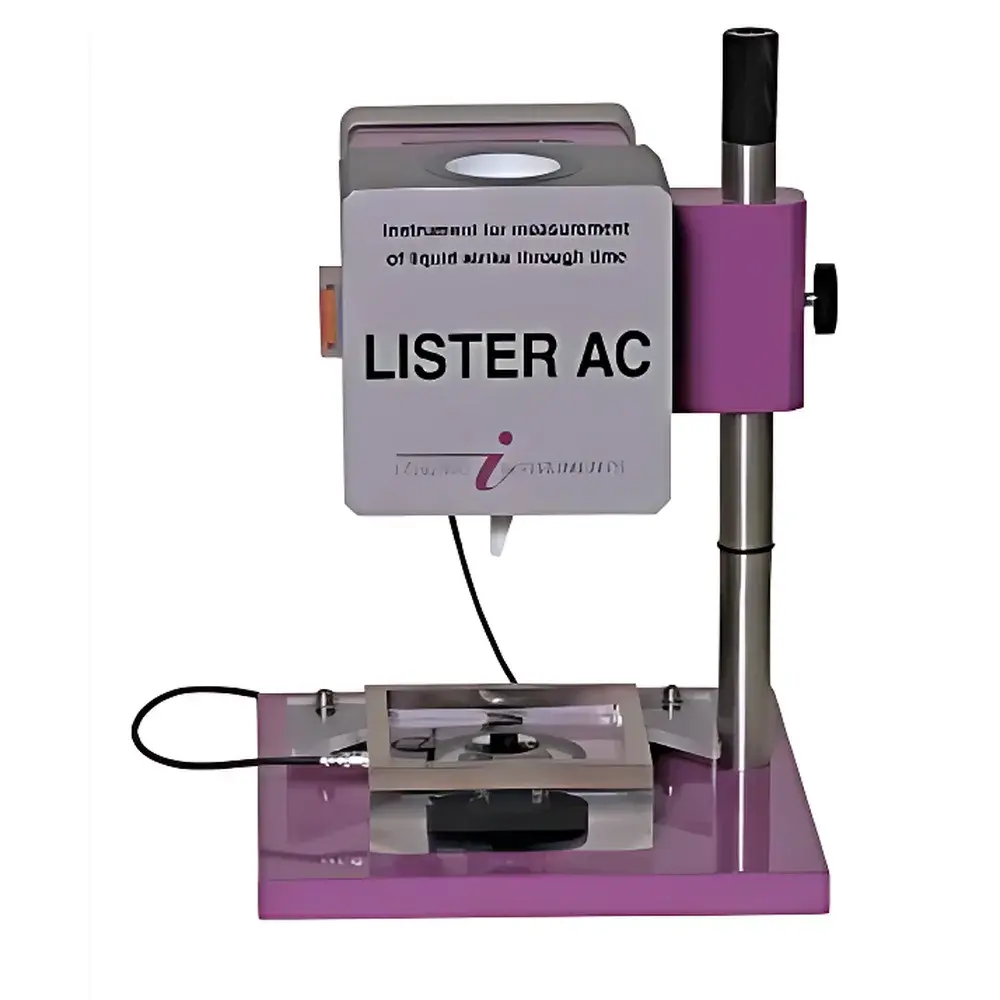
Lenzing Instruments LISTER AC Electronic Liquid Strike-Through Time Tester
| Brand | Lenzing Instruments |
|---|---|
| Country of Origin | Austria |
| Model | LISTER AC |
| Compliance Standards | WSP 70.3 / EDANA ERT 150.5 (02), WSP 70.7 / EDANA ERT 153.0 (02), ISO 9073-8:1995, ISO 9073-13:2001 |
| Measurement Resolution | 0.01 s |
| Accuracy | Exceeds EDANA/INDA Standard Requirements |
| Re-wet Testing Capability | Yes, per WSP 80.10 (ERT 151.3) and WSP 70.8 (ERT 154.0) on same specimen |
| Test Fluid | Synthetic Urine (standardized formulation per EDANA/INDA protocols) |
| Filter Paper | Original Lenzing-certified filter paper recommended |
Overview
The Lenzing Instruments LISTER AC Electronic Liquid Strike-Through Time Tester is a precision-engineered instrument designed specifically for quantifying the dynamic liquid transport behavior of nonwoven fabrics used in hygiene products—including diapers, feminine care pads, and adult incontinence materials. It operates on the principle of controlled gravitational delivery of a standardized synthetic urine solution onto a horizontally mounted fabric specimen, followed by real-time electronic detection of the moment the liquid front first breaches the reverse surface. This measurement—defined as strike-through time (STT)—is a critical performance indicator directly linked to user comfort, leakage prevention, and product efficacy. The LISTER AC implements a fully automated timing sequence compliant with internationally harmonized test methodologies developed by EDANA (European Disposables and Nonwovens Association) and INDA (Association of the Nonwoven Fabrics Industry), ensuring data comparability across global R&D laboratories, quality control facilities, and regulatory submissions.
Key Features
- High-resolution electronic timing system with 0.01-second resolution, enabling precise discrimination between subtle differences in fabric wettability and capillary structure.
- Dual-function capability: performs both primary strike-through time measurement and subsequent re-wet evaluation on the identical specimen without manual repositioning—reducing inter-test variability and improving throughput efficiency.
- Standardized fluid delivery mechanism calibrated to dispense 0.5 mL or 1.0 mL (user-selectable) of synthetic urine at a defined volumetric rate, replicating physiological challenge conditions.
- Integrated sensor array detects liquid breakthrough via electrical conductivity change across the lower support plate, eliminating subjective visual interpretation and operator bias.
- Robust mechanical architecture with stainless-steel sample holder and adjustable clamping force ensures consistent specimen tension and eliminates edge leakage artifacts.
- Designed for compliance with EDANA/INDA reference methods; recognized as an EDANA-recommended instrument for routine STT assessment in certified testing labs.
Sample Compatibility & Compliance
The LISTER AC accommodates standard circular specimens (typically 100 mm diameter) cut from roll goods or finished products. It supports single-layer and multi-layer composite structures common in modern absorbent cores and acquisition/distribution layers. All test procedures adhere strictly to WSP 70.3 (EDANA ERT 150.5, 2002 edition), WSP 70.7 (EDANA ERT 153.0, 2002), ISO 9073-8:1995 (determination of liquid strike-through time), and ISO 9073-13:2001 (determination of re-wet). For traceable results, use of Lenzing-certified reference filter paper is strongly advised during calibration and validation runs. The instrument meets requirements for GLP-compliant environments when paired with appropriate laboratory documentation practices and audit-ready software logs.
Software & Data Management
While the base LISTER AC model operates via standalone hardware controls and digital display, optional PC connectivity enables export of timestamped STT and re-wet values in CSV format. When integrated into enterprise QC workflows, data may be imported into LIMS platforms supporting ASTM E1482 or ISO/IEC 17025 traceability frameworks. Full audit trails—including operator ID, test date/time, specimen ID, and environmental conditions (if externally logged)—can be maintained to satisfy FDA 21 CFR Part 11 requirements for electronic records in regulated manufacturing settings.
Applications
- Formulation screening of superabsorbent polymers (SAP) and cellulose fiber blends.
- Process optimization of hydrophilic finishing treatments and surfactant coatings.
- Comparative benchmarking of competing nonwoven suppliers against internal specification limits.
- Root-cause analysis of field complaints related to leakage or surface dampness.
- Supporting regulatory dossiers for CE marking, FDA 510(k), or Health Canada submissions where functional performance data is required.
FAQ
What synthetic urine formulation is required for LISTER AC testing?
A standardized synthetic urine solution conforming to EDANA/INDA specifications (e.g., 0.9% NaCl, 0.1% urea, pH 6.0 ± 0.2) must be used. Preparation protocols are detailed in WSP 70.3 Annex A.
Can the LISTER AC test biodegradable or hydrophobic nonwovens?
Yes—provided the material permits measurable strike-through within the instrument’s operational range (typically 0.1–300 seconds); extended-range protocols may require method validation per ISO 17025.
Is calibration verification required before each test series?
Daily verification using certified reference filter paper and timed drop calibration is recommended; full calibration per manufacturer guidelines should occur at least quarterly or after maintenance.
Does the system support multi-specimen batch testing?
No—the LISTER AC evaluates one specimen per cycle; however, sequential testing is streamlined via rapid specimen exchange and auto-zeroing between runs.
How is re-wet measured following strike-through?
After STT detection, a pre-defined pressure load (e.g., 0.5 kPa) is applied for 60 seconds, followed by gravimetric quantification of residual surface moisture using a precision balance—per WSP 80.10 protocol.





