
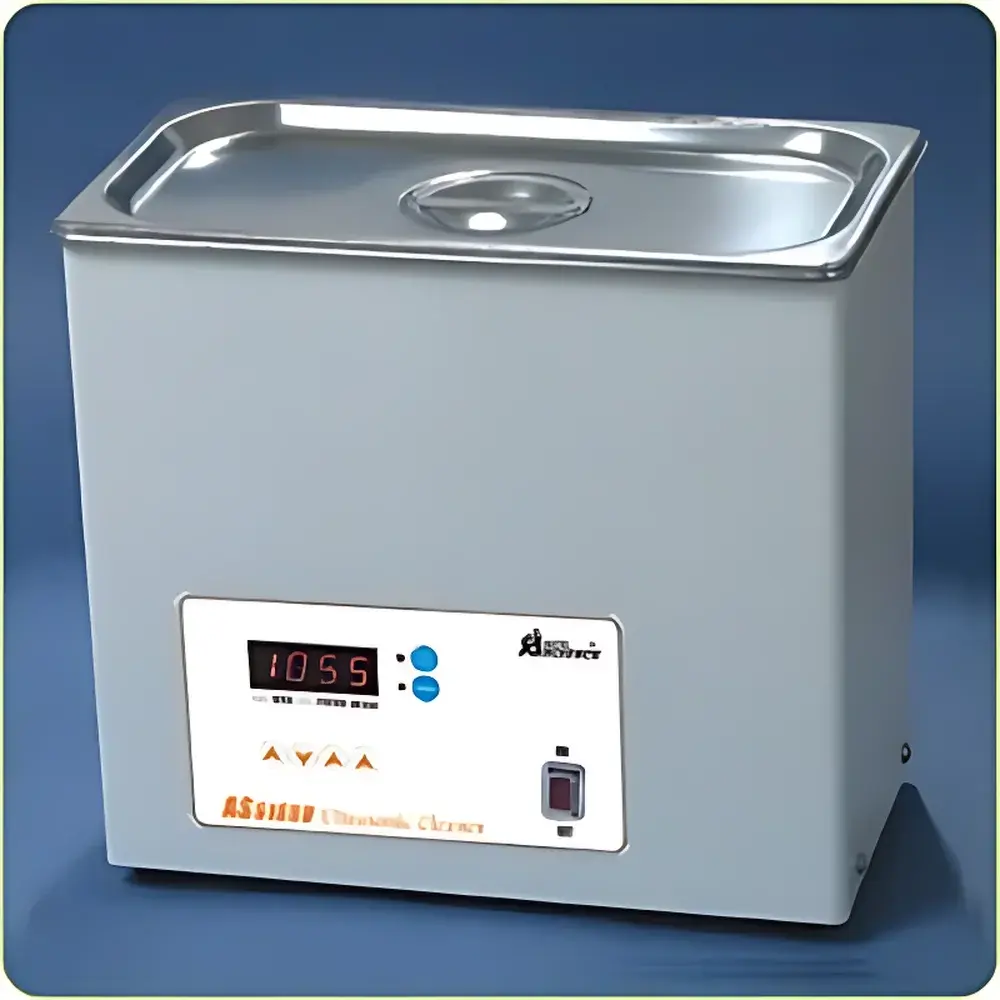
Otisence AS5150B Benchtop Ultrasonic Cleaner
| Brand | Otisence |
|---|---|
| Model | AS5150B |
| Type | General-purpose ultrasonic cleaner |
| Capacity | 6 L |
| Ultrasonic frequency | 40 / 50 / 60 kHz |
| Ultrasonic power output | 180 W |
| Power adjustment range | 1–100% |
| Timer range | 1–999 min |
| Noise-reduction lid | Yes |
| Manual fill/drain | Yes |
| Internal tank dimensions (W×L×D) | 300 × 150 × 150 mm |
| External dimensions (W×L×H) | 320 × 175 × 290 mm |
| Tank material | Aluminum alloy |
| Degassing function | Yes |
| Temperature control | Not available |
Overview
The Otisence AS5150B is a benchtop general-purpose ultrasonic cleaner engineered for precision cleaning of laboratory glassware, precision components, optical elements, and small instrumentation parts. It operates on the principle of cavitation—high-frequency sound waves (40, 50, or 60 kHz) generate microscopic bubbles in the cleaning solvent that rapidly collapse, producing localized high-pressure shockwaves and microstreaming effects. This physical mechanism effectively dislodges particulate contaminants, organic residues, and loosely adhered biofilms from complex surface geometries without mechanical abrasion. Designed for routine use in QC labs, research facilities, and maintenance workshops, the AS5150B delivers consistent energy distribution across its 6-liter aluminum alloy tank and supports reproducible cleaning cycles under controlled time and power parameters.
Key Features
- Digital timer with adjustable range from 1 to 999 minutes—enabling precise cycle definition for both short-duration rinses and extended soak-and-clean protocols.
- Three selectable ultrasonic frequencies (40 kHz, 50 kHz, 60 kHz) to optimize cleaning efficiency based on contaminant type and substrate sensitivity—lower frequencies favor aggressive particle removal; higher frequencies improve gentleness on delicate surfaces.
- Continuously variable power output (1–100% of 180 W nominal), allowing fine-tuned energy delivery to prevent damage to fragile samples while maintaining efficacy on tenacious soils.
- Integrated degassing mode to remove dissolved air from solvents prior to cleaning—reducing bubble interference and ensuring maximal cavitation intensity during operation.
- Acoustically damped lid included as standard equipment—significantly attenuates airborne noise and suppresses solvent evaporation during operation, improving operator safety and environmental control.
- Aluminum alloy tank construction provides excellent corrosion resistance against common aqueous and mild organic solvents, while enabling rapid thermal equilibration and long-term structural integrity.
Sample Compatibility & Compliance
The AS5150B accommodates a broad range of sample types including volumetric flasks, pipette tips, filter housings, semiconductor wafers, watch components, dental instruments, and printed circuit board assemblies. Its open-tank configuration and 150 mm depth support immersion of vertically oriented items up to 140 mm tall. While the unit does not incorporate active temperature regulation, it remains compatible with temperature-stable cleaning solutions such as aqueous alkaline detergents, ethanol/water mixtures, and low-volatility terpenes. The device complies with IEC 61000-6-3 (EMC emission standards) and meets basic electrical safety requirements per IEC 61010-1 for laboratory equipment. It is suitable for environments operating under GLP-aligned workflows where documented cleaning parameters (time, frequency, power) are manually recorded and retained for audit purposes.
Software & Data Management
The AS5150B operates via an embedded digital control interface with no external software dependency. All operational parameters—including selected frequency, power level, timer setting, and degas activation—are set and confirmed through front-panel LED indicators and tactile push-button inputs. No data logging, USB export, or remote interface capabilities are provided; this design prioritizes reliability, electromagnetic immunity, and ease of validation in regulated settings where minimal firmware complexity reduces qualification burden. Users may integrate the unit into broader SOPs by referencing its fixed parameter setpoints within batch records or equipment logs—consistent with FDA 21 CFR Part 11 expectations for non-electronic record systems.
Applications
- Routine decontamination of HPLC vials, autosampler needles, and column frits prior to analytical runs.
- Preparation of substrates for SEM/TEM sample mounting—removing dust, fingerprint oils, and polishing residues.
- Cleaning of reusable surgical tools and endoscope accessories in clinical research labs (when used with validated disinfectant-compatible solutions).
- Removal of flux residues from soldered PCBs before functional testing or conformal coating.
- Supporting ASTM D2240 (Shore A hardness) sample preparation by eliminating mold release agents from elastomer test specimens.
- Maintenance of calibration standards—e.g., NIST-traceable weights and gauge blocks—where particulate-free surfaces are essential for metrological accuracy.
FAQ
Is the AS5150B suitable for cleaning delicate optics such as coated lenses or laser mirrors?
Yes—selecting 60 kHz and reducing power to ≤30% minimizes cavitation erosion risk while retaining sufficient energy for sub-micron particle removal. Always verify compatibility with your specific coating chemistry using a representative test sample.
Can the unit be operated continuously for extended durations?
The AS5150B supports uninterrupted operation up to 999 minutes per cycle; however, duty-cycle limitations apply. For continuous use exceeding 4 hours, allow ≥30 minutes of cooling interval between cycles to maintain transducer longevity and thermal stability.
Does the aluminum tank resist corrosion when used with isopropyl alcohol or acetone?
Aluminum exhibits limited resistance to halogenated and strongly acidic solvents, but is compatible with IPA and acetone for intermittent use (<30 min exposure). Prolonged immersion or elevated temperatures may accelerate oxidation—rinse thoroughly with deionized water after solvent use.
Is there a drain valve for automated emptying?
No—the AS5150B uses manual fill and drain via the rear-mounted port. This simplifies construction, improves seal reliability, and avoids potential leakage paths associated with integrated valves.
What safety certifications does the unit carry?
It conforms to IEC 61000-6-3 (EMC emissions) and IEC 61010-1 (safety for electrical equipment for measurement, control, and laboratory use), with CE marking applied for European market compliance.



