
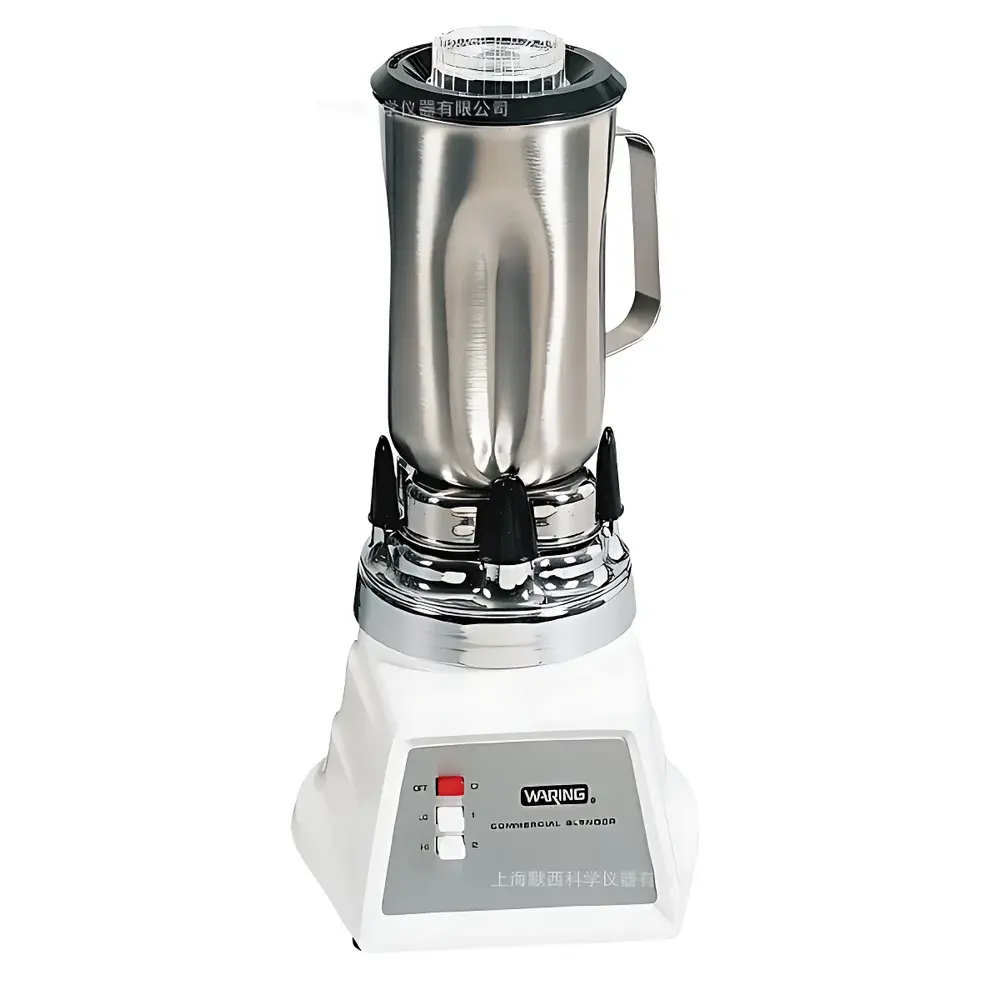
Waring 8011S/8011G/8011ES/8011EG Dual-Speed Laboratory Homogenizer
| Brand | Waring |
|---|---|
| Origin | USA |
| Model Series | 8011S / 8011G / 8011ES / 8011EG |
| Capacity | 1 L (standard) / 1.2 L (optional) |
| Speed Settings | 18,000 rpm and 22,000 rpm |
| Base Coating | Epoxy-resin coated |
| Container Materials | Stainless steel (8011S/CAC33) or borosilicate glass (8011G/CAC32) |
| Lid Construction | Two-layer polyethylene/polypropylene seal |
| Height | 38 cm (8011S) / 40.5 cm (8011G) |
| Weight | 4.3 kg (8011S) / 5.2 kg (8011G) |
| Optional Accessories | CAC32 (1.2 L glass), CAC33 (1 L stainless steel), CAC19 (1.4 L polycarbonate), CAC64 (500 mL polycarbonate) |
Overview
The Waring 8011S/8011G/8011ES/8011EG Dual-Speed Laboratory Homogenizer is a robust, benchtop mechanical homogenization system engineered for reproducible sample disruption, emulsification, and suspension preparation in life science, pharmaceutical, food, and industrial R&D laboratories. Based on high-torque rotor–stator shear principle, the unit delivers controlled mechanical energy through rapid rotation of a precision-balanced stainless-steel blade assembly within a sealed container—generating intense fluid shear, cavitation, and turbulent mixing to achieve uniform particle size reduction and dispersion. Its fixed dual-speed architecture (18,000 rpm and 22,000 rpm) eliminates variable-speed complexity while ensuring consistent operational repeatability across users and shifts—a critical advantage in GLP-compliant workflows where protocol standardization is mandated.
Key Features
- Fixed dual-speed motor drive (18,000 rpm / 22,000 rpm) with momentary push-button activation for precise timing control and operator safety
- Epoxy-coated die-cast aluminum base for chemical resistance, structural rigidity, and long-term stability on laboratory benches
- Interchangeable 1 L primary containers: Type 304 stainless steel (8011S/CAC33) for abrasive or corrosive samples; borosilicate glass (8011G/CAC32) for visual monitoring and thermal compatibility up to 120 °C
- Two-layer polyethylene/polypropylene lid system with integrated sealing gasket ensures leak-proof containment during high-shear operation and minimizes aerosol generation
- Ergonomic handle design on all standard containers facilitates secure handling, pouring, and cleaning without direct contact with processed material
- UL-listed electrical components and thermally protected motor meet North American safety standards (UL 61010-1)
Sample Compatibility & Compliance
The 8011-series accommodates a broad range of biological, viscous, and particulate-laden matrices—including soft animal tissues, plant leaves, cultured cells, dairy emulsions, protein suspensions, and polymer dispersions—without requiring pre-chopping or dilution. Stainless steel and glass vessels are autoclavable (121 °C, 15 psi, 20 min), supporting ISO 13485-aligned sterilization protocols in biomanufacturing environments. All models comply with IEC 61000-6-3 (EMC emission limits) and IEC 61000-6-2 (immunity). While not inherently 21 CFR Part 11 compliant due to lack of electronic audit trail, the device is routinely deployed in FDA-regulated labs as a pre-analytical sample preparation tool under documented SOPs that include manual logbook entries for run parameters, lot numbers, and operator ID.
Software & Data Management
This is a stand-alone electromechanical instrument with no embedded firmware, touchscreen interface, or digital connectivity. Operational data (speed selection, run duration, container type, sample ID) must be recorded manually in lab notebooks or integrated into LIMS via external time-stamped entry. Its simplicity supports uninterrupted use in high-throughput core facilities where reliability, minimal maintenance, and rapid turnover between users are prioritized over digital integration. For labs requiring traceability, pairing with a calibrated stopwatch and standardized run sheets satisfies ISO/IEC 17025 clause 7.7 (result reporting) and USP guidance on analytical instrument qualification.
Applications
- Tissue homogenization: Efficient lysis of liver, spleen, or brain tissue for downstream DNA/RNA extraction, ELISA, or enzymatic activity assays
- Food product development: Consistent emulsification of cheese spreads, meat pastes, and plant-based analogs under controlled shear history
- Pharmaceutical formulation: Preparation of suspensions for dissolution testing (USP ) and colloidal carrier systems (e.g., nanoemulsions)
- Microbiology: Disruption of fungal mycelia or biofilm aggregates prior to CFU enumeration or metagenomic analysis
- Materials science: Dispersion of nanomaterials (e.g., graphene oxide, TiO₂ nanoparticles) in aqueous or organic media for rheological or optical characterization
FAQ
What is the maximum recommended operating time per cycle?
Continuous operation should not exceed 60 seconds per cycle to prevent motor overheating and blade deformation. Allow ≥90 seconds of cooling between cycles when processing viscous or dense samples.
Can the 8011G glass container be used with acidic solutions?
Borosilicate glass (e.g., Pyrex®-grade) resists most weak acids (e.g., acetic, citric) at room temperature; avoid prolonged exposure to hydrofluoric acid or hot concentrated phosphoric acid.
Is the CAC64 500 mL polycarbonate container suitable for centrifugation after homogenization?
No—CAC64 is designed solely for homogenization; it lacks the wall thickness and balance specifications required for safe centrifugation. Transfer samples to certified centrifuge tubes before spinning.
Does Waring provide calibration certificates for rotational speed?
Speed calibration is factory-verified using NIST-traceable tachometry; formal calibration documentation is available upon request (fee applies) and includes uncertainty budget per ISO/IEC 17025.
How often should the blade assembly be replaced?
Under typical usage (≤10 cycles/day), inspect blades monthly for nicks or dulling; replace every 6–12 months or immediately after processing abrasive materials (e.g., bone, seeds, silica beads).



