
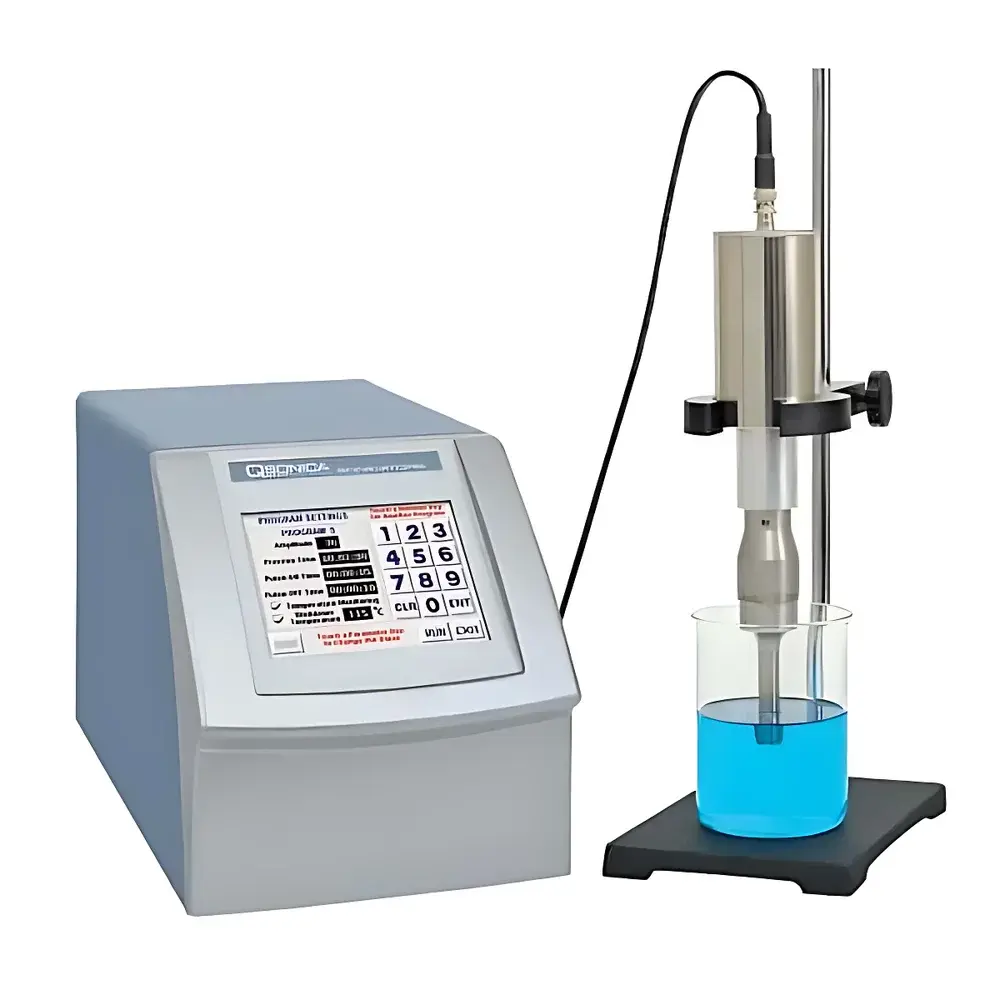
Qsonica Q700 Touchscreen 700-Watt Ultrasonic Cell Disruptor
| Origin | USA |
|---|---|
| Manufacturer Type | Authorized Distributor |
| Origin Category | Imported |
| Model | Q700 |
| Instrument Type | Ultrasonic Cell Disruptor |
| Ultrasonic Power Output | 700 W |
| Operating Frequency | 20 kHz |
| Sample Volume Range | 0.2 mL to 40 L |
| Input Voltage | 220 VAC |
| Input Frequency | 50/60 Hz |
| Catalog Number | 04712-84 |
Overview
The Qsonica Q700 Touchscreen Ultrasonic Cell Disruptor is a high-power, microprocessor-controlled sonication system engineered for reproducible and scalable disruption of biological cells, tissue homogenization, chromatin shearing, nanoparticle dispersion, and solvent-free extraction across research and process development laboratories. It operates on the principle of piezoelectric ultrasonics: an RF-driven transducer converts electrical energy into mechanical oscillations at a fixed resonant frequency of 20 kHz, transmitted via titanium horn (probe) into the sample medium. This generates intense cavitation—formation, growth, and implosive collapse of microbubbles—producing localized shear forces, shockwaves, and transient hotspots sufficient to disrupt membranes, fragment nucleic acids, and deaggregate colloids. Unlike fixed-amplitude analog systems, the Q700 dynamically tracks and compensates for real-time shifts in probe resonance (caused by thermal drift or load variation), maintaining optimal electroacoustic coupling and consistent energy delivery over extended operation.
Key Features
- 700 W nominal output power with closed-loop amplitude control (0–100% in 1% increments), enabling precise energy dosing across diverse sample viscosities and volumes.
- Capacitive touchscreen interface with intuitive icon-based navigation, multi-level user access (operator/admin), and on-screen contextual help menus for rapid protocol deployment.
- Programmable pulse mode: adjustable on/off intervals from 1 second to 24 hours; total cumulative runtime up to 72 hours per session for unattended overnight processing.
- Real-time energy monitoring: integrated wattmeter displays instantaneous power, cumulative energy (Joules), and duty cycle—critical for method transfer and regulatory documentation.
- Self-diagnostic subsystem continuously monitors transducer temperature, impedance, and frequency deviation; alerts users to suboptimal coupling or overheating conditions before probe damage occurs.
- Modular probe architecture supporting interchangeable horns (e.g., 13 mm stepped horn included) and optional accessories including cup horns, flow-through cells, and temperature-controlled sample chambers.
Sample Compatibility & Compliance
The Q700 accommodates sample volumes ranging from microliter-scale lysates (0.2 mL in microtubes) to liter-scale bioprocessing batches (up to 40 L with external flow cell integration). It supports aqueous buffers, organic solvents (e.g., ethanol, chloroform), viscous lysates, and heterogeneous suspensions—including bacterial cultures, mammalian cells, plant tissues, yeast, and synthetic nanomaterials. All firmware and operational logic comply with IEC 61000-6-3 (EMC emission standards) and IEC 61010-1 (safety requirements for laboratory equipment). Data logging features support GLP/GMP-aligned workflows: timestamped run records, user ID tagging, and audit-trail-capable export (CSV/Excel) meet FDA 21 CFR Part 11 readiness when paired with validated networked storage solutions.
Software & Data Management
The embedded operating system stores up to 100 user-defined protocols with full parameter sets (amplitude, duration, pulse profile, ramp settings). Each run generates a digital log containing start/stop timestamps, total energy delivered (J), average power (W), frequency deviation (±Hz), and thermal history of the transducer. Logs are exportable via USB flash drive or RS-232 serial interface. Optional Q-Connect software (Windows-compatible) enables remote monitoring, batch report generation, and integration with LIMS environments. All data fields adhere to ISO/IEC 17025 traceability requirements for calibration and performance verification.
Applications
- Cell lysis for protein extraction and subcellular fractionation in proteomics and enzymology studies.
- Controlled DNA fragmentation for ChIP-seq, ATAC-seq, and library preparation in next-generation sequencing workflows.
- Homogenization of fibrous or lipid-rich tissues (e.g., liver, adipose, plant roots) without phenol-chloroform phase separation.
- Nanoparticle deagglomeration and stabilization in drug delivery formulation development.
- Accelerated solvent-free extraction of bioactive compounds (e.g., polyphenols, terpenes) from botanical matrices.
- Emulsification and dispersion of high-viscosity polymer blends in biomaterial synthesis.
FAQ
What is the maximum continuous run time for the Q700?
The system supports uninterrupted operation for up to 72 hours per session when configured with appropriate cooling and duty cycling.
Can the Q700 be used with temperature-sensitive samples?
Yes—when coupled with external recirculating chillers or ice-water baths, and operated in pulsed mode, the Q700 maintains sample temperatures below 10 °C during extended processing.
Is probe calibration required before each use?
No routine recalibration is needed; however, annual verification of amplitude accuracy and power output against NIST-traceable standards is recommended for regulated environments.
Does the Q700 support automated liquid handling integration?
While not natively robotic, the RS-232 port and TTL-compatible trigger inputs allow synchronization with third-party autosamplers and programmable stage controllers.
What safety certifications does the Q700 hold?
It carries CE marking per EU Directive 2014/30/EU (EMC) and 2014/35/EU (LVD), and complies with UL 61010-1 for North American laboratory use.




