
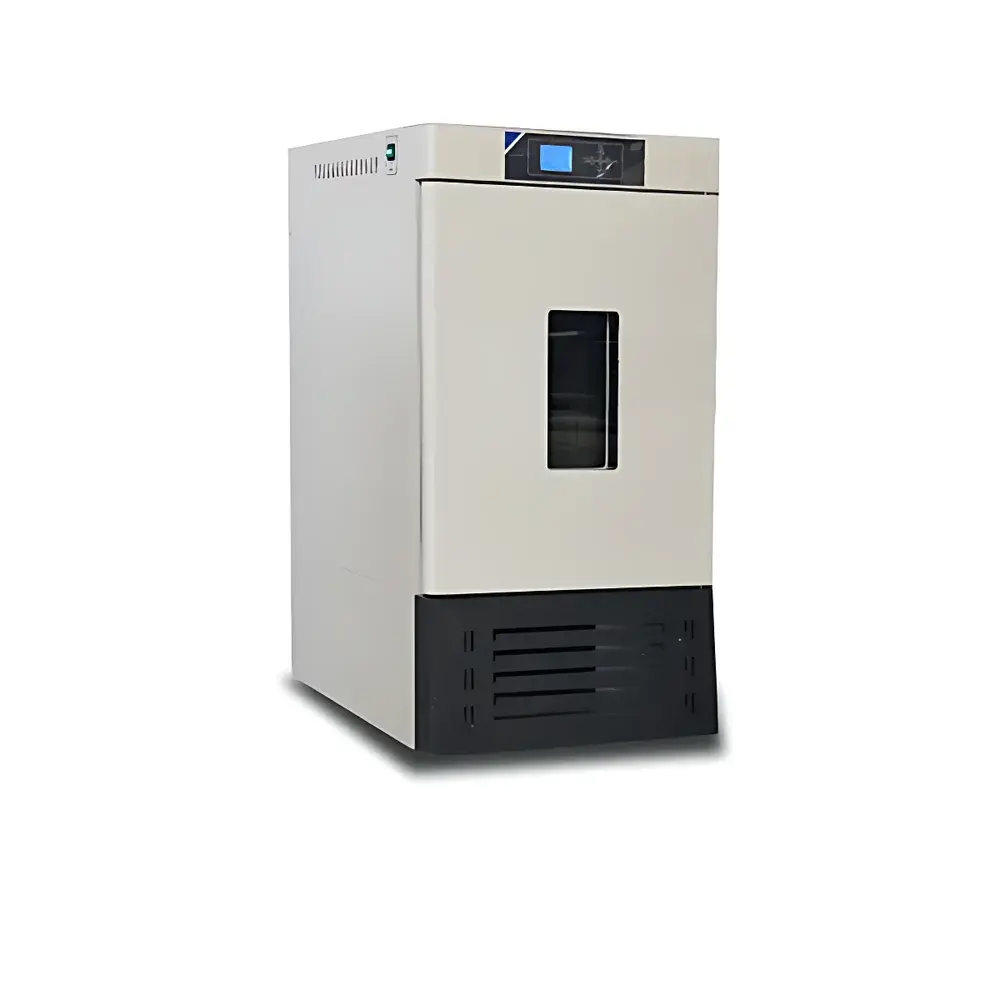
Shanghai Hujing LRH-70-ZD Biochemical Incubator
| Brand | Hujing Purification (HJ) |
|---|---|
| Origin | Shanghai, China |
| Manufacturer Type | Direct Manufacturer |
| Model | LRH-70-ZD |
| Temperature Range | 0–70 °C |
| Temperature Resolution | 0.1 °C |
| Temperature Fluctuation | ±0.5 °C |
| Temperature Uniformity | ±1 °C (at 37 °C) |
| Chamber Volume | 70 L |
| Interior Dimensions (D×W×H) | 350×400×500 mm |
| Exterior Dimensions (D×W×H) | 540×540×1070 mm |
| Power Supply | 220 V, 50 Hz |
| Heating Power | 0.5 kW |
| Refrigerant | R134a |
| Control Method | PID-based heating/cooling balance |
| Display | LCD |
| Setpoint Input | Membrane keypad (touchscreen optional) |
| Timer Range | 0–9999 min |
| Safety Features | Over-temperature alarm, compressor overheat protection, instrument fault detection, power failure memory |
| Insulation | Flame-retardant rigid polyurethane foam + fire-resistant board |
| Interior Material | Stainless steel (304), radius-cornered construction |
| Door | Double-door design with full-view tempered glass inner door and magnetic seal outer door |
| Air Circulation | Forced convection via low-noise centrifugal fan |
| Additional Functions | Built-in illumination, UV sterilization, temperature offset calibration, menu lock, programmable operation mode, automatic defrost, dual test ports (1 internal, 1 external), 4 casters, 2 adjustable stainless steel shelves (15 kg load capacity each) |
Overview
The Shanghai Hujing LRH-70-ZD Biochemical Incubator is an engineered environmental control system designed for precise, stable, and reproducible temperature regulation in life science laboratories. It operates on a forced-air convection principle—using a low-noise centrifugal fan to ensure uniform airflow distribution across the 70-liter stainless-steel chamber—enabling consistent thermal conditions essential for microbial cultivation, mammalian cell propagation, pharmaceutical stability testing, entomological rearing, and small-animal housing protocols. Unlike static or natural-convection incubators, the LRH-70-ZD maintains active thermal equilibrium through simultaneous PID-regulated heating (via stainless-steel sheathed resistive elements) and cooling (via a hermetically sealed R134a refrigeration circuit), delivering high fidelity across its operational range of 0–70 °C. The unit meets baseline functional requirements for GLP-compliant environments where traceability, repeatability, and operational safety are mandated by institutional biosafety policies.
Key Features
- Stainless-steel interior (AISI 304) with radius-cornered welds and electropolished finish—resistant to corrosion, easy to sanitize, and compliant with ISO 14644-1 Class 8 cleanroom-compatible surface standards.
- Dual-door architecture: outer door with magnetic EPDM gasket seal (tested to ≤0.5 m³/h leakage at 25 Pa differential) and inner full-view tempered glass door—minimizing thermal loss during observation without opening the primary chamber.
- PID-controlled thermal management system with real-time feedback from dual PT100 platinum resistance thermometers—one mounted in air stream, one near chamber wall—ensuring dynamic compensation for ambient drift and load-induced thermal inertia.
- Integrated safety redundancy: independent over-temperature cutoff (mechanical backup), compressor thermal overload relay, controller self-diagnostic routine, and non-volatile memory retention for setpoints and runtime logs after power interruption.
- Configurable auxiliary functions including UV-C germicidal irradiation (254 nm, timer-controlled), LED interior lighting (6500 K, flicker-free), and user-adjustable temperature bias correction (±5.0 °C range) to compensate for sensor positioning or calibration offsets.
Sample Compatibility & Compliance
The LRH-70-ZD accommodates standard microbiological and cell culture formats—including Petri dishes (up to 150 mm), multiwell plates (6–96-well), Erlenmeyer flasks (≤2 L), and animal caging systems (up to 30 cm × 30 cm footprint). Its chamber geometry supports placement of up to two 15 kg-rated stainless-steel shelves with 4-point support rails, enabling vertical stacking of heterogeneous sample loads without airflow obstruction. While not certified to IEC 61010-1 Ed. 3 or UL 61010B-1 out-of-the-box, the unit conforms to GB/T 14710–2009 (Chinese national standard for environmental testing of medical electrical equipment) and incorporates design elements aligned with ISO 13485:2016 risk management principles. For regulated applications requiring audit-ready documentation, optional factory-installed validation kits (IQ/OQ templates, thermocouple mapping reports, and 21 CFR Part 11–compatible firmware upgrade) are available upon request.
Software & Data Management
The embedded controller provides local operation via a 4.3-inch monochrome LCD with tactile membrane keypad interface; touchscreen upgrade (7-inch resistive TFT) supports multi-language UI (English, Spanish, German, French). All temperature setpoints, timer configurations, alarm thresholds, and program sequences are stored in non-volatile EEPROM with timestamped event logging (power-on, door open/close, alarm triggers, deviation alerts). Optional RS-485 Modbus RTU output enables integration into centralized lab monitoring platforms (e.g., LabVantage, Siemens Desigo CC, or custom SCADA). Data export is supported via USB flash drive (CSV format), including 30-day rolling temperature history at 1-minute intervals. Firmware adheres to basic ALCOA+ data integrity principles: attributable, legible, contemporaneous, original, accurate—with electronic signatures disabled by default unless upgraded to GxP-compliant firmware version.
Applications
- Microbiological assays requiring controlled mesophilic or thermophilic growth (e.g., E. coli, Bacillus subtilis, yeast fermentation at 30–37 °C).
- Cell line maintenance under normothermic conditions (e.g., HEK293, CHO-K1 at 37 °C ±0.5 °C), including pre-incubation prior to transfection or metabolic stress induction.
- Pharmaceutical stability studies per ICH Q1A(R2) guidelines—long-term (25 °C/60% RH), accelerated (40 °C/75% RH), and intermediate (30 °C/65% RH) storage condition simulation.
- Insect rearing protocols (e.g., Drosophila melanogaster, Tribolium castaneum) demanding diurnal temperature cycling (programmable ramp-hold profiles).
- Seed germination and plant tissue culture experiments requiring precise chilling stratification (e.g., 4 °C for 72 h) followed by warm-phase activation (22 °C).
FAQ
What is the minimum ambient temperature required for reliable sub-10 °C operation?
The unit requires ambient conditions below 26 °C and relative humidity under 80% RH to achieve stable setpoints below 10 °C, as specified in GB/T 14710–2009 environmental test protocol.
Can the UV sterilization function be operated independently of temperature control?
Yes—the UV lamp circuit is electrically isolated and can be activated manually or scheduled separately via the timer module, regardless of chamber temperature state.
Is remote monitoring or control supported natively?
Standard configuration includes only local interface and RS-485 Modbus RTU port; Ethernet/WiFi connectivity and cloud-based telemetry require optional communication gateway hardware and licensed software add-ons.
Does the unit comply with FDA 21 CFR Part 11 requirements?
Out-of-the-box firmware does not include electronic signature, audit trail, or role-based access control; these capabilities are available only with validated GxP firmware package and associated qualification documentation.
What calibration documentation is provided with shipment?
Each unit ships with a factory-assembled calibration certificate referencing NIST-traceable PT100 sensors, indicating as-found/as-left readings at three points (10 °C, 37 °C, 60 °C) per ISO/IEC 17025–accredited internal procedure.




