
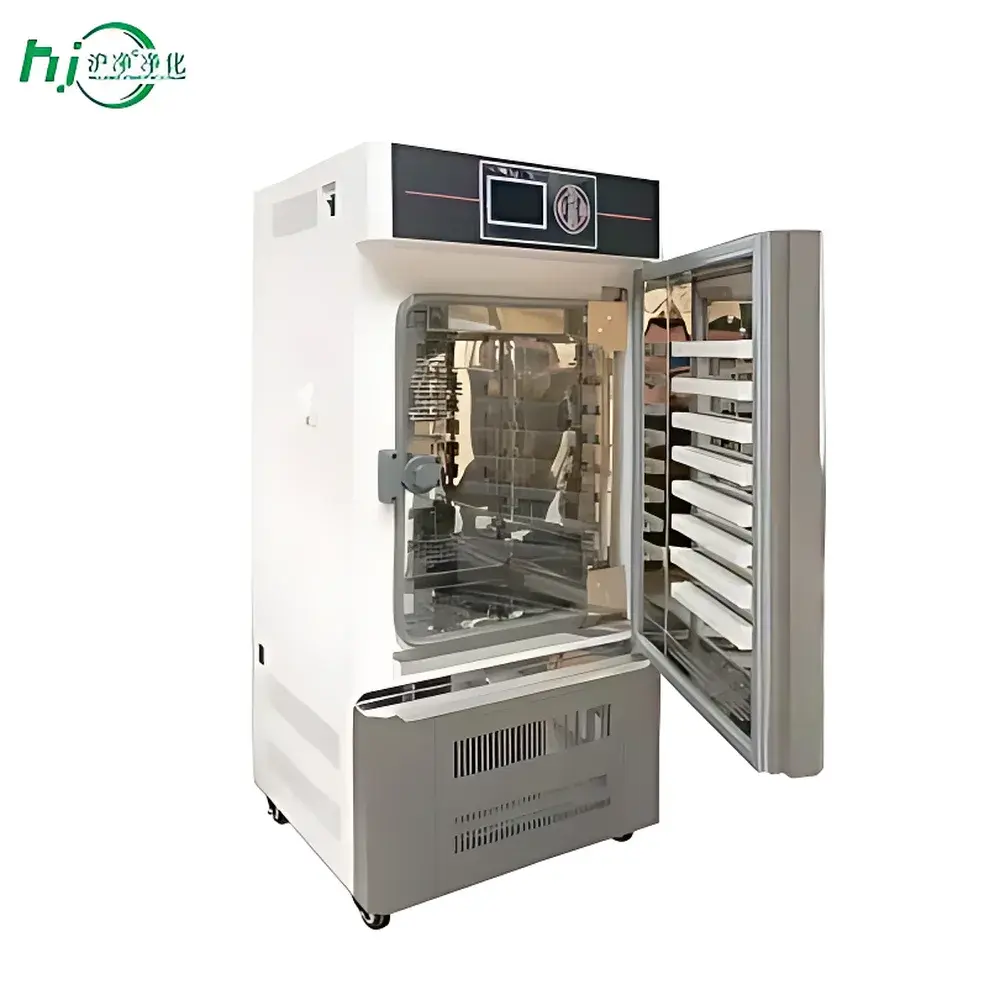
HJ QHP Series Plant Growth Chamber
| Brand | HJ |
|---|---|
| Origin | Shanghai, China |
| Manufacturer Type | Direct Manufacturer |
| Model | QHP-70ZD / QHP-150ZD / QHP-250ZD / QHP-360ZD / QHP-460ZD |
| Temperature Control Range (with light) | 10–50°C |
| (without light) | 0–50°C |
| Temperature Resolution / Uniformity | 0.1°C / ±1°C (at 37°C) |
| QHP-460ZD | ±0.5°C |
| Temperature Fluctuation | ≤1.0°C (QHP-70ZD to QHP-360ZD), ≤0.5°C (QHP-460ZD) |
| Humidity Range | 50–95% RH (operational only at 10–30°C |
| Humidity Fluctuation | ±5% RH |
| Illumination | 0–12,000 lux (LED, dual-side or top-mounted) |
| Air Circulation | Forced convection via centrifugal fan |
| Refrigerant | R134a |
| Compressor | Hermetic, eco-friendly |
| Heating Element | Stainless steel sheathed heater |
| Insulation | Fire-retardant rigid board + polyurethane foam |
| Interior Material | 304 stainless steel |
| Exterior Finish | Cold-rolled steel with chemical-resistant coating |
| Control System | PID-based, microprocessor-controlled |
| Display & Interface | LCD (BE-type) or capacitive touchscreen (CE-type) |
| Safety Features | Over-temperature alarm, compressor overheat protection, sensor fault detection, power failure memory, door-open alert |
| Power Supply | 220 V AC, 50 Hz |
| Internal Volume | 70 L / 150 L / 250 L / 360 L / 460 L |
| Shelf Capacity | 2 shelves (4 adjustable positions), 15 kg per shelf |
| Casters | Four omnidirectional, locking wheels |
| Test Port | 1 × Φ50 mm |
| Humidification Port | 1 × Φ30 mm |
| Weight (Net/Gross) | 60/80 kg to 140/180 kg |
Overview
The HJ QHP Series Plant Growth Chamber is a precision-engineered environmental simulation system designed for controlled plant physiology studies, microbial cultivation, seed germination, photobiology research, and long-term stability testing of biological samples. Built on the principles of forced-air convection thermoregulation and balanced heating–cooling dynamics, the chamber maintains stable temperature and humidity profiles across its working volume while delivering uniform, spectrally consistent LED illumination. Its architecture integrates ISO-compliant thermal management—using R134a refrigerant and high-efficiency hermetic compressors—with corrosion-resistant 304 stainless steel interiors and chemically inert exterior coatings, ensuring durability in demanding laboratory environments. The system operates within defined climatic envelopes validated under ambient conditions ≤25°C and <80% RH, meeting baseline requirements for GLP-aligned experimental reproducibility in academic, agricultural, and pharmaceutical preclinical settings.
Key Features
- Microprocessor-based PID control system with real-time feedback from PT100 platinum resistance sensors ensures tight thermal regulation and rapid recovery after door openings.
- Dual-mode illumination architecture: top-mounted or dual-side LED arrays deliver 0–12,000 lux output with spectral consistency optimized for photosynthetic active radiation (PAR) applications.
- Forced convection airflow design minimizes vertical and horizontal thermal gradients—validated at ±1.0°C uniformity (±0.5°C in QHP-460ZD) at 37°C reference point.
- Robust mechanical construction includes fire-retardant composite insulation (rigid board + polyurethane foam), double-glazed magnetic-seal doors with tempered glass, and four locking casters for lab mobility and leveling.
- Comprehensive safety suite includes independent over-temperature cutoff, compressor thermal overload protection, sensor fault diagnostics, and automatic power-loss recovery with program retention.
- Flexible operational modes: time-programmed cycles, custom ramp-soak profiles, auto-stop termination, and user-defined deviation correction for calibration traceability.
Sample Compatibility & Compliance
The QHP series accommodates standard microbiological culture vessels (Petri dishes, flasks, multiwell plates), plant tissue culture racks, seed trays, and small-scale hydroponic modules. Its interior dimensions—from 350×400×500 mm (QHP-70ZD) to 650×650×1100 mm (QHP-460ZD)—support scalable experimental designs without compromising environmental fidelity. All models comply with IEC 61000-6-3 (EMC emissions) and IEC 61000-6-2 (immunity). While not certified to UL/CSA or CE for medical device use, the chambers meet general-purpose laboratory equipment standards referenced in ISO 17025-accredited facilities. Humidity control functionality is restricted to operational temperatures between 10°C and 30°C, aligning with ASTM E1918 practices for hygrothermal validation in non-sterile growth environments.
Software & Data Management
The CE-type models feature a capacitive touchscreen interface supporting intuitive graphical programming of multi-step environmental profiles—including simultaneous ramping of temperature, humidity, and light intensity. Data logging is performed internally at user-selectable intervals (1 min to 24 h), with timestamped records stored in non-volatile memory. Export options include USB mass storage (CSV format) for post-processing in MATLAB, Python, or LIMS-integrated platforms. Audit trail functionality meets foundational expectations for FDA 21 CFR Part 11 compliance when paired with institutional electronic signature protocols—though full Part 11 validation requires site-specific IQ/OQ/PQ documentation. BE-type units utilize membrane-keypad interfaces with comparable parameter retention and password-protected menu locking.
Applications
- Controlled-environment plant phenotyping: photoperiod manipulation, vernalization studies, stress response assays (drought, heat, chilling).
- Bacterial and fungal culture under defined aerobic conditions—BOD incubation, mold inhibition testing, yeast propagation.
- Seed viability and germination kinetics per ISTA guidelines, including light-dependent dormancy release experiments.
- Stability assessment of biologics, excipients, and lyophilized formulations per ICH Q1A(R2) accelerated condition protocols (e.g., 40°C/75% RH).
- Educational use in undergraduate life science labs for teaching environmental physiology, circadian rhythm analysis, and experimental design fundamentals.
FAQ
What is the minimum operating temperature when humidity is enabled?
Humidification is disabled below 10°C; therefore, the functional lower limit for RH control is 10°C.
Can the chamber maintain setpoints during extended power outages?
Yes—the system retains programmed parameters and resumes operation upon power restoration, including elapsed time tracking for timed runs.
Is remote monitoring supported via Ethernet or Wi-Fi?
No native network interface is provided; data retrieval is limited to local USB export. Integration with building management systems requires third-party analog/digital I/O adapters.
Are calibration certificates included with shipment?
Factory calibration reports (temperature/humidity/sensor verification) are supplied. NIST-traceable certification requires optional on-site service engagement.
What maintenance intervals are recommended for optimal performance?
Compressor oil inspection every 24 months; condenser coil cleaning quarterly; door gasket integrity check semiannually; PT100 sensor validation annually per ISO/IEC 17025 internal procedure.



