
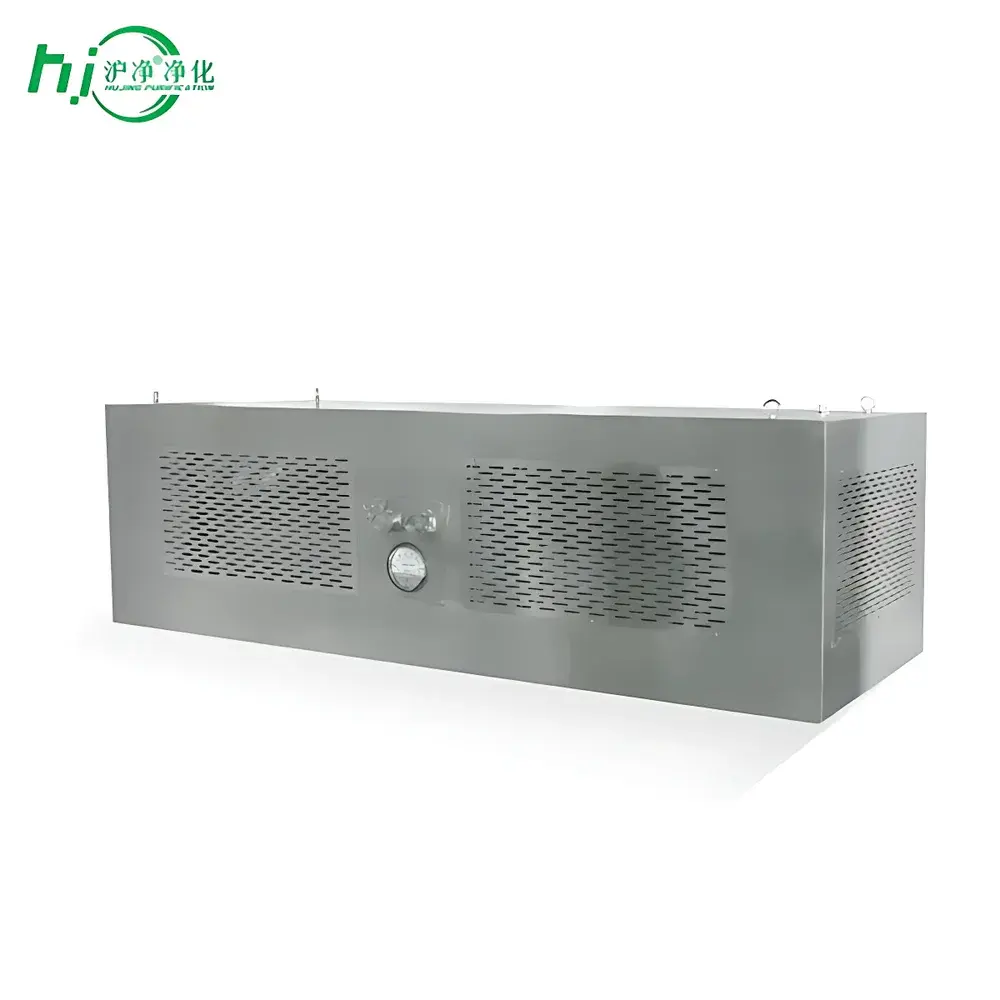
Hujing Purification Vertical Laminar Flow Hood FXCL Series
| Brand | Hujing Purification (HJ) |
|---|---|
| Origin | Zhejiang, China |
| Manufacturer Type | Direct Manufacturer |
| Regional Category | Domestic (China) |
| Model | FXCL Series |
| Price | USD 2,500 (approx.) |
| Airflow Pattern | Vertical Unidirectional Flow |
| Filter Type | Liquid-Seal HEPA Filter (ULPA optional) |
| Cleanliness Class | ISO Class 5 (Fed. Std. 209E Class 100) |
| Average Air Velocity | 0.25–0.45 m/s |
| Power Supply | 220 V AC, 50 Hz |
| Sound Pressure Level | ≤62 dB(A) |
| Illumination | 300 lux |
| DOP Test Port | Standard |
| Differential Pressure Gauge | Integrated |
| Construction Material | 1.0 mm 304 Stainless Steel Welded Frame |
| Mounting Options | Ceiling-Suspended or Freestanding with Adjustable Support Frame |
| Optional Accessories | PVC Strip Curtain, UV Germicidal Lamp (254 nm), Pre-filter Upgrade |
Overview
The Hujing Purification FXCL Series Vertical Laminar Flow Hood is an ISO Class 5 (Fed. Std. 209E Class 100) clean air workstation engineered for critical local environmental control in laboratories, pilot-scale production, and quality assurance environments. It operates on the principle of vertical unidirectional airflow—air is drawn through a pre-filter, pressurized by a high-efficiency centrifugal blower, conditioned in a stainless-steel plenum (static pressure chamber), and then uniformly delivered downward through liquid-seal HEPA filters (rated ≥99.99% @ 0.3 µm) and a diffuser membrane. This laminar flow profile minimizes turbulence and particle resuspension, ensuring consistent particle-free conditions across the work surface. Designed for integration into non-ISO-classified rooms, the FXCL series serves as a self-contained micro-environment where airborne particulate concentration remains below 3,520 particles/m³ (≥0.5 µm), meeting stringent requirements for aseptic handling, precision assembly, and contamination-sensitive analytical procedures.
Key Features
- Robust structural integrity: All primary enclosures fabricated from 1.0 mm electropolished 304 stainless steel with full TIG welding—resistant to corrosion, easy to decontaminate, and compliant with cGMP surface finish standards (Ra ≤ 0.8 µm).
- Validated airflow uniformity: Integral velocity monitoring ports and factory-balanced blower/filter system ensure average face velocity remains within 0.25–0.45 m/s across the entire work area, supporting reproducible ISO 14644-3 testing protocols.
- Integrated process instrumentation: Each unit includes a calibrated differential pressure gauge (measuring filter ΔP in real time) and a dedicated DOP (Di-Octyl Phthalate) aerosol challenge port for upstream/downstream filter integrity testing per ISO 14644-3 Annex B and IEST-RP-CC001.
- Modular mounting flexibility: Configurable for ceiling suspension (with adjustable aircraft cable system) or freestanding installation using rigid stainless-steel support frames—enabling rapid repositioning without structural modification.
- Human-centric ergonomics: Uniform 300 lux illumination provided by low-EMI LED fixtures positioned outside the laminar path; optional UV-C germicidal lamp (254 nm, interlocked with sash safety switch) available for surface decontamination between operations.
Sample Compatibility & Compliance
The FXCL series accommodates a wide range of sample types—including sterile biological reagents, microelectronic wafers, pharmaceutical dosage forms, and optical components—without introducing viable or non-viable particulate contamination. Its liquid-seal HEPA filtration architecture eliminates gasket leakage pathways common in dry-frame systems, enhancing long-term seal integrity under variable ambient humidity. Units are designed and tested in accordance with ISO 14644-1 (cleanroom classification), ISO 14644-3 (test methods), and EN 1822-1 (HEPA filter performance). For regulated environments, the system supports audit-ready documentation packages including Factory Acceptance Test (FAT) reports, filter certification (including scan test data), and airflow mapping records—all traceable to NIST-calibrated instrumentation.
Software & Data Management
While the base FXCL model operates via hardwired controls (on/off, fan speed preset), optional digital controllers enable RS-485 Modbus RTU communication for integration into centralized facility monitoring systems (e.g., SCADA or BMS). The controller logs timestamped operational parameters—including cumulative runtime, filter ΔP trends, and power cycle events—with exportable CSV output. When paired with optional validation accessories (e.g., thermal anemometers, particle counters), the system supports 21 CFR Part 11-compliant electronic records when deployed with validated third-party software platforms that provide user access control, audit trails, and electronic signatures.
Applications
- Pharmaceutical: Aseptic filling of vials and syringes, media fill simulations, and sterility test preparation under Grade A conditions per EU GMP Annex 1 and USP .
- Microelectronics: Wire bonding, die attach, and photomask handling in Class 100/ISO 5 mini-environments.
- Food & Beverage QA: Microbial enumeration, pathogen isolation, and sensory panel sample preparation requiring low-bioburden workspaces.
- Academic & Clinical Research: Cell culture maintenance, CRISPR transfection workflows, and forensic DNA extraction where ambient particulate interference must be excluded.
- Calibration Labs: Shielding high-precision mass standards and optical interferometers from airborne contamination during verification cycles.
FAQ
What certifications accompany the FXCL series upon delivery?
Each unit ships with a Certificate of Conformance, HEPA filter test report (per EN 1822), and ISO 14644-3 airflow uniformity validation summary.
Can the FXCL hood be integrated into a building’s HVAC monitoring system?
Yes—via optional Modbus-enabled controller with dry-contact alarm outputs and analog 4–20 mA filter ΔP signal.
Is UV-C disinfection capability included as standard?
No—UV-C lamps are optional and require interlocked sash position sensing and timer-based exposure control per IEC 62471 photobiological safety guidelines.
What maintenance intervals are recommended for liquid-seal HEPA filters?
Filter replacement is determined by ΔP monitoring: replace when differential pressure exceeds 250 Pa above baseline or annually—whichever occurs first.
Does the unit meet FDA or EMA regulatory expectations for Grade A environments?
Yes—when installed, qualified (IQ/OQ/PQ), and operated per EU GMP Annex 1 §4.38–4.44 and FDA Guidance for Industry: Sterile Drug Products Produced by Aseptic Processing (2004).



