
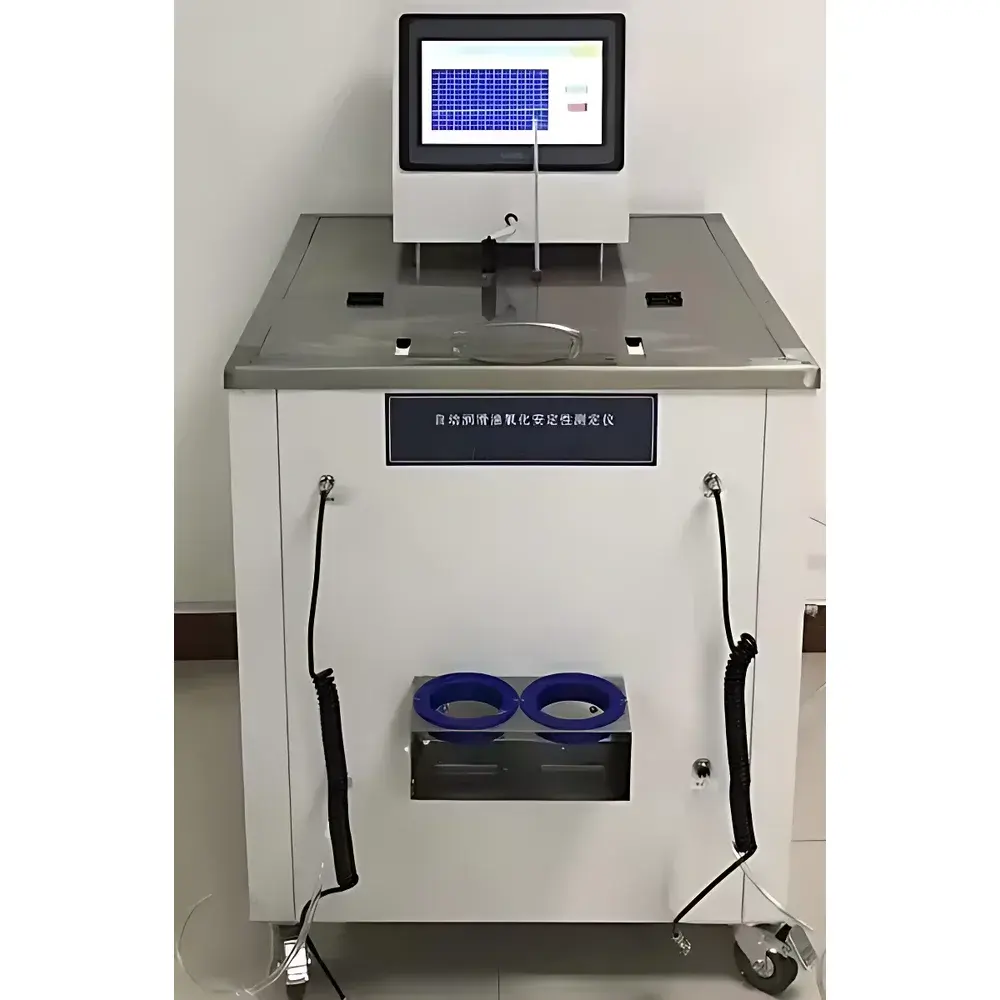
Karrie KA-331A Automatic Lubricating Oil Oxidation Stability Tester (Rotating Bomb Method)
| Brand | Karrie |
|---|---|
| Model | KA-331A |
| Power Supply | AC 220 V ±10%, 50 Hz |
| Heating Power | ≤3.4 kW |
| Temperature Control Range | Ambient to 200 °C |
| Temperature Control Accuracy | ±0.1 °C |
| Pressure Sensor Accuracy | ±0.2% FS |
| Rotation Speed | 100 ±3 rpm |
| Dimensions | 600 × 750 × 850 mm |
| Dual-Sample Capacity | Yes |
| Compliance | SH/T 0193, ASTM D2272 |
| Communication Interface | RS-232/USB for PC connectivity |
| Data Output | Real-time pressure–time curve,拐点 detection, automated test termination |
Overview
The Karrie KA-331A Automatic Lubricating Oil Oxidation Stability Tester is an engineered solution for quantitative assessment of oxidation resistance in new and in-service turbine oils and other mineral- or synthetic-based lubricants. Based on the rotating bomb oxidation test (RBOT) principle defined in ASTM D2272 and SH/T 0193, the instrument subjects a sealed oxygen-pressurized sample—contained within a precision-machined stainless-steel bomb—to controlled thermal stress while rotating at a constant angular velocity. Under these accelerated conditions, oxidative degradation initiates measurable pressure decay due to oxygen consumption by reactive species. The system continuously monitors absolute pressure and temperature as primary kinetic indicators, enabling precise determination of induction period—the time elapsed until the onset of rapid oxidation (i.e., inflection point in the pressure–time profile). This parameter serves as a critical quality control metric for predicting service life, evaluating antioxidant package efficacy, and verifying conformance to OEM and refinery specifications.
Key Features
- Automated dual-bomb configuration enables concurrent testing of two independent oil samples under identical thermal–mechanical conditions, improving throughput without compromising inter-test reproducibility.
- High-stability brushless DC motor drive ensures consistent 100 ±3 rpm rotation with low acoustic emission (<55 dB(A)) and minimal torque fluctuation—critical for eliminating mechanical artifacts in pressure signal acquisition.
- Digital pressure transduction using calibrated piezoresistive sensors (±0.2% full-scale accuracy) coupled with Pt100-class RTD temperature sensing provides traceable, NIST-referenced metrology throughout the 0–1.5 MPa and ambient–200 °C operating envelope.
- Microprocessor-based controller executes real-time derivative analysis of pressure decay to identify the oxidation induction point algorithmically, eliminating subjective endpoint interpretation.
- Integrated data logging records pressure, temperature, and time at user-configurable intervals (default: 10 s), generating ASCII-compatible .csv files suitable for LIMS integration and statistical process control (SPC) analysis.
- Front-panel touchscreen interface supports calibration verification routines for both temperature and pressure channels, with audit-trail-capable event logging compliant with GLP documentation requirements.
Sample Compatibility & Compliance
The KA-331A is validated for use with homogeneous liquid-phase petroleum products—including turbine oils, hydraulic fluids, and engine oils—provided they exhibit no phase separation, excessive volatility (<10% loss at 100 °C per ASTM D975), or suspended particulates that may interfere with bomb sealing integrity. It strictly adheres to the procedural constraints of ASTM D2272 (2023 edition) and SH/T 0193 (2019), including prescribed oxygen partial pressure (0.86 MPa), water content limits (<0.05 wt%), and mandatory pre-conditioning steps (e.g., degassing, filtration to ≤5 µm). The instrument’s hardware design meets IEC 61010-1 safety standards for laboratory electrical equipment, and its pressure containment system conforms to PED 2014/68/EU Category II requirements.
Software & Data Management
The accompanying Windows-based software suite provides secure local operation via USB or RS-232 serial link. It supports multi-user access control with role-based permissions (operator, supervisor, administrator), electronic signature capture for report finalization, and 21 CFR Part 11–compliant audit trails—including timestamped records of parameter changes, calibration events, and result modifications. Raw data export includes annotated pressure–time curves with auto-marked inflection points, statistical summaries (mean, SD, RSD across replicates), and customizable PDF report templates aligned with ISO/IEC 17025 reporting clauses. Data archiving follows hierarchical folder structures indexed by batch ID, operator ID, and test date, facilitating retrospective trending analysis over extended periods.
Applications
- Quality assurance of base oil blending batches prior to additive package introduction.
- Evaluation of antioxidant synergism in formulated lubricants (e.g., phenolic–amine combinations).
- Condition monitoring of in-service turbine oils in power generation and marine propulsion systems.
- Regulatory compliance verification for API licensed engine oils and aviation lubricants (MIL-PRF-23699, SAE AS5780).
- R&D screening of novel synthetic ester or polyalphaolefin (PAO) base stocks under simulated aging protocols.
- Root-cause analysis of premature varnish formation in hydraulic systems through correlation of RBOT induction time with MPC (Membrane Patch Colorimetry) values.
FAQ
What standards does the KA-331A explicitly support?
ASTM D2272 (Standard Test Method for Oxidation Stability of Turbine Oils – Rotating Bomb Method) and SH/T 0193 (Chinese national standard for oxidation stability of lubricating oils).
Can the instrument be used for greases or solid-lubricant formulations?
No. The rotating bomb method requires homogeneous, low-viscosity liquids capable of uniform heat transfer and oxygen diffusion; greases, pastes, or suspensions are incompatible.
Is external calibration certification available?
Yes—traceable calibration certificates issued by CNAS-accredited laboratories (ISO/IEC 17025) can be provided upon request, covering pressure, temperature, and rotational speed subsystems.
How is test repeatability ensured between operators?
Through standardized SOP enforcement via software-enforced sequence locks, automatic validation of sample mass and oxygen fill pressure, and elimination of manual timing or endpoint judgment.
Does the system support remote diagnostics or firmware updates?
Firmware updates are performed locally via USB stick; remote diagnostic capability is not implemented to maintain air-gapped security in regulated QA environments.






