
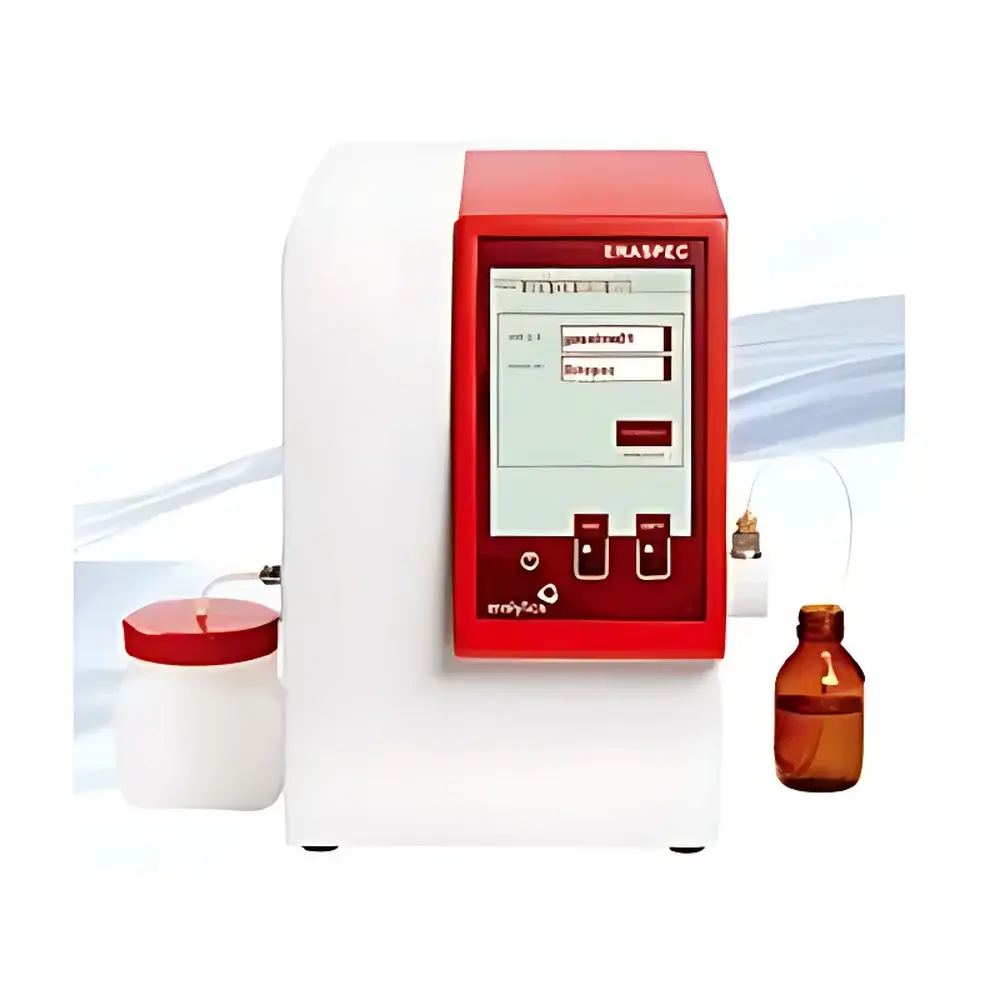
KA ERASPEC-JET Infrared Jet Fuel Analyzer by KARRIE
| Brand | KARRIE |
|---|---|
| Model | KA ERASPEC-JET |
| Type | Fourier Transform Infrared (FTIR) Spectrometer-Based Aviation Turbine Fuel Analyzer |
| Origin | Shenzhen, China |
| Power Supply | 85–263 VAC, 47–63 Hz / 12 VDC, 4 A |
| Dimensions | 220 × 320 × 280 mm |
| Weight | 8 kg |
| Sample Volume | 10 mL |
| Analysis Time | ≤60 s per test |
| Spectral Range | 4000–400 cm⁻¹ |
| Spectral Resolution | Standard FTIR resolution with ≥3000 data points across full range |
| Density Measurement Accuracy | ±0.0001 g/cm³ (integrated Anton Paar density module) |
| Data Storage Capacity | Up to 2000 test records |
| Interface Ports | 3× USB, 1× Ethernet, 1× RS-232, LIMS-compatible output |
| Display | 6.5″ color touchscreen, native Chinese UI |
| Compliance | Designed for ASTM D1655, ASTM D7462, ASTM D7845, ISO 8217, DEF STAN 91-91, and GB/T 6536, GB/T 268, GB/T 1884, GB/T 2430, GB/T 17040 |
Overview
The KA ERASPEC-JET Infrared Jet Fuel Analyzer is a field-deployable, benchtop-grade FTIR spectrometer system engineered specifically for rapid, multi-parameter physicochemical characterization of aviation turbine fuels (Jet A, Jet A-1, JP-5, JP-8) and related hydrocarbon distillates. Operating on the principle of mid-infrared absorption spectroscopy, the instrument quantifies molecular vibrational signatures across the 4000–400 cm⁻¹ spectral window—capturing over 3000 discrete data points per scan—to deliver high-fidelity spectral fingerprints. These spectra are processed using chemometric calibration models validated against reference methods (e.g., ASTM D2386 for freeze point, ASTM D93 for flash point, ASTM D445 for kinematic viscosity, ASTM D1298 for density), enabling simultaneous inference of ice point, flash point, kinematic viscosity, distillation profile (T10/T50/T90), density, aromatic content, and olefin content from a single 10 mL sample in under 60 seconds. Its integrated Anton Paar density module ensures traceable, high-resolution density measurement (±0.0001 g/cm³), while its ruggedized mechanical architecture supports both laboratory and mobile deployment—including vehicle-mounted operation via 12 VDC input.
Key Features
- Single-shot multi-parameter analysis: Ice point, flash point, kinematic viscosity, distillation endpoints, density, aromatic/olefin content—all derived from one FTIR spectrum
- Automated liquid handling: Precision syringe-based autosampler with integrated air-liquid purge cycle for cross-contamination mitigation
- Field-ready portability: Compact footprint (220 × 320 × 280 mm), 8 kg mass, dual-power capability (AC mains or 12 VDC automotive supply)
- High-fidelity spectral acquisition: Michelson interferometer with sealed, alignment-stable optics; ≥3000-point spectral sampling across full 4000–400 cm⁻¹ range
- Intuitive human interface: 6.5″ capacitive touchscreen with native Chinese language support; context-aware workflow guidance and real-time spectral visualization
- Robust connectivity suite: Three USB 2.0 ports, one Gigabit Ethernet interface, one RS-232 serial port, and standardized LIMS export protocol (ASTM E1384-compliant data structure)
- Onboard data governance: Local storage for up to 2000 complete test records including raw interferograms, processed spectra, calibration metadata, and QC flags
Sample Compatibility & Compliance
The KA ERASPEC-JET is validated for use with aviation turbine fuels meeting ASTM D1655, DEF STAN 91-91, and ISO 8217 specifications, as well as diesel fuel blends (EN 590, ASTM D975) where cross-contamination screening (e.g., diesel in jet fuel) is required. It accommodates clear, homogenous liquid samples with viscosities up to 20 mm²/s at 20 °C. The system supports routine verification using certified reference materials (CRMs) traceable to NIST or national metrology institutes. All analytical outputs comply with data integrity requirements outlined in FDA 21 CFR Part 11 when operated in audit-trail-enabled mode (user login, electronic signature, immutable record logging). Calibration models are developed and maintained per ICH Q2(R2) guidelines and undergo periodic revalidation per internal SOPs aligned with GLP principles.
Software & Data Management
The embedded firmware runs a deterministic real-time OS with dedicated spectral preprocessing (zero-filling, apodization, phase correction) and multivariate regression engines (PLS, PCR). Chemometric models are stored in encrypted, version-controlled containers with checksum validation. Raw and processed data export formats include ASTM E1384-compliant .CSV, JCAMP-DX v5.1, and proprietary .KAR binary archives. The software supports user-defined report templates with configurable fields (sample ID, operator, instrument ID, timestamp, uncertainty estimates), digital signature embedding, and automated transfer to networked LIMS via secure FTP or HTTP POST. Audit trail functionality logs all critical events—including method edits, calibration updates, user logins, and result overrides—with timestamps and operator identifiers.
Applications
- Rapid quality release testing of incoming jet fuel batches at airports and fuel depots
- On-site contamination detection: Identification and semi-quantification of diesel, gasoline, or kerosene adulteration in aviation fuel streams
- Process monitoring during fuel blending and additive dosing operations
- Field verification of freeze point compliance prior to aircraft refueling (per IATA Guidance Material)
- Supporting root cause analysis during fuel-related engine performance anomalies
- Regulatory submission support: Generating supplementary data aligned with ASTM D7845 (FTIR-based jet fuel specification testing)
- Research applications: Correlation studies between FTIR-predicted parameters and traditional ASTM test results
FAQ
Does the KA ERASPEC-JET require external calibration standards for daily operation?
No—factory-installed chemometric models are pre-validated against primary reference methods. Daily verification uses a single control standard (e.g., certified jet fuel CRM); full recalibration is recommended every 90 days or after major hardware service.
Can the instrument differentiate between Jet A and Jet A-1 based on aromatic content?
Yes—the system quantifies total aromatic hydrocarbons (wt%) within ±0.3% accuracy relative to ASTM D1319, enabling discrimination per specification limits (Jet A-1: max 25%, Jet A: max 20%).
Is the density module compliant with ASTM D4052?
The integrated Anton Paar DMA 4500M module meets all mechanical, thermal, and metrological requirements of ASTM D4052, including temperature control stability (±0.01 °C) and repeatability (≤0.00005 g/cm³).
How is data security enforced during LIMS transmission?
All network communications use TLS 1.2 encryption; LIMS integration requires mutual certificate authentication and role-based API access controls.
What maintenance is required beyond routine cleaning?
Annual optical alignment verification and interferometer mirror coating inspection are recommended; no consumables other than standard lab-grade solvents for flow path cleaning.




