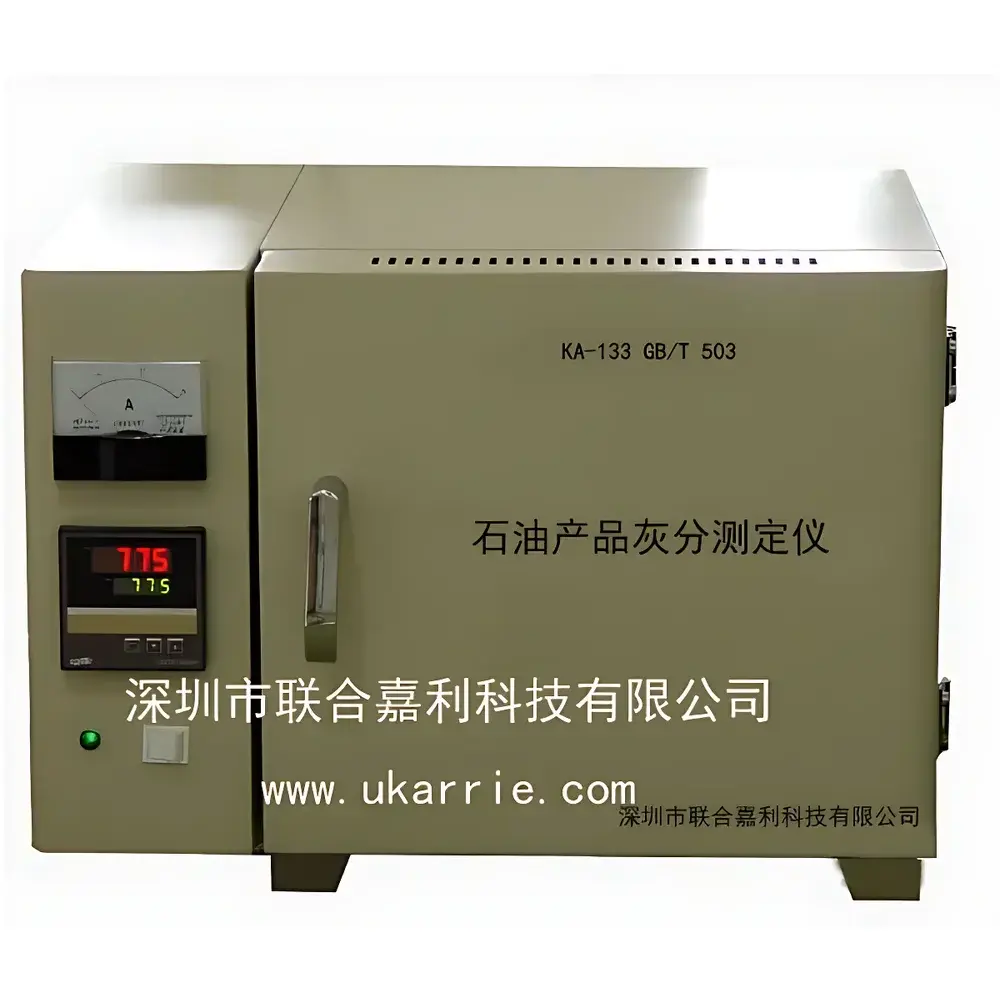
KA-133 Petroleum Products Ash Content Analyzer by KARRIE
| Brand | KARRIE |
|---|---|
| Origin | Shenzhen, China |
| Model | KA-133 |
| Power Supply (Furnace) | AC 220 V ±10%, 50 Hz |
| Rated Power (Furnace) | 2500 W |
| Temperature Range (Furnace) | Ambient to 1000 °C |
| Setpoint Control Temperature | (775 ± 25) °C |
| Temperature Sensor | Thermocouple |
| Empty Furnace Warm-up Time | ≤60 min |
| Furnace Uniformity | ≤15 °C |
| Furnace Chamber Dimensions | 200 × 120 × 80 mm (L×W×H) |
| Power Supply (Hotplate) | AC 220 V ±10%, 50 Hz |
| Rated Power (Hotplate) | 2400 W (3 × 800 W) |
| Hotplate Surface | Cast Iron, 450 × 350 mm |
| Crucibles Supplied | 50 mL and 100 mL porcelain crucibles |
| Compliance Standard | GB/T 508—2010 |
Overview
The KARRIE KA-133 Petroleum Products Ash Content Analyzer is a dedicated laboratory instrument engineered for precise determination of ash content in petroleum products in strict accordance with the Chinese national standard GB/T 508—2010, “Standard Test Method for Ash from Petroleum Products.” This method employs controlled high-temperature incineration in a muffle furnace followed by gravimetric analysis to quantify non-volatile inorganic residue remaining after complete combustion of the sample. The KA-133 integrates two thermally independent modules—a digitally controlled box-type resistance furnace and a triple-zone cast-iron hotplate—enabling sequential sample preparation, pre-ashing, and post-incineration cooling in compliance with the procedural requirements of GB/T 508. It is intended for use with virgin or lightly used distillate fuels, lubricating base oils, and other refined hydrocarbon streams that do not contain ash-forming additives (e.g., organophosphorus compounds, metallic detergents) or lead-based anti-wear agents. The system is not validated for used engine oils, crankcase samples, or formulations containing intentionally added ash contributors, as such materials violate the scope assumptions of the referenced standard.
Key Features
- Modular dual-heating architecture: Independent furnace and hotplate modules support full GB/T 508 workflow—sample drying, pre-ashing, ignition, and controlled cooling—without cross-contamination or thermal interference.
- Digital temperature-controlled muffle furnace with integral thermocouple feedback loop ensures stable setpoint maintenance at (775 ± 25) °C, minimizing overshoot and drift during prolonged ashing cycles.
- Compact furnace chamber (200 × 120 × 80 mm) constructed with high-density refractory insulation and optimized heating element layout delivers uniform thermal distribution (≤15 °C variation across load zone) and rapid ambient-to-1000 °C warm-up (≤60 minutes).
- Triple-zone cast-iron hotplate (450 × 350 mm surface) provides consistent, localized heating for pre-treatment steps; each 800 W zone operates independently, enabling parallel processing of multiple crucibles.
- Robust mechanical design: Furnace housing fabricated from welded cold-rolled steel; hotplate top plate precision-cast from high-carbon gray iron for thermal stability and corrosion resistance.
- Analog temperature controller with needle indicator and integrated ammeter enables real-time monitoring of heating current draw and thermal status—critical for troubleshooting and process verification under GLP-aligned lab practices.
Sample Compatibility & Compliance
The KA-133 is validated exclusively for petroleum products falling within the scope of GB/T 508—namely, unadditized or low-additive-content fuels and lubricants where ash formation arises solely from inherent inorganic contaminants (e.g., sodium, calcium, silicon, vanadium). It is explicitly excluded for samples containing metallic detergent packages, phosphorus-containing anti-wear additives (e.g., ZDDP), leaded gasoline components, or heavily oxidized used engine oils—materials which generate non-representative or non-volatile residues inconsistent with the standard’s definition of “ash.” While GB/T 508 does not map directly to ASTM D482 or ISO 6245, laboratories performing cross-standard comparisons must conduct method equivalence studies per ISO/IEC 17025:2017 Clause 7.2.2. Instrument design adheres to IEC 61010-1 safety requirements for electrical equipment used in laboratory environments.
Software & Data Management
The KA-133 operates as a standalone hardware platform without embedded firmware or digital data logging. Temperature control is analog, and no software interface, USB connectivity, or audit trail functionality is provided. Users are required to manually record time–temperature profiles, crucible tare/mass values, and final ash mass using laboratory notebooks compliant with GLP documentation standards. For labs requiring electronic records, integration with external balance systems (e.g., METTLER TOLEDO XSR series) and LIMS-compatible spreadsheets is recommended. Though not 21 CFR Part 11 compliant out-of-the-box, the instrument may be operated within a validated analytical procedure where manual entries are counter-signed and dated per internal SOPs.
Applications
- Quality control of naphtha, kerosene, diesel fuel, and jet fuel for trace inorganic contamination prior to blending or certification.
- Base oil purity assessment in refinery QC labs to verify removal of catalyst residues (e.g., Ni, Mo, V) following hydrotreating.
- Specification testing of industrial white oils and transformer oils per GB/T 508–defined limits (typically ≤0.005 wt%).
- Educational use in petroleum engineering curricula for teaching standardized gravimetric combustion techniques.
- Pre-screening of feedstocks for catalytic cracking units where excessive ash can deactivate zeolite catalysts.
FAQ
Does the KA-133 comply with ASTM D482 or ISO 6245?
No—the instrument is designed and calibrated specifically for GB/T 508–2010. While operational principles are similar, procedural differences (e.g., crucible type, ramp rate, hold time) preclude direct equivalency without formal method transfer validation.
Can the furnace temperature be adjusted outside the (775 ± 25) °C range?
Yes—the furnace supports ambient-to-1000 °C operation; however, only the (775 ± 25) °C setpoint is qualified for GB/T 508 conformance. Deviations require revalidation per ISO/IEC 17025.
What crucible materials are supported?
Only porcelain crucibles (50 mL and 100 mL, supplied) are specified in GB/T 508. Platinum or silica crucibles are not permitted under this standard.
Is the instrument suitable for continuous 24/7 operation?
No—it is rated for intermittent laboratory use (≤8 hours/day duty cycle). Extended operation beyond manufacturer-specified thermal cycling limits may compromise heater longevity and temperature uniformity.
Does KARRIE provide calibration certificates traceable to NIM or CNAS?
Calibration documentation is available upon request; however, end-user responsibility includes periodic verification using NIST-traceable reference thermocouples and certified reference materials per ISO/IEC 17025 Clause 6.6.