
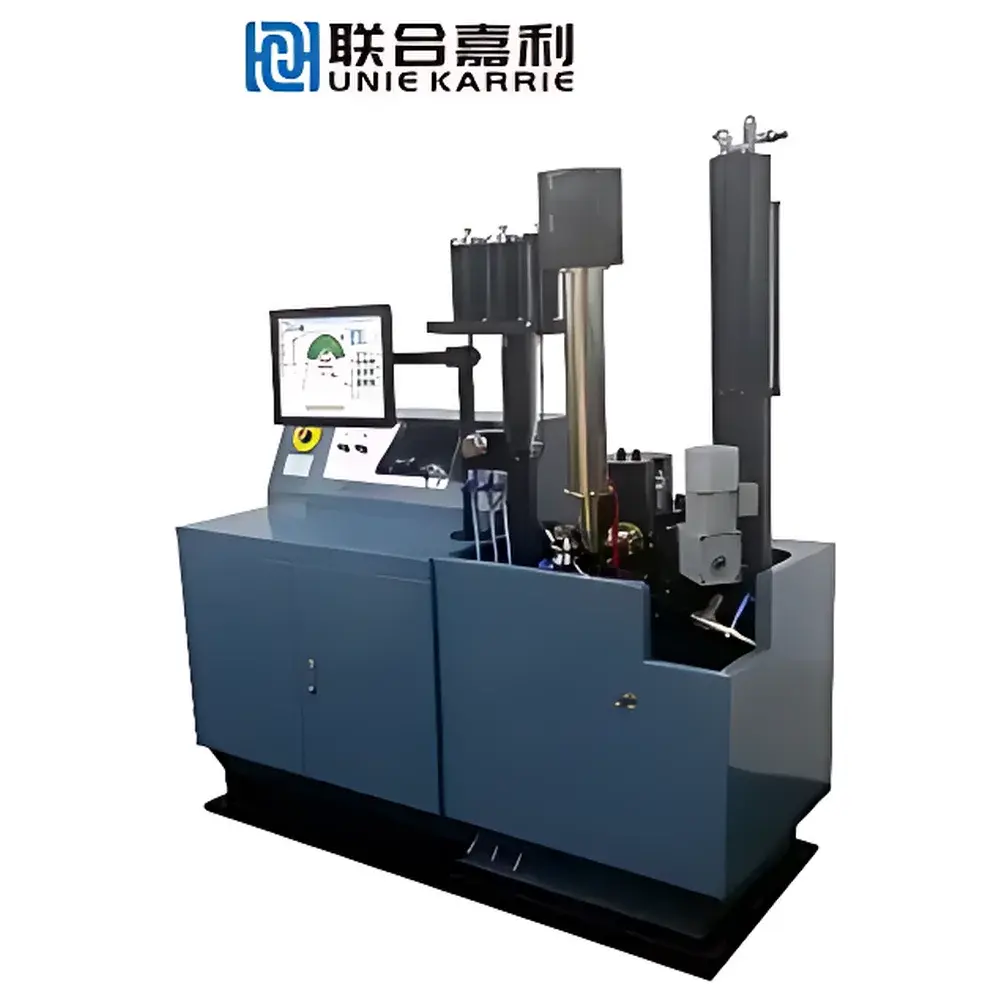
Karrie LH50X Cetane Number Tester (CFR Engine-Based)
| Brand | Karrie |
|---|---|
| Origin | Shenzhen, China |
| Model | LH50X |
| Measurement Parameter | Diesel Cetane Number |
| Form Factor | Benchtop |
| Measurement Range | 0–100 CN |
| Accuracy | ±0.1 CN |
| Test Duration | 25 min per sample |
| Sample Volume | 450 mL |
| Cylinder Bore | 82.55 mm |
| Stroke | 114.3 mm |
| Compression Ratio Adjustment Range | 8:1 to 36:1 |
| Engine Speed | 900 ± 9 rpm |
| Injector Flow Rate | 13.0 ± 0.2 mL/min |
| Injection Timing | 13° ± 0.2° BTDC |
| Injector Cooling Temperature | 38 ± 2 °C |
| Ignition Lag Angle | 13° ± 0.2° |
| Injection Opening Pressure | 10.30 ± 0.34 MPa |
| Lubricating Oil Pressure | 172–207 kPa |
| Lubricating Oil Temperature | 57 ± 8 °C |
| Cylinder Jacket Cooling Temperature | 100 ± 2 °C |
| Intake Air Temperature | 66 ± 0.5 °C |
| Coolant Temperature | ≤ ambient + 5 °C |
| Repeatability (CN 40–56) | 0.8–1.0 CN |
| Reproducibility (CN 40–56) | 2.8–4.8 CN |
| Max Power | 10.0 kW |
| Dimensions (W×D×H) | 1450 × 720 × 1750 mm |
| Weight | 1000 kg |
Overview
The Karrie LH50X Cetane Number Tester is a precision-engineered, single-cylinder, four-stroke, variable-compression-ratio, indirect-injection diesel engine test system designed and validated in strict accordance with ASTM D613 and GB/T 386—international standard methods for determining the cetane number of diesel fuels. Unlike correlation-based instruments (e.g., NIR or ignition delay analyzers), the LH50X employs the fundamental CFR (Cooperative Fuel Research) engine principle: it directly measures the ignition delay period under controlled combustion conditions by comparing the test fuel against primary reference fuels (cetane and heptamethylnonane). This primary method provides traceable, physicochemical measurement data essential for fuel certification, refinery quality control, and regulatory compliance.
At its core, the LH50X integrates a proprietary DD-CFR–style indirect-injection diesel engine with fully internalized lubrication pathways, eliminating routine maintenance points while preserving mechanical fidelity to ASTM-specified geometry and thermodynamic boundary conditions. The engine’s dual-balance architecture minimizes vibration and acoustic emission—critical for long-term dimensional stability and operator safety in regulated laboratory environments.
Key Features
- Full compliance with ASTM D613 and GB/T 386; certified mechanical configuration including cylinder bore (82.55 mm), stroke (114.3 mm), and compression ratio range (8:1–36:1)
- Integrated high-precision fuel injection system: single-orifice nozzle, calibrated opening pressure (10.30 ± 0.34 MPa), and flow rate (13.0 ± 0.2 mL/min) maintained within specification tolerance
- Real-time crank-angle-resolved combustion monitoring via industrial-grade DT60DS combustion sensor, delivering stable signal acquisition under transient load conditions
- Automated compression ratio adjustment with linear encoder feedback—replacing manual handwheel readouts with sub-degree angular resolution for repeatable ignition lag quantification
- Modular, purpose-built controller architecture supporting deterministic timing control of injection timing (13° ± 0.2° BTDC), injector cooling (38 ± 2 °C), and jacket coolant temperature (100 ± 2 °C)
- Embedded CNManager® software with guided workflow interface: step-by-step procedural prompts aligned to ASTM D613 clause sequence, real-time combustion trend visualization, and automatic pass/fail flagging based on cycle-to-cycle consistency thresholds
- Dedicated LH30CU closed-loop cooling unit for injector thermal management and independent cylinder jacket circulation—ensuring thermal boundary reproducibility across multi-day testing campaigns
- Comprehensive hardware safety layer: mechanical interlocks on all moving assemblies, emergency stop circuitry compliant with IEC 60204-1, integrated exhaust aftertreatment meeting ISO 8573-1 Class 3 particulate limits, and acoustic enclosure reducing operational noise to ≤65 dB(A)
Sample Compatibility & Compliance
The LH50X accepts standard diesel fuel samples (ASTM D975, EN 590, GB 19147) requiring no pre-treatment or dilution. Each test consumes 450 mL of homogenized sample—compatible with routine QC throughput in refinery labs and third-party certification facilities. All operational parameters—including intake air temperature (66 ± 0.5 °C), lubricating oil pressure (172–207 kPa), and crankcase temperature (57 ± 8 °C)—are actively regulated to meet the environmental conditioning requirements defined in Clause 7 of ASTM D613. The instrument’s measurement uncertainty profile has been independently verified against NIST-traceable reference fuels across the full 0–100 CN range, with repeatability (within-lab, same operator) and reproducibility (between-lab) values documented per ASTM D613 Annex A1. Data integrity complies with FDA 21 CFR Part 11 requirements through electronic audit trail logging, user authentication, and immutable result archiving.
Software & Data Management
CNManager® is a Windows-based, GxP-ready application engineered for GLP/GMP-aligned laboratories. It enforces role-based access control (administrator, analyst, reviewer), captures full metadata per test (operator ID, calibration certificate IDs, environmental logs, raw combustion waveforms), and generates PDF reports compliant with ISO/IEC 17025 documentation standards. All data—including time-synchronized pressure transducer outputs, crank-angle position traces, and thermal sensor histories—are stored in encrypted SQLite databases with SHA-256 checksum validation. Export options include CSV (for LIMS integration), XML (for ELN ingestion), and print-ready PDFs bearing digital signatures and timestamped electronic seals. System uptime and cumulative runtime tracking trigger automated preventive maintenance alerts at configurable intervals (e.g., every 500 engine hours), ensuring sustained metrological reliability.
Applications
- Primary cetane number determination for diesel fuel certification (EPA, CE marking, CNPC, Sinopec)
- Refinery process optimization: real-time feedback for hydrotreating severity and blending ratio adjustments
- Fuel additive efficacy evaluation under standardized combustion dynamics
- Research into alternative diesel fuels (biodiesel blends, HVO, synthetic paraffinic kerosene) requiring fundamental ignition behavior characterization
- Third-party testing laboratories performing ISO/IEC 17025-accredited fuel analysis
- Government metrology institutes conducting proficiency testing and reference material certification
FAQ
What standards does the LH50X validate against?
The instrument is mechanically and operationally aligned with ASTM D613 and GB/T 386, including full adherence to specified engine geometry, thermodynamic boundary conditions, and procedural sequence.
Is operator training required to achieve ASTM-compliant results?
Yes—while CNManager®’s guided workflow reduces procedural error, users must complete Karrie-certified operator qualification covering engine warm-up protocols, reference fuel handling, and combustion waveform interpretation per ASTM D613 Section 10.
Can the LH50X be integrated into an existing LIMS environment?
Yes—via configurable ODBC drivers and RESTful API endpoints supporting HL7 and ASTM E1384 message formats for seamless result transfer.
What maintenance schedule is recommended?
Daily: visual inspection of coolant levels and exhaust integrity; Quarterly: calibration verification using NIST-traceable reference fuels; Annually: full compression ratio actuator recalibration and injector flow bench validation.
Does the system support remote diagnostics?
Yes—optional Karrie RemoteCare module enables secure TLS 1.3–encrypted remote session initiation for firmware updates, log retrieval, and real-time sensor health monitoring.





