
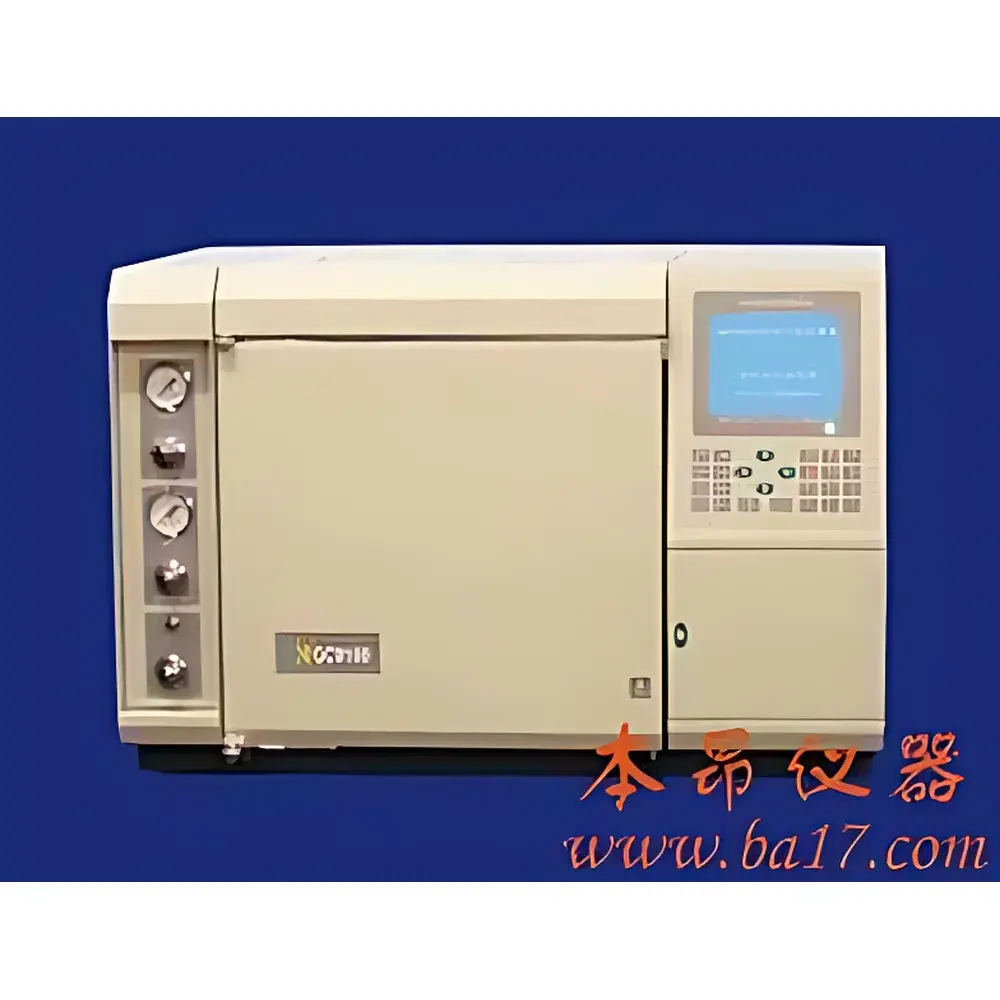
BenAng OHGC9160 Gas Chromatograph
| Brand | BenAng |
|---|---|
| Origin | Shanghai, China |
| Manufacturer Type | Authorized Distributor |
| Origin Category | Domestic (China) |
| Model | OHGC9160 |
| Price | USD 5,980 (FOB Shanghai) |
| Column Oven Temp Range | 10°C above ambient to 399°C (±0.1°C) |
| Programmed Temperature Ramp | 0.1–40°C/min (≤200°C), 0.1–20°C/min (>200°C) |
| Max. Ramp Stages | 5 |
| Injector & Detector Temp Range | 10°C above ambient to 399°C (±0.1°C) |
| Carrier Gas Control | Dual-stage pressure → flow regulation |
| Detectors Available | FID (Mt ≤ 1×10⁻¹¹ g/s n-hexadecane |
| Display | Backlit LCD with GB2312 Chinese character set |
| Data Interface | USB Host, SPP, ECP, EPP |
| Power Backup | Non-volatile memory retention (FLASH + EEPROM) |
| Safety | Dual overtemperature protection per zone |
Overview
The BenAng OHGC9160 Gas Chromatograph is a benchtop analytical instrument engineered for routine and method-developed separation of volatile and semi-volatile organic compounds across industrial QC, food & beverage, petrochemical, and environmental laboratories. It operates on the fundamental principle of gas–solid or gas–liquid partition chromatography: analytes are vaporized, carried through a thermally stabilized capillary or packed column by an inert carrier gas (e.g., He, H₂, or N₂), and differentially retained based on polarity, boiling point, and molecular interaction with the stationary phase. Separated components elute at characteristic retention times and are quantified via selective detection—primarily using flame ionization (FID) or thermal conductivity (TCD) mechanisms. Designed for robustness in non-GMP environments, the OHGC9160 delivers high repeatability (RSD < 1.5% for retention time; < 2.0% for peak area under optimized conditions) and operational stability across extended run sequences—critical for batch release testing of solvents, ethanol in beverages, residual monomers, or purity profiling of synthesis intermediates.
Key Features
- Microprocessor-based temperature control architecture with FLASH and EEPROM non-volatile memory—eliminates backup battery dependency and ensures long-term parameter integrity during power interruption.
- Column oven with ±0.1°C temperature accuracy across its full operating range (10°C above ambient to 399°C), supported by dual independent overtemperature cutoff circuits and intelligent rear-door air-cooling for rapid thermal equilibration—even near ambient conditions.
- Five-stage programmable temperature ramp capability, enabling precise resolution of wide-boiling-point mixtures (e.g., C₃–C₁₂ hydrocarbons, fragrance profiles, or polymer additive extracts).
- Dual-stage carrier gas regulation: upstream pressure stabilization followed by downstream mass-flow precision—ensuring consistent linear velocity and retention time reproducibility across variable ambient pressures and column dimensions.
- Front-panel accessible split/splitless inlet with integrated septum purge and visual flow verification port—facilitating routine maintenance and method transfer without disassembly.
- Modular detector bay accommodating either FID or TCD (or both simultaneously)—each with factory-calibrated sensitivity, low-noise electronics, and dedicated current-source (TCD) or hydrogen/air stoichiometric optimization (FID).
Sample Compatibility & Compliance
The OHGC9160 supports analysis of liquid, gaseous, and headspace samples via compatible injectors (packed-column, split/splitless, and septum-purge configurations). It accommodates standard 0.53 mm, 0.32 mm, and 0.25 mm ID fused-silica capillaries as well as stainless-steel or glass packed columns (2–4 mm ID). While not certified for 21 CFR Part 11 compliance out-of-the-box, its firmware supports audit-trail-enabling data logging when paired with validated third-party chromatography data systems (CDS). The instrument meets IEC 61010-1 safety standards for laboratory electrical equipment and conforms to GB/T 30431–2013 (Chinese national standard for gas chromatographs). Its thermal and flow stability enables adherence to ASTM D3606 (benzene/toluene in gasoline), ISO 11372 (solvent residue testing), and USP residual solvent methodologies—provided method validation is performed per ICH Q2(R2) guidelines.
Software & Data Management
The OHGC9160 incorporates an embedded chromatographic data system (CDS) with real-time peak detection, integration, calibration curve generation (linear, quadratic, or multi-point), and report export via USB-host interface to generic printers (ESC/P, PCL, or generic text modes). The 128×64 pixel backlit LCD displays retention time, peak area/height, % composition, and diagnostic status in both English and GB2312-encoded Chinese characters. All acquisition parameters—including method files, calibration tables, and raw signal traces—are stored in FLASH memory with automatic timestamping and checksum validation. Data export formats include CSV and proprietary binary (.DAT), compatible with post-processing tools such as OpenChrom or commercial CDS platforms. Optional RS-232 or Ethernet modules (sold separately) enable remote monitoring and integration into LIMS workflows.
Applications
- Quality control of industrial solvents (e.g., acetone, methanol, xylene purity per ASTM D1317)
- Alcohol content and congener profiling in distilled spirits and fermented beverages (AOAC 989.02)
- Residual monomer analysis in PVC, acrylics, and silicone elastomers
- Hydrocarbon speciation in refinery streams and LPG (ASTM D2425, D2593)
- Trace moisture and permanent gas analysis in high-purity nitrogen or argon (via TCD with molecular sieve columns)
- Environmental screening of VOCs in soil headspace or indoor air samples (EPA TO-17 compliant with appropriate sampling)
FAQ
Does the OHGC9160 support GLP-compliant electronic signatures?
No—the embedded software does not implement user role management, electronic signature capture, or audit-trail encryption. For regulated environments, connect to a validated external CDS meeting 21 CFR Part 11 requirements.
Can the instrument operate unattended overnight?
Yes—equipped with automatic shutdown on fault detection, non-volatile method storage, and stable thermal control, it supports unattended multi-run sequences when configured with appropriate autosampler hardware (not included).
What is the maximum column bleed tolerance for FID operation?
When using low-bleed 5% phenyl methyl polysiloxane columns at ≤320°C, baseline drift remains below 0.5 pA/min—within acceptable limits for quantitative work at ppm-level detection.
Is helium required as carrier gas?
No—hydrogen and nitrogen are fully supported. Hydrogen offers optimal efficiency and speed; nitrogen provides enhanced safety and compatibility with TCD. Pressure/flow parameters must be re-optimized per gas type.
How often does the FID jet require cleaning?
Under normal use with clean samples, jet cleaning is recommended every 200–300 injections. Increased carbon buildup indicates need for septum replacement or liner cleaning.
Related Products





