
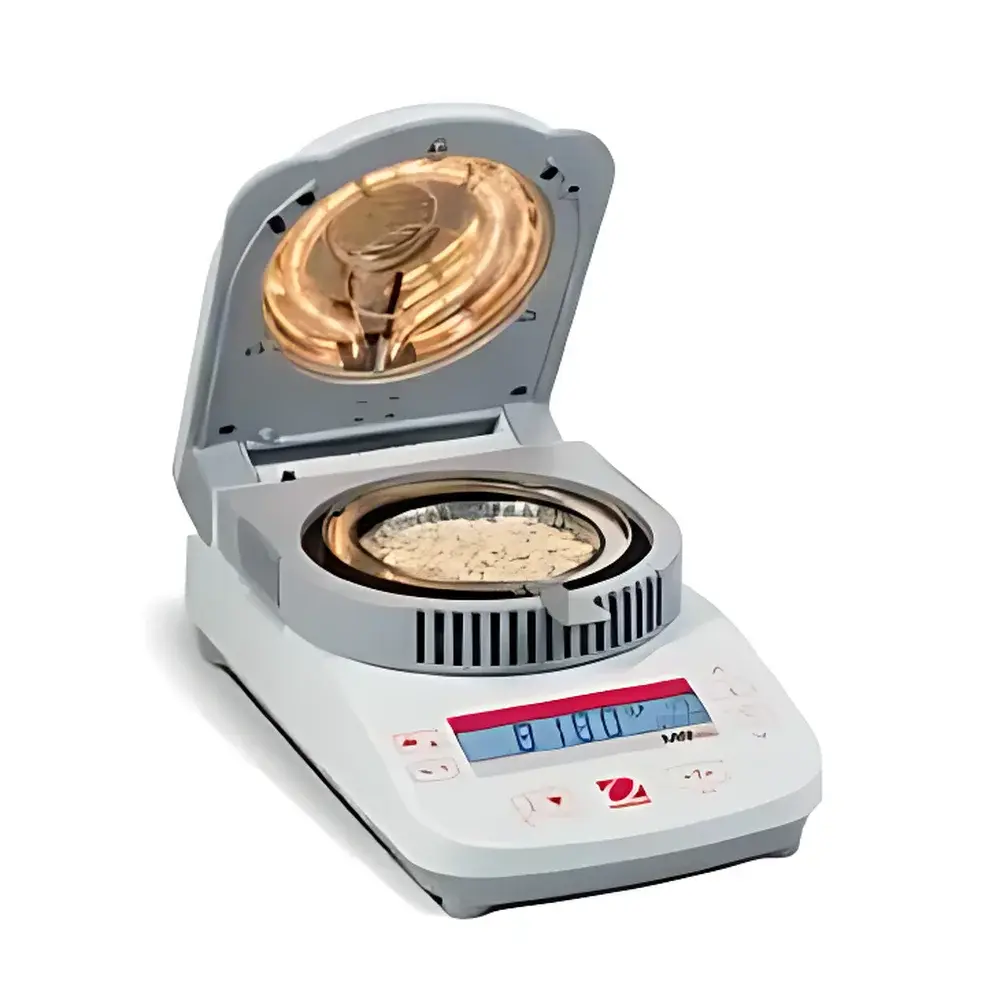
OHAUS MB27 Infrared Moisture Analyzer
| Origin | USA |
|---|---|
| Manufacturer Type | Authorized Distributor |
| Origin Category | Imported |
| Model | MB27 |
| Price | USD 1,550 (approx.) |
Overview
The OHAUS MB27 Infrared Moisture Analyzer is a precision halogen-heated thermogravimetric instrument engineered for rapid, reliable moisture content determination in solid and semi-solid samples. It operates on the principle of loss-on-drying (LOD), where sample mass is continuously monitored during controlled heating; moisture loss is calculated as the percentage change between initial and final dry mass. Unlike traditional oven methods requiring hours, the MB27 delivers repeatable results in minutes—making it ideal for high-throughput quality control environments where speed and traceability are critical. Its design integrates a high-stability electromagnetic force restoration balance with an optimized halogen lamp heating system, ensuring thermal uniformity across the sample surface while minimizing thermal drift during measurement.
Key Features
- Halogen lamp heating source (50–160 °C in 5 °C increments) provides rapid, controllable, and reproducible thermal energy transfer—superior to conventional infrared emitters in response time and spatial homogeneity.
- High-resolution weighing system with 0.001 g readability and ±0.01% moisture repeatability (on ≥10 g samples), validated per ASTM D4442 and ISO 13789 protocols for wood-based materials and analogous matrices.
- Thermally isolated load cell architecture minimizes conduction-induced drift during heating—critical for maintaining accuracy over extended drying cycles (up to 90 minutes).
- Backlit LCD display presents real-time data including moisture %, solids %, current weight (g), elapsed time (min:sec), and chamber temperature (°C)—all simultaneously without menu navigation.
- Six-button intuitive interface eliminates hierarchical menus; all functions—including method selection, start/stop, tare, and parameter adjustment—are accessible in one or two keystrokes.
- Built-in bidirectional RS232 interface supports direct connection to label printers, LIMS workstations, or PCs running OHAUS Moisture Pro software for automated data export and audit-ready reporting.
Sample Compatibility & Compliance
The MB27 accommodates sample masses from 0.5 g (minimum) to 99 g (maximum), with optimal performance observed between 3–20 g. It is validated for use with granular, powdered, flaked, and paste-like materials common in pharmaceutical excipients (e.g., lactose, microcrystalline cellulose), food ingredients (flour, sugar, dairy powders), agricultural commodities (grains, feed pellets), and industrial chemicals (catalysts, pigments, polymers). The instrument meets general requirements for GLP-compliant moisture analysis and supports user-defined method validation per USP , EP 2.2.32, and AOAC 952.07. While not intrinsically 21 CFR Part 11 compliant, its RS232 output enables integration into validated systems with appropriate electronic signature and audit trail controls.
Software & Data Management
The MB27 operates autonomously but interfaces seamlessly with OHAUS Moisture Pro PC software (Windows-compatible) via RS232. This software enables method library creation, multi-step heating profile programming (e.g., ramp-hold-cool sequences), real-time graphing of weight vs. time curves, and export of CSV- or Excel-formatted reports—including operator ID, timestamp, method name, and raw weight data. All exported files retain metadata required for internal QA review and external regulatory submissions. No onboard memory or USB port is included; data persistence relies on external recording—ensuring full traceability and eliminating risk of local data corruption.
Applications
- Pharmaceutical QC labs: Moisture verification of active pharmaceutical ingredients (APIs) and tablet granules prior to compression—ensuring stability and preventing hydrolysis during storage.
- Food manufacturing: In-process monitoring of flour, starch, coffee, and snack products to maintain texture, shelf life, and compliance with FDA moisture limits.
- Agricultural testing: Rapid field-adjacent analysis of grain moisture for harvest scheduling and storage safety (e.g., avoiding mycotoxin formation at >14% moisture).
- Chemical production: Batch release testing of hygroscopic reagents, catalysts, and polymer resins where residual solvent or water impacts reaction kinetics.
- Environmental labs: Determination of total solids and moisture in sludge, compost, and soil samples per EPA Method 1684 and Standard Methods 2540B.
FAQ
What heating technology does the MB27 use, and why is it preferred over traditional IR lamps?
The MB27 employs a focused halogen lamp with optimized reflector geometry, delivering faster thermal response, narrower spectral emission (centered near 1.2 µm), and superior irradiance uniformity compared to broad-spectrum ceramic IR elements—reducing charring risk in heat-sensitive organics.
Can the MB27 be calibrated for specific materials using reference standards?
Yes—users may develop and store up to 9 custom drying methods, each with unique temperature profiles, endpoint criteria (time-based or slope-based), and correction factors derived from Karl Fischer titration or gravimetric oven validation.
Is the MB27 suitable for volatile organic compounds (VOCs) or only water?
It measures total volatile loss—not exclusively water. For VOC-rich samples (e.g., solvents, essential oils), results represent total volatiles unless coupled with complementary techniques (e.g., GC-MS) for speciation.
Does the MB27 support GLP audit trails or electronic signatures?
No standalone audit trail functionality is built-in; however, when integrated with validated third-party LIMS or OHAUS Moisture Pro on a secured network, full 21 CFR Part 11 compliance can be achieved through system-level controls.
What maintenance is required to ensure long-term accuracy?
Daily cleaning of the sample pan and chamber with lint-free cloth; annual calibration verification using certified weights and NIST-traceable moisture standards; halogen lamp replacement every ~10,000 operating hours (typically 2–3 years under normal use).





