
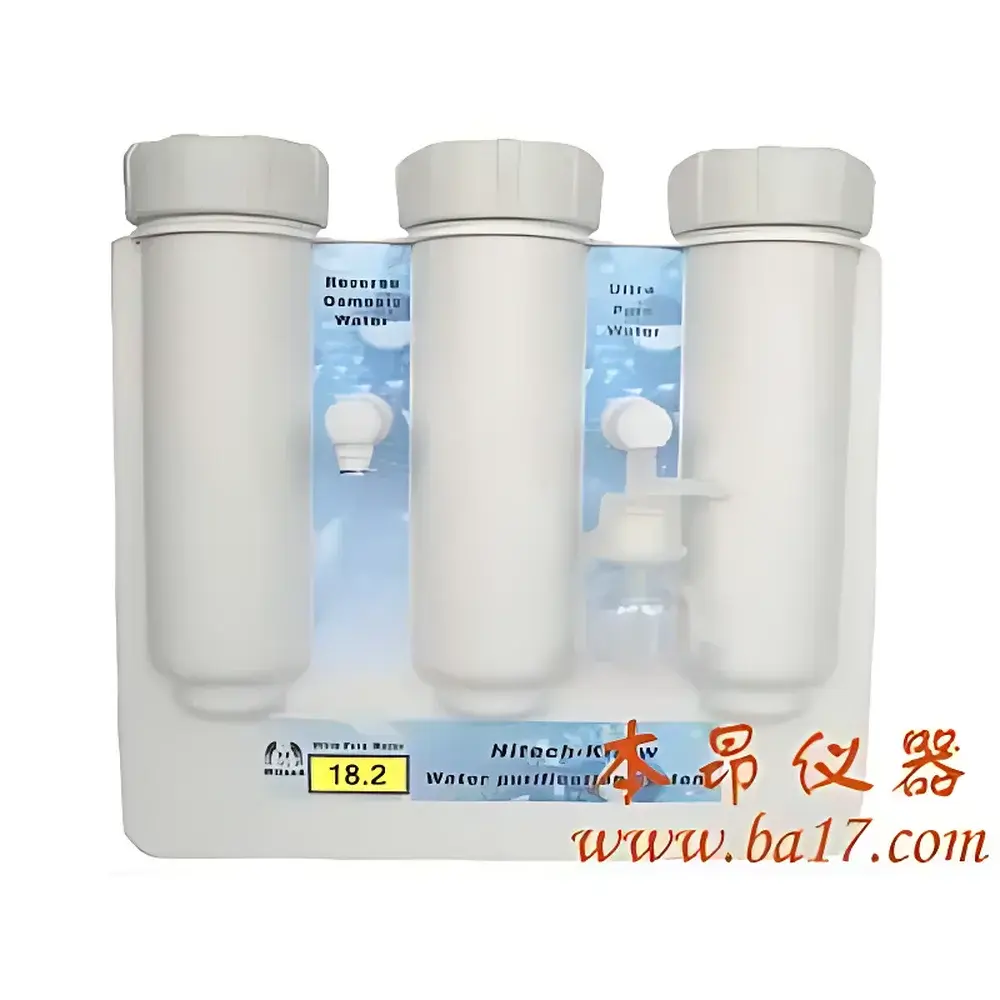
BenAng UP-15 Basic Ultra Pure Water System
| Brand | BenAng |
|---|---|
| Origin | Shanghai, China |
| Manufacturer Type | Authorized Distributor |
| Country of Origin | China |
| Model | UP-15 |
| Price | USD 2,400 (FOB Shanghai) |
| Production Standard | GB/T 11446.1–1997 Grade I, GB 6682–1992 Grade I, ASTM D1193 Type I, NCCLS CLSI EP22-A2 |
| Feed Water | Municipal tap water (TDS < 200 ppm, 5–40 °C, pressure 1.0–3.5 kg/cm²) |
| Output Flow Rate | 15 L/h |
| Resistivity | 18.2 MΩ·cm @ 25 °C |
| Total Organic Carbon (TOC) | <10 ppb |
| Microbial Count | <1 CFU/mL |
| Particulates (>0.22 µm) | <1 particles/mL |
| Terminal Filtration | 0.22 µm hydrophilic PES membrane (Sartorius, Germany) |
| UV Wavelengths | 254 nm + 185 nm dual-lamp system |
| UF Module | MWCO 5000 Da (Pall, USA) |
| RO Membrane | Dow FilmTec™ or FCS high-rejection TFC membrane (>99% salt rejection, >99.5% microbial removal) |
| Pre-filtration | Dual-stage activated carbon + PP sediment filter (Kflow, USA) |
| Polishing | Four-column nuclear-grade mixed-bed ion exchange resin (Rohm & Haas / Dow) |
| System Architecture | PF + AC + RO + DI + UV + UF + DMF + 0.22 µm terminal filtration |
| Automation | Fully programmable PLC with real-time pressure monitoring, auto RO flush, dry-run protection, reservoir-level feedback control, and 24/7 unattended operation |
Overview
The BenAng UP-15 Basic Ultra Pure Water System is a compact, fully integrated laboratory water purification platform engineered for consistent production of Type I ultrapure water per ASTM D1193, ISO 3696 Class 1, GB/T 11446.1–1997 Grade I, and GB 6682–1992 Grade I specifications. It employs a multi-stage purification architecture combining prefiltration, reverse osmosis (RO), dual-wavelength ultraviolet photooxidation (254 nm for microbial inactivation and 185 nm for TOC reduction), ultrafiltration (UF), mixed-bed deionization, and final 0.22 µm sterile filtration. The system accepts municipal tap water as feedstock and delivers two independent streams: purified RO water (suitable for glassware rinsing, buffer preparation, and general lab use) and ultrapure water (for critical applications requiring resistivity ≥18.2 MΩ·cm at 25 °C). Its modular design integrates components from globally recognized suppliers—including Dow FilmTec™ and FCS RO membranes, Kflow precision pumps and housings, Rohm & Haas nuclear-grade ion exchange resins, Pall UF modules, and Sartorius-certified terminal filters—ensuring long-term stability, low maintenance frequency, and compliance with GLP/GMP-aligned operational traceability.
Key Features
- Continuous 15 L/h ultrapure water output with real-time resistivity monitoring via backlit LCD display (range: 0.0–18.25 MΩ·cm)
- Dual-wavelength UV system (254 nm + 185 nm) for simultaneous microbial inactivation and organic oxidation, reducing TOC to <10 ppb
- High-rejection thin-film composite RO membrane (>99% salt rejection, >99.5% bacterial removal), coupled with automated daily anti-scaling flush cycles
- Four-column mixed-bed polishing cartridge using nuclear-grade resins (Rohm & Haas / Dow) for extended service life and stable 18.2 MΩ·cm output
- Pall ultrafiltration module (MWCO 5000 Da) eliminating endotoxins, nucleases, and submicron particles
- Sartorius 0.22 µm hydrophilic polyethersulfone (PES) terminal filter certified for sterile filtration and low protein binding
- Fully automated PLC control with dry-run protection, reservoir-level feedback, auto-shutdown on tank saturation, and fault logging capability
- Pre-filter lifespan up to 24 months under typical municipal feed conditions, minimizing consumable replacement frequency and total cost of ownership
Sample Compatibility & Compliance
The UP-15 is validated for use with standard municipal tap water meeting TDS ≤200 ppm, temperature range 5–40 °C, and inlet pressure 1.0–3.5 kg/cm². It does not require pretreatment for compliant feed sources. All wetted materials—including tubing, housings, and cartridges—are USP Class VI-compliant and extractables-tested. The system conforms to national and international standards for analytical-grade water: GB/T 11446.1–1997 (Electronic Grade I), GB 6682–1992 (Laboratory Grade I), ASTM D1193 Type I, and NCCLS EP22-A2. While not inherently 21 CFR Part 11–compliant out-of-the-box, its digital interface supports optional audit-trail-enabled firmware upgrades for regulated environments requiring electronic record integrity.
Software & Data Management
The UP-15 features an embedded microcontroller with non-volatile memory for storing operational logs—including runtime hours, RO flush cycles, alarm history, and resistivity trend snapshots (sampled every 30 seconds). Data export is supported via RS-232 serial interface for integration into LIMS or local lab databases. No proprietary software installation is required; raw ASCII log files are human-readable and compatible with Excel or MATLAB. Optional analog 4–20 mA output enables connection to building management systems (BMS) or centralized monitoring dashboards. All calibration parameters (e.g., temperature compensation coefficients) are field-adjustable via password-protected menu navigation.
Applications
This system serves as a primary water source for laboratories requiring reliable, low-TIC, low-endotoxin water across diverse disciplines: HPLC and UHPLC mobile phase preparation; ICP-MS, AA, and IC sample dilution; cell culture media formulation and reagent preparation; ELISA and Western blotting buffers; molecular biology workflows including PCR, qRT-PCR, and NGS library prep; semiconductor wafer cleaning validation; and trace metal analysis where background contamination must remain below detection thresholds. Its dual-outlet configuration allows concurrent use of RO water for preliminary rinsing and ultrapure water for final sterilization steps—optimizing workflow efficiency without cross-contamination risk.
FAQ
What feed water quality is required?
Municipal tap water with TDS ≤200 ppm, temperature between 5–40 °C, and inlet pressure of 1.0–3.5 kg/cm².
Does the UP-15 include data logging capabilities?
Yes—it records cumulative runtime, RO flush events, resistivity trends, and fault codes in non-volatile memory, exportable via RS-232.
Can the system be integrated into a central water distribution loop?
No—the UP-15 is a point-of-use system designed for direct benchtop operation; it lacks booster pump or loop-return functionality.
Is the terminal filter sterilized and certified?
Yes—the Sartorius 0.22 µm PES filter is gamma-irradiated, individually packaged, and supplied with CoA confirming bioburden <0.1 CFU/unit.
How often must the RO membrane be replaced?
Under typical municipal feed conditions, the RO membrane service life exceeds 24 months; replacement interval depends on feed water hardness and chlorine exposure history.
Does the system meet FDA requirements for pharmaceutical water?
It meets ASTM/GB/ISO Type I specifications but is not validated for USP Purified Water or Water for Injection (WFI); additional qualification per USP is required for GMP manufacturing use.



