
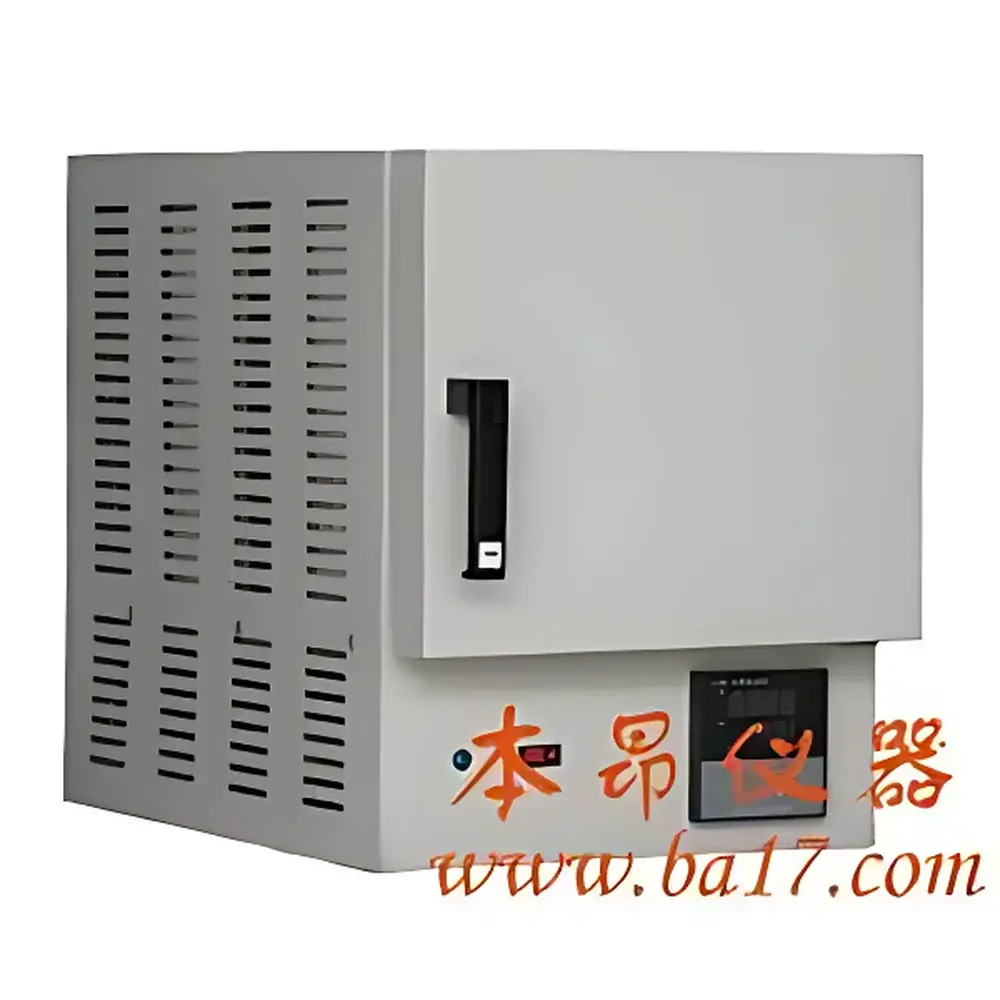
BenAng BA-8-10B Ceramic Fiber Muffle Furnace
| Brand | BenAng |
|---|---|
| Origin | Shanghai, China |
| Manufacturer Type | Authorized Distributor |
| Country of Origin | China |
| Model | BA-8-10B |
| Chamber Dimensions | 500 × 500 × 500 mm |
| Max Operating Temperature | 1000 °C |
| Heating Rate | ≥60 °C/min (0–1000 °C in ≤12 min) |
| Temperature Uniformity | ±1 °C |
| Control System | PID Intelligent Temperature Controller |
| Sensor | K-type Thermocouple (NiCr–NiSi) |
| Power Supply | AC 380 V |
| Rated Power | 8 kW |
| Insulation | 50 mm High-Purity Alumina-Silica Ceramic Fiber (US-sourced) |
| Heating Element | Kanthal® A1 Alloy Resistance Wire (Sweden) |
| Surface Temperature at 1000 °C | ≤60 °C |
| Energy Efficiency | ~40% of conventional refractory-brick muffle furnaces |
Overview
The BenAng BA-8-10B Ceramic Fiber Muffle Furnace is a high-performance benchtop laboratory furnace engineered for rapid thermal processing, precise temperature control, and exceptional energy efficiency. Designed around the principles of resistive heating within an insulated cavity, it employs Kanthal® A1 alloy heating elements embedded in a 50 mm-thick monolithic layer of high-purity alumina-silica ceramic fiber insulation—sourced from certified U.S. manufacturers. This architecture enables stable operation up to 1000 °C with minimal thermal lag and superior heat retention. Unlike traditional brick-lined muffle furnaces, the BA-8-10B achieves full setpoint temperature in under 12 minutes while maintaining surface casing temperatures below 60 °C—well within ISO 13732-1 ergonomic safety thresholds. Its compact 500 × 500 × 500 mm chamber volume supports standardized sample handling across academic, industrial, and regulatory laboratory workflows, including ashing, calcination, heat treatment, and thermal pre-conditioning of analytical specimens.
Key Features
- Ultra-fast heating kinetics: Reaches 1000 °C in ≤12 minutes with ramp rates ≥60 °C/min, significantly reducing cycle time for high-throughput labs.
- High-precision temperature regulation: PID-based intelligent controller with K-type thermocouple feedback ensures ±1 °C stability across the entire operating range.
- Advanced thermal insulation: 50 mm thick, low-density ceramic fiber module (alumina content >96%) delivers exceptional thermal resistance and negligible dust shedding—critical for contamination-sensitive applications such as elemental analysis and pharmaceutical residue testing.
- Robust heating system: Kanthal® A1 alloy wire elements offer extended service life, uniform resistivity distribution, and mechanical resilience against thermal cycling fatigue.
- Comprehensive safety architecture: Includes door-interlocked power cutoff, overtemperature cutout (dual-stage), auto-restart inhibition after power interruption, and real-time surface temperature monitoring.
- Energy-optimized design: Consumes approximately 40% less electrical energy than equivalent brick-insulated furnaces operating under identical duty cycles—validated per IEC 60068-3-5 thermal efficiency protocols.
Sample Compatibility & Compliance
The BA-8-10B accommodates standard crucibles (alumina, quartz, platinum), ceramic boats, and stainless-steel sample holders up to 100 mm in height. Its inert, non-reactive chamber environment complies with ASTM E1112 (standard practice for ashing organic materials), ISO 1171 (determination of ash in coal and coke), and USP <281> (residue on ignition). The furnace meets CE marking requirements for electrical safety (EN 61000-6-3, EN 61000-6-4) and is suitable for GLP-compliant laboratories requiring audit-ready operational records when integrated with optional data logging modules. All internal materials are non-outgassing above 1000 °C and do not introduce metallic contaminants during prolonged use.
Software & Data Management
While the base unit operates via front-panel PID interface, optional RS485/Modbus RTU connectivity enables integration into centralized lab management systems (LIMS) or SCADA platforms. When paired with BenAng’s optional TC-Link™ data acquisition module, users can export timestamped temperature profiles compliant with FDA 21 CFR Part 11 requirements—including electronic signatures, audit trails, and immutable data archiving. Firmware supports configurable alarm thresholds, programmable multi-step ramps, and automatic calibration verification logs—facilitating routine IQ/OQ validation per ISO/IEC 17025 standards.
Applications
- Coal and biomass analysis: Determination of moisture, ash content, volatile matter, fusibility, and elemental composition (ASTM D3172–D3176).
- Environmental testing: EPA Method 2540C ashing of filter media, sediment, and sludge samples prior to ICP-OES or AAS quantification.
- Pharmaceutical QC: Residue-on-ignition assays (USP <281>), excipient thermal stability screening, and container closure integrity validation.
- Materials science: Sintering of advanced ceramics, annealing of thin-film substrates, and pre-oxidation of metal powders prior to XRD or SEM characterization.
- Academic research: Kinetic studies of solid-state reactions, catalyst activation/deactivation profiling, and thermogravimetric method development.
FAQ
What is the maximum continuous operating temperature?
The BA-8-10B is rated for continuous operation at 1000 °C. Short-term excursions up to 1020 °C are permissible for ≤30 minutes per cycle without compromising insulation integrity.
Does the furnace support programmable multi-step temperature profiles?
Yes—when equipped with the optional TC-Link™ module and BenAng LabControl™ software, users can define up to 32 segments with independent ramp rates, dwell times, and soak conditions.
Is the ceramic fiber insulation certified for ISO Class 5 cleanroom compatibility?
While not classified for cleanroom use per ISO 14644-1, the fiber matrix is non-shedding and passes ASTM C711 particulate emission testing at 1000 °C, making it suitable for low-particulate environments in analytical labs.
Can this furnace be used for sulfur determination (e.g., ASTM D2492)?
Yes—the inert chamber atmosphere and absence of metallic catalytic surfaces prevent sulfur loss or oxidation artifacts during sulfate ashing procedures.
What maintenance intervals are recommended for the heating elements and insulation?
Kanthal® A1 elements typically require no replacement for 5,000+ hours at 1000 °C; annual visual inspection of fiber integrity and thermocouple calibration is advised per ISO/IEC 17025 Clause 6.4.3.



