
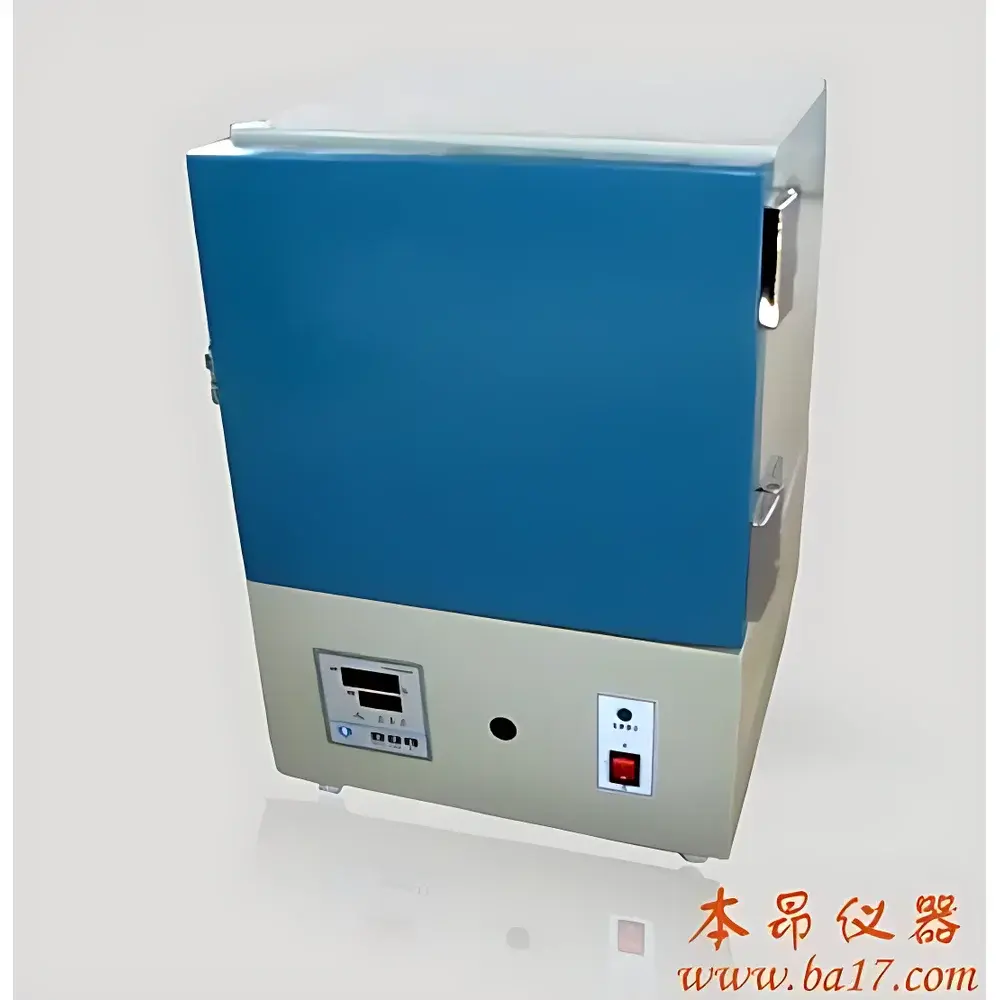
BenAng BA-2-13B Ceramic Fiber Muffle Furnace
| Brand | BenAng |
|---|---|
| Origin | Shanghai, China |
| Model | BA-2-13B |
| Type | Box-type Muffle Furnace |
| Max Temperature | 1300 °C |
| Temperature Control Accuracy | ±1 °C |
| Rated Power | 2000 W |
| Heating Rate to 1000 °C | 12 min |
| Internal Chamber Dimensions | 165 × 120 × 105 mm |
| Heating Method | Resistance Wire (Kanthal® A1 alloy) |
| Insulation Material | High-Purity Alumina-Silica Ceramic Fiber (50 mm thick) |
| Temperature Sensor | K-type Thermocouple (NiCr–NiSi) |
| Control System | PID Digital Controller |
| Safety Features | Door-Interlocked Power Cut-off, Surface Over-Temperature Protection, Auto-Reset Prevention After Power Failure |
Overview
The BenAng BA-2-13B Ceramic Fiber Muffle Furnace is a precision-engineered box-type laboratory furnace designed for rapid, uniform, and energy-efficient high-temperature thermal processing up to 1300 °C. Built on the principles of resistive heating and low-thermal-mass insulation, it employs Kanthal® A1 resistance wire—sourced from Sweden—as the primary heating element, embedded within a 50 mm-thick monolithic chamber lined with high-purity alumina-silica ceramic fiber (US-sourced). This architecture minimizes thermal inertia, enabling acceleration to 1000 °C in just 12 minutes—approximately 85% faster than conventional refractory-brick muffle furnaces. The furnace operates under open-air ambient conditions without forced convection or gas purging, making it suitable for ashing, calcination, sintering, heat treatment, and pre-conditioning of samples in inert or oxidizing atmospheres. Its compact internal volume (165 × 120 × 105 mm) supports reproducible small-batch thermal protocols while maintaining strict temperature uniformity (±1 °C) across the working zone—critical for method validation in regulated environments.
Key Features
- Ultra-low thermal mass design using 50 mm high-purity ceramic fiber insulation—reducing surface temperature to ≤60 °C at 1000 °C operation (well below ISO 21501-2 and ASTM E1112 surface safety thresholds)
- Kanthal® A1 alloy heating elements offering exceptional oxidation resistance, structural stability, and long service life (>5000 h at 1200 °C)
- Digital PID temperature controller with K-type thermocouple feedback, supporting ramp-soak programming and real-time deviation monitoring
- Integrated safety architecture: door-actuated mechanical power cutoff, dual-stage over-temperature protection (sensor + independent thermal fuse), and anti-restart logic following grid interruption
- Energy efficiency optimized—consumes ~40% less power than equivalent brick-lined furnaces during identical thermal cycles, aligning with ISO 50001 energy management benchmarks
- Non-shedding, non-dusting chamber lining—eliminating particulate contamination critical for trace-element analysis (e.g., ASTM D3174, USP <281> ash residue testing)
Sample Compatibility & Compliance
The BA-2-13B accommodates crucibles, boats, and trays made from alumina, quartz, silicon carbide, or platinum—compatible with standard ASTM, ISO, and pharmacopeial sample containers (e.g., ASTM D3172 for coal ash, ISO 1171 for ash content, USP <281> for residual solvents). Its stable thermal profile meets GLP requirements for calibration traceability when paired with NIST-traceable thermocouples. The furnace conforms to IEC 61000-6-3 (EMC emissions) and IEC 61010-1 (safety for laboratory equipment), and its control system supports audit-ready logging when interfaced with external data acquisition systems compliant with FDA 21 CFR Part 11 (electronic records/signatures).
Software & Data Management
While the BA-2-13B operates via standalone PID controller with front-panel interface, it features RS485 Modbus RTU output for integration into centralized lab management platforms (e.g., LabVantage, Thermo Fisher SampleManager). Optional analog 4–20 mA output enables connection to PLC-based environmental monitoring systems. All temperature setpoints, ramp rates, soak durations, and real-time sensor readings can be logged externally with time-stamped metadata—supporting ALCOA+ data integrity principles (Attributable, Legible, Contemporaneous, Original, Accurate, Complete, Consistent, Enduring, Available).
Applications
- Coal and biomass analysis: moisture, volatile matter, fixed carbon, ash content, and ash fusion temperature per ASTM D3172, D3174, D3175, and ISO 1171
- Environmental testing: TSS, TOC, and heavy metal digestion residue ashing per EPA Method 200.2 and ISO 11464
- Pharmaceutical QC: loss-on-drying (LOD), residual solvent ashing, and excipient thermal stability screening per USP <731> and <281>
- Materials science: pre-sintering of ceramic powders, binder burnout, and thermal cycling of thin-film substrates
- Academic research: kinetic studies of decomposition reactions, catalyst activation, and phase transformation experiments requiring precise thermal profiles
FAQ
What is the maximum continuous operating temperature of the BA-2-13B?
The furnace is rated for continuous operation at 1300 °C, with thermal stability maintained for ≥100 h under load per manufacturer qualification protocol.
Does the BA-2-13B support programmable multi-step temperature profiles?
Yes—the PID controller supports up to 30 segment ramp-soak programs, adjustable via keypad or Modbus command.
Is the ceramic fiber insulation chemically resistant to halogenated or acidic fumes?
The alumina-silica fiber is inert to most oxidizing and neutral atmospheres but not recommended for prolonged exposure to hydrofluoric acid vapor or molten alkali metals.
Can the furnace be validated for GMP-compliant processes?
Yes—when equipped with calibrated K-type thermocouples and connected to a 21 CFR Part 11–compliant data logger, it satisfies IQ/OQ/PQ documentation requirements for thermal process validation.
What maintenance is required for long-term reliability?
Annual verification of thermocouple calibration and visual inspection of heating element continuity are recommended; no routine replacement of insulation or wiring is needed under normal usage.
Related Products



