
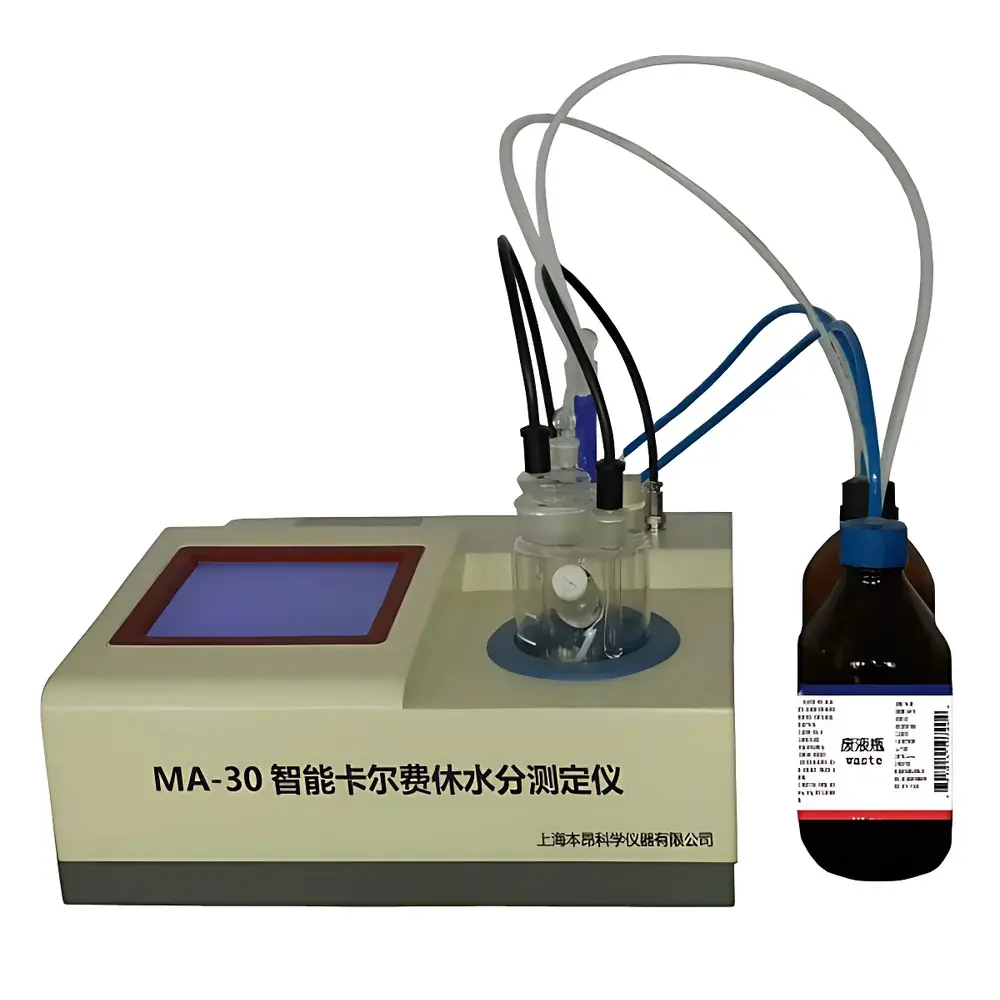
BenAng MA-30 “Sprite I” Intelligent Coulometric Karl Fischer Moisture Analyzer
| Brand | BenAng |
|---|---|
| Origin | Shanghai, China |
| Manufacturer Type | Authorized Distributor |
| Instrument Type | Coulometric Karl Fischer Titrator |
| Titration Mode | Fully Automatic |
| Measurement Resolution | 0.1 ppm |
| Moisture Content Range | 0.00001% (0.1 ppm) to 100% |
| Measurement Accuracy | ±0.1 ppm |
| Minimum Dispensing Volume | 0.5 µL |
| Titration Control Precision | ±0.1 mV |
| Repeatability | ≤0.0002% RSD |
| Linearity Correlation Coefficient | ≥0.9999 |
| Power Consumption | <50 W |
| Operating Voltage | AC 220 V ±10%, 50 Hz |
| Ambient Temperature Range | 5–40 °C |
| Relative Humidity Limit | ≤85% RH (non-condensing) |
Overview
The BenAng MA-30 “Sprite I” Intelligent Coulometric Karl Fischer Moisture Analyzer is a precision-engineered laboratory instrument designed for trace and macro-level water quantification in diverse liquid, solid, and gaseous samples using the coulometric principle of Karl Fischer titration. Unlike volumetric systems, the MA-30 generates iodine electrochemically at the anode via controlled current application—ensuring stoichiometric accuracy without reagent standardization or burette calibration drift. This architecture delivers inherent high sensitivity and exceptional reproducibility, particularly critical for samples with water content below 100 ppm. The analyzer operates under strict adherence to electrochemical equivalence (1 mole of iodine ≡ 1 mole of H₂O), enabling absolute quantification traceable to fundamental physical constants. Its fully sealed titration cell minimizes ambient moisture ingress, while integrated temperature and humidity monitoring compensates for environmental fluctuations during extended analysis sequences—key for GLP-compliant routine QC in regulated environments.
Key Features
- Fully automated reagent aspiration and waste expulsion via dual-channel peristaltic pump system, eliminating manual handling and reducing operator exposure to toxic KF reagents (e.g., SO₂, pyridine-free solvents)
- Multi-point electronic gain calibration using certified water standards (e.g., 1.00 mg H₂O/g standard), allowing software-based adjustment of system response slope to correct for electrode aging or solvent batch variation
- Real-time reagent consumption tracking with predictive end-of-life alerting based on cumulative coulombic charge and electrolyte conductivity decay
- Adjustable titration kinetics: users select between high-speed mode (optimized for >1000 ppm samples, ~45 s/test) and high-precision mode (extended stabilization for sub-ppm quantification, ~90–120 s/test)
- 7-inch capacitive touchscreen LCD with intuitive icon-driven interface; no programming expertise required—navigation follows ISO/IEC 62366 human factors guidelines
- Hermetically sealed double-compartment titration cell with Pt generator/anode and Pt indicator/cathode electrodes, compliant with ASTM D6304 requirements for cell geometry and electrode spacing
Sample Compatibility & Compliance
The MA-30 supports direct injection of liquids (oils, solvents, pharmaceutical excipients), dissolution-based analysis of solids (polymers, APIs, catalysts), and headspace analysis of gases (natural gas, SF₆, refrigerants) using optional vaporizer modules. It meets or exceeds the methodological requirements of 22 national standards—including GB/T 7600 (transformer oil), GB/T 11133 (petroleum products), GB/T 606 (chemical reagents), and GB/T 18826 (HFC-134a)—all of which reference ISO 8534, ASTM D6304, and USP <921>. For pharmaceutical applications, the system supports audit trails, electronic signatures, and 21 CFR Part 11–compliant data integrity features when operated with validated firmware version 3.2+. All calibration records, method parameters, and raw titration curves are stored with time-stamped metadata and immutable hash verification.
Software & Data Management
Embedded firmware v3.2 provides local data storage for ≥10,000 test records with full traceability: sample ID, analyst ID, date/time stamp, method name, raw current vs. time curve, endpoint detection algorithm (dynamic slope threshold + second derivative confirmation), and final water content (wt%, ppm, or mg H₂O). Export options include CSV (for LIMS integration), PDF reports (with embedded QR codes linking to raw data), and XML files compatible with LabWare LIMS and Thermo Fisher SampleManager. Audit trail logs record all user actions—including method edits, calibration events, and result overrides—with IP address, timestamp, and role-based access control (admin/operator modes). Data encryption at rest (AES-256) and TLS 1.2–secured remote diagnostics ensure compliance with GDPR and HIPAA-aligned data governance policies.
Applications
- Quality control of lithium battery electrolytes (LiPF₆ solutions), where residual water >20 ppm induces HF formation and cathode degradation
- Stability-indicating assay of hygroscopic active pharmaceutical ingredients (e.g., amorphous ritonavir) per ICH Q5C guidelines
- Moisture mapping in polymer resins (PA6, PET) prior to extrusion—critical for preventing hydrolytic chain scission
- Trace water verification in semiconductor-grade solvents (acetone, IPA) per SEMI F57 specifications
- Regulatory testing of biofuels (EN 14103, ASTM D6304) and aviation turbine fuels (ASTM D3240)
- Research applications requiring kinetic water uptake profiling (e.g., MOF hydration isotherms) using programmable multi-step titration protocols
FAQ
What distinguishes coulometric from volumetric Karl Fischer titration on the MA-30?
Coulometric operation eliminates reagent standardization errors and delivers superior precision below 100 ppm. The MA-30 generates iodine on-demand via Faraday-controlled current, ensuring 1:1 stoichiometry without pipetting uncertainty.
Can the MA-30 comply with FDA 21 CFR Part 11 requirements?
Yes—when deployed with firmware v3.2+ and configured with password-protected user roles, electronic signatures, and immutable audit trails, it satisfies electronic record and signature criteria for GMP environments.
How does the system handle electrode passivation during long-term use?
The MA-30 performs automatic electrode cleaning cycles (reverse-polarity pulse regeneration) every 50 analyses or upon conductivity drop >15%, restoring baseline sensitivity without manual intervention.
Is method validation support available for pharmaceutical applications?
BenAng provides IQ/OQ documentation templates aligned with ASTM E2500 and USP <1225>, including specificity, linearity (0.1–1000 ppm), LOD/LOQ, and ruggedness testing protocols.
What maintenance intervals are recommended for routine operation?
Daily: solvent level check and cell drying purge; Quarterly: electrode polishing and diaphragm inspection; Annually: full system performance qualification using NIST-traceable water standards.






