
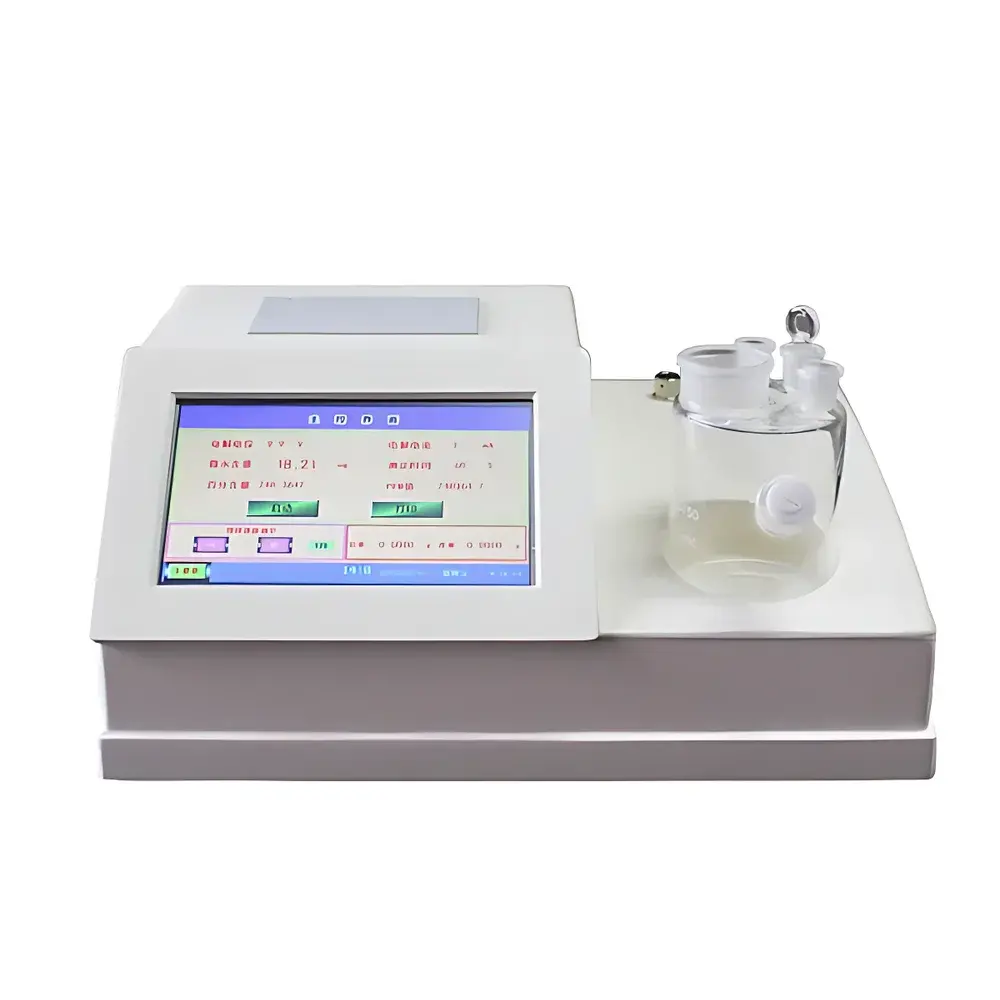
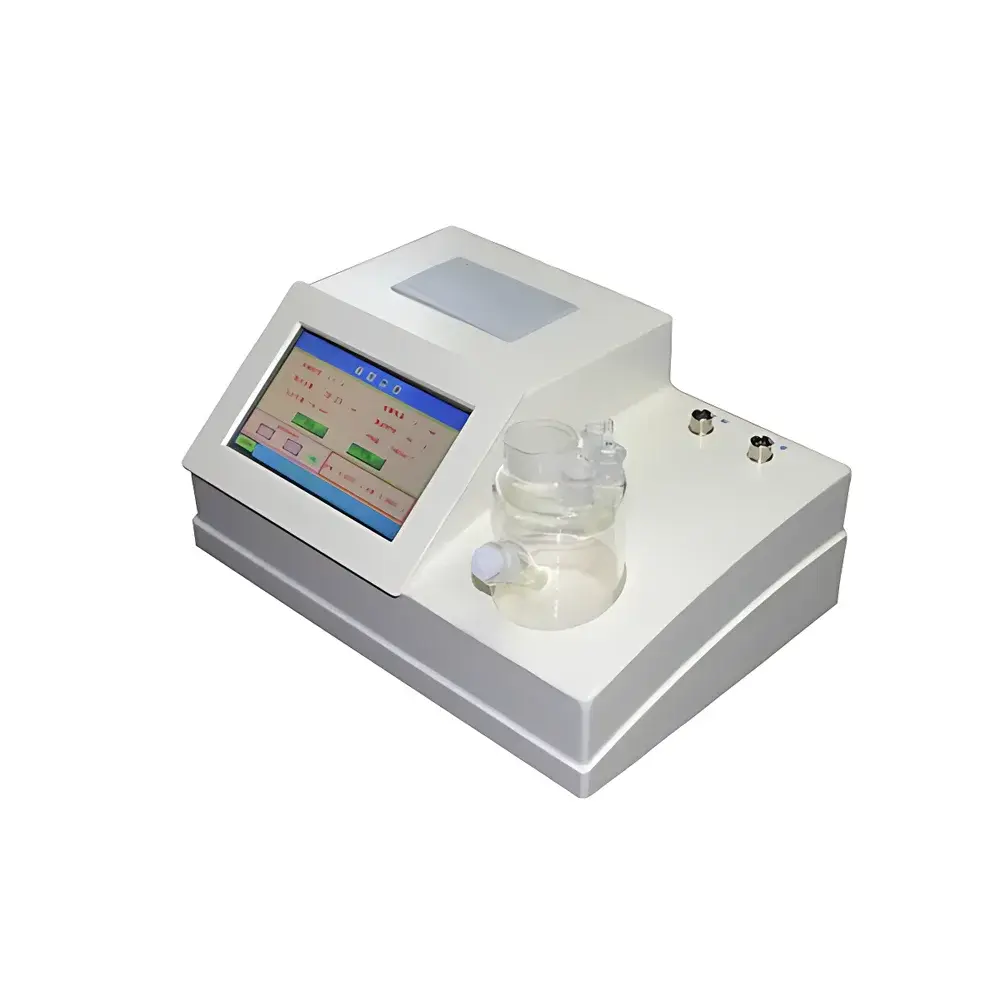
BenAng MA-3 Advanced Intelligent Karl Fischer Moisture Analyzer
| Brand | BenAng |
|---|---|
| Origin | Shanghai, China |
| Model | MA-3 |
| Instrument Type | Volumetric & Coulometric Karl Fischer Titrator |
| Moisture Range | 0.1 ppm to 100% (w/w) |
| Measurement Precision | ±0.1 µg for water mass ≤ 1 mg |
| Minimum Dispensing Resolution | 1/2000 of full stroke |
| Display | 7-inch color LCD touchscreen |
| Data Storage | Up to 999 test records with timestamp, sample ID, operator ID, and result export capability |
| Compliance | Fully aligned with GB/T 7600, GB 6283, SH/T 0246, SH/T 0255, GB/T 11133, GB/T 7380, GB 10670, GB/T 606, GB/T 8350, GB/T 8351, GB/T 3776.1, GB/T 6023, GB/T 3727, GB/T 7376, GB/T 18619.1, GB/T 512, GB/T 1600, GB/T 11146, GB/T 12717, GB/T 5074, GB/T 18826, and Chinese Pharmacopoeia (ChP) general chapter <0832> for Karl Fischer titration |
Overview
The BenAng MA-3 Advanced Intelligent Karl Fischer Moisture Analyzer is a dual-mode (volumetric and coulometric) titration system engineered for high-precision quantitative determination of water content in solids, liquids, and gases across pharmaceutical, petrochemical, polymer, and fine chemical laboratories. It operates on the fundamental electrochemical principle of the Karl Fischer reaction—where iodine stoichiometrically reacts with water in the presence of sulfur dioxide, a base, and a solvent—enabling trace-level detection down to 0.1 ppm (0.00001% w/w). Unlike single-mode instruments, the MA-3 dynamically selects optimal titration mode based on sample matrix and expected moisture concentration, ensuring both sensitivity for ultra-trace analysis and robustness for high-water-content samples up to 100%. Its closed-loop titration cell design minimizes atmospheric moisture ingress, while integrated temperature and humidity monitoring compensates for environmental drift during extended operation.
Key Features
- Hybrid titration architecture supporting both volumetric and coulometric Karl Fischer methods within a single platform
- 0.1 ppm detection limit and resolution, validated per ISO 8573-3 and ASTM E203 guidelines for trace moisture quantification
- 7-inch capacitive color touchscreen with intuitive icon-driven interface and real-time graphical titration curve display
- Automated endpoint detection using dynamic polarization current thresholding and second-derivative peak recognition
- Sealed, inert-gas-purged titration cell with dual-electrode configuration to eliminate oxygen interference and enhance reproducibility
- Onboard microbalance integration support (via RS-232 or USB) for direct sample weight acquisition and automatic calculation of % w/w or % v/v results
- Volumetric mode includes programmable burette drive with 1/2000-step precision dosing control and auto-zero calibration
- Coulometric mode features constant-current electrolysis (10–200 µA range), optimized anode/cathode electrode geometry, and adaptive current regulation
- Embedded thermal management system maintains stable cell temperature (±0.3°C) across ambient conditions from 5–40°C
Sample Compatibility & Compliance
The MA-3 accommodates diverse sample types—including hygroscopic powders (e.g., APIs, excipients), viscous oils (lubricants, transformer oils), volatile solvents (ethanol, acetone), and gaseous streams (natural gas, fluorocarbons)—via configurable injection modules and optional oven coupling (KF oven adapter kit). All measurement protocols adhere strictly to national and international standards referenced in its technical documentation: GB/T 7600 (transformer oil), GB 6283 (general chemical products), SH/T 0246 (light petroleum), ChP (pharmaceuticals), and ISO 12937 (petroleum products). The instrument supports audit-ready operation under GLP and GMP environments through built-in electronic signatures, user access levels (admin/operator/auditor), and tamper-evident data logging compliant with FDA 21 CFR Part 11 requirements when connected to validated network storage.
Software & Data Management
Firmware version 3.2.1 delivers a modular software architecture with local data retention (999 test records), CSV export via USB flash drive, and optional Ethernet/Wi-Fi connectivity for LIMS integration. Each record stores sample ID, operator code, date/time stamp, titration curve metadata (endpoint volume/current, slope, noise level), raw sensor readings, and calculated values (% H₂O, µg H₂O, RSD%). Audit trail functionality logs all parameter changes, method edits, and calibration events with timestamps and user attribution. For regulated labs, optional software validation packages include IQ/OQ documentation templates, performance qualification protocols, and electronic signature implementation guides aligned with Annex 11 and ALCOA+ principles.
Applications
- Pharmaceutical QC: Residual moisture analysis in lyophilized biologics, tablet granules, and sterile active pharmaceutical ingredients per USP and ICH Q5C
- Petrochemical QA: Water quantification in crude oil, jet fuel, and refrigerant gases per ASTM D6304 and ISO 15512
- Electronics materials: Moisture screening in lithium battery electrolytes and semiconductor-grade solvents
- Food & feed testing: Water activity correlation studies in dried dairy powders and cereal-based matrices
- Polymers & composites: Monitoring hydrolytic degradation onset in polyamide and polyester resins
- Research laboratories: Method development for novel KF reagents and non-aqueous solvent systems
FAQ
Does the MA-3 support both volumetric and coulometric titration in one instrument?
Yes—the MA-3 automatically detects sample water concentration and switches between volumetric (for >100 ppm) and coulometric (for <100 ppm) modes without manual hardware reconfiguration.
Can it be used for Karl Fischer analysis of gaseous samples?
Yes, when paired with the optional gas sampling kit (MA-GSK-01), which includes a calibrated flow controller, moisture-permeable membrane interface, and pressure-regulated inlet manifold.
Is the firmware compliant with 21 CFR Part 11 for electronic records?
The embedded firmware supports electronic signatures, audit trails, and role-based access control; full Part 11 compliance requires deployment on a validated IT infrastructure and documented SOPs.
What maintenance intervals are recommended for long-term accuracy?
Daily: Electrode cleaning and solvent replacement. Quarterly: Burette piston calibration and reference electrode verification. Annually: Full system performance qualification per ISO/IEC 17025 clause 5.5.
How does the MA-3 handle samples with interfering substances like aldehydes or ketones?
It incorporates methanol-free reagent compatibility and optional pyridine-free two-component reagents, along with algorithmic compensation for side reactions based on titration curve morphology analysis.
Related Products





